

256
4 Thermodynamics and Statistical Physics
4.54 The probability for occupying the Fermi level P F = 1/2. If the probability for
occupying a level ΔE above E F is P + and that for a level ΔE below E F is P − ,
then show that for
ΔE
kT
1, P F is the mean of P + and P −
4.55 Find the number of ways in which two particles can be distributed in six states
if
(a) the particles are distinguishable
(b) the particles are indistinguishable and obey Bose-Einstein statistics
(c) the particles are indistinguishable and only one particle can occupy any
one state.
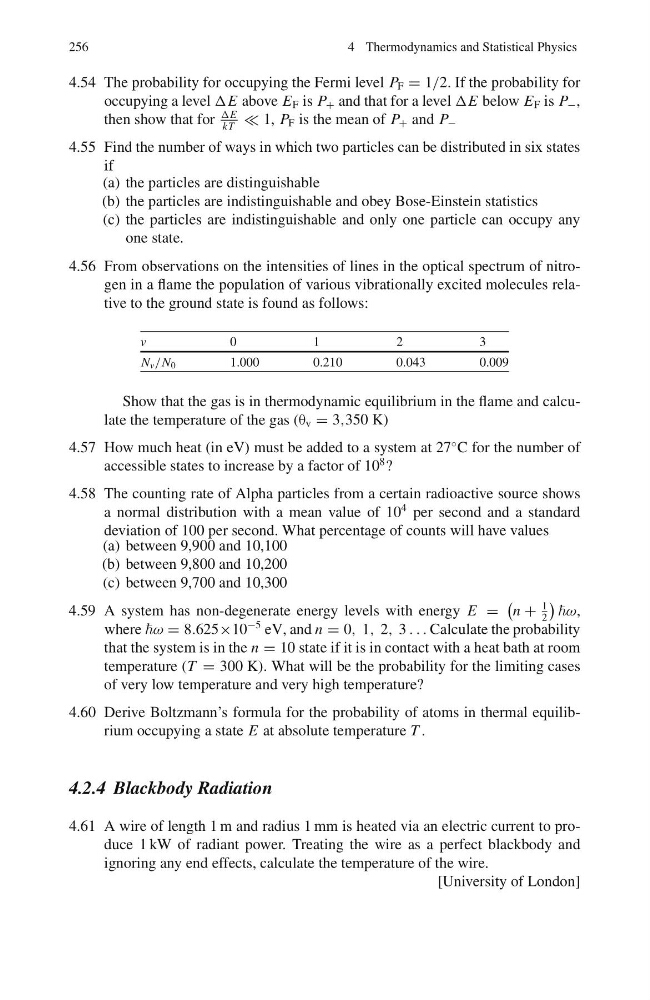
4.56 From observations on the intensities of lines in the optical spectrum of nitrogen in a flame the population of various vibrationally excited molecules relative to the ground state is found as follows:
v
0
1
2
3
N v /N 0
1.000
0.210
0.043
0.009
Show that the gas is in thermodynamic equilibrium in the flame and calculate the temperature of the gas (θ v = 3,350 K)
4.57 How much heat (in eV) must be added to a system at 27
◦ C for the number of
accessible states to increase by a factor of 10
8 ?
4.58 The counting rate of Alpha particles from a certain radioactive source shows
a normal distribution with a mean value of 10
4 per second and a standard
deviation of 100 per second. What percentage of counts will have values
(a) between 9,900 and 10,100
(b) between 9,800 and 10,200
(c) between 9,700 and 10,300
4.59 A system has non-degenerate energy levels with energy E =
n +
1
2
ω,
where ω = 8.625×10
−5 eV, and n = 0, 1, 2, 3 . . . Calculate the probability
that the system is in the n = 10 state if it is in contact with a heat bath at room
temperature (T = 300 K). What will be the probability for the limiting cases
of very low temperature and very high temperature?
4.60 Derive Boltzmann’s formula for the probability of atoms in thermal equilibrium occupying a state E at absolute temperature T .
4.2.4 Blackbody Radiation
4.61 A wire of length 1 m and radius 1 mm is heated via an electric current to produce 1 kW of radiant power. Treating the wire as a perfect blackbody and
ignoring any end effects, calculate the temperature of the wire.
[University of London]
4 Thermodynamics and Statistical Physics
4.54 The probability for occupying the Fermi level P F = 1/2. If the probability for
occupying a level ΔE above E F is P + and that for a level ΔE below E F is P − ,
then show that for
ΔE
kT
1, P F is the mean of P + and P −
4.55 Find the number of ways in which two particles can be distributed in six states
if
(a) the particles are distinguishable
(b) the particles are indistinguishable and obey Bose-Einstein statistics
(c) the particles are indistinguishable and only one particle can occupy any
one state.
4.56 From observations on the intensities of lines in the optical spectrum of nitrogen in a flame the population of various vibrationally excited molecules relative to the ground state is found as follows:
v
0
1
2
3
N v /N 0
1.000
0.210
0.043
0.009
Show that the gas is in thermodynamic equilibrium in the flame and calculate the temperature of the gas (θ v = 3,350 K)
4.57 How much heat (in eV) must be added to a system at 27
◦ C for the number of
accessible states to increase by a factor of 10
8 ?
4.58 The counting rate of Alpha particles from a certain radioactive source shows
a normal distribution with a mean value of 10
4 per second and a standard
deviation of 100 per second. What percentage of counts will have values
(a) between 9,900 and 10,100
(b) between 9,800 and 10,200
(c) between 9,700 and 10,300
4.59 A system has non-degenerate energy levels with energy E =
n +
1
2
ω,
where ω = 8.625×10
−5 eV, and n = 0, 1, 2, 3 . . . Calculate the probability
that the system is in the n = 10 state if it is in contact with a heat bath at room
temperature (T = 300 K). What will be the probability for the limiting cases
of very low temperature and very high temperature?
4.60 Derive Boltzmann’s formula for the probability of atoms in thermal equilibrium occupying a state E at absolute temperature T .
4.2.4 Blackbody Radiation
4.61 A wire of length 1 m and radius 1 mm is heated via an electric current to produce 1 kW of radiant power. Treating the wire as a perfect blackbody and
ignoring any end effects, calculate the temperature of the wire.
[University of London]