

3.3 Solutions
237
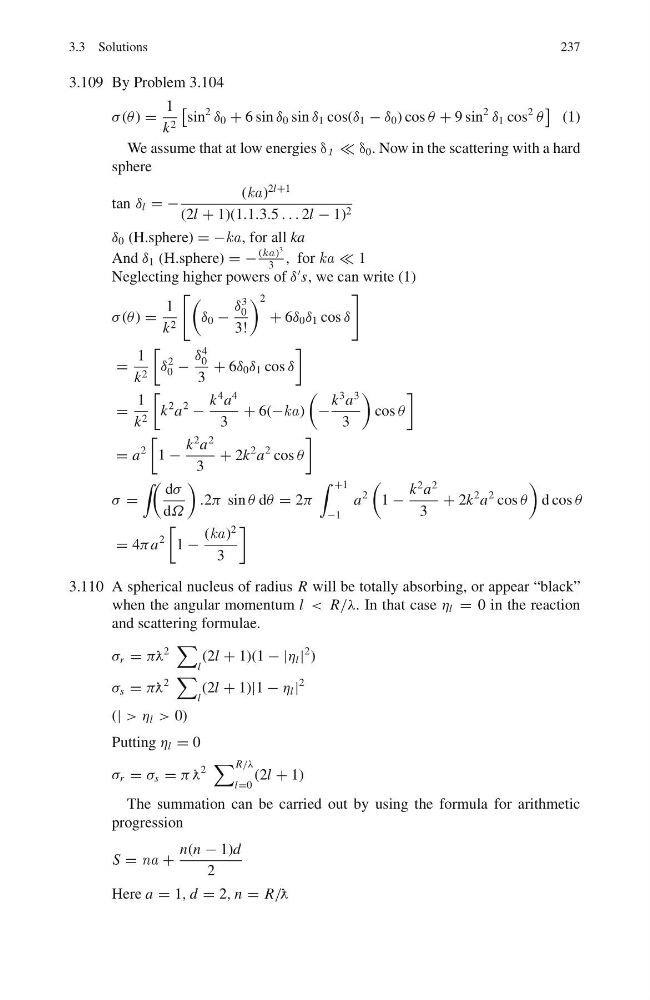
3.109 By Problem 3.104
σ (θ ) =
1
k 2
sin
2
δ 0 + 6 sin δ 0 sin δ 1 cos(δ 1 − δ 0 ) cos θ + 9 sin
2
δ 1 cos
2
θ
(1)
We assume that at low energies δ 1 δ 0 . Now in the scattering with a hard
sphere
tan δ l = −
(ka)
2l+1
(2l + 1)(1.1.3.5 . . . 2l − 1) 2
δ 0 (H.sphere) = −ka, for all ka
And δ 1 (H.sphere) = −
(ka)
3
3
, for ka 1
Neglecting higher powers of δ
s, we can write (1)
σ (θ ) =
1
k 2
δ 0 −
δ
3
0
3!
2
+ 6δ 0 δ 1 cos δ
=
1
k 2
δ
2
0 −
δ
4
0
3
+ 6δ 0 δ 1 cos δ
=
1
k 2
k
2 a
2
−
k
4 a
4
3
+ 6(−ka)
−
k
3 a
3
3
cos θ
= a
2
1 −
k
2 a
2
3
+ 2k
2 a
2 cos θ
σ =
dσ
dΩ
.2π sin θ dθ = 2π
+1
−1
a
2
1 −
k
2 a
2
3
+ 2k
2 a
2 cos θ
d cos θ
= 4πa
2
1 −
(ka)
2
3
3.110 A spherical nucleus of radius R will be totally absorbing, or appear “black”
when the angular momentum l < R/λ. In that case η l = 0 in the reaction
and scattering formulae.
σ r = π -
λ
2
l
(2l + 1)(1 − |η l |
2 )
σ s = π -
λ
2
l
(2l + 1)|1 − η l |
2
(| > η l > 0)
Putting η l = 0
σ r = σ s = π -
λ
2
R/λ
l=0
(2l + 1)
The summation can be carried out by using the formula for arithmetic
progression
S = na +
n(n − 1)d
2
Here a = 1, d = 2, n = R/ -
λ
237
3.109 By Problem 3.104
σ (θ ) =
1
k 2
sin
2
δ 0 + 6 sin δ 0 sin δ 1 cos(δ 1 − δ 0 ) cos θ + 9 sin
2
δ 1 cos
2
θ
(1)
We assume that at low energies δ 1 δ 0 . Now in the scattering with a hard
sphere
tan δ l = −
(ka)
2l+1
(2l + 1)(1.1.3.5 . . . 2l − 1) 2
δ 0 (H.sphere) = −ka, for all ka
And δ 1 (H.sphere) = −
(ka)
3
3
, for ka 1
Neglecting higher powers of δ
s, we can write (1)
σ (θ ) =
1
k 2
δ 0 −
δ
3
0
3!
2
+ 6δ 0 δ 1 cos δ
=
1
k 2
δ
2
0 −
δ
4
0
3
+ 6δ 0 δ 1 cos δ
=
1
k 2
k
2 a
2
−
k
4 a
4
3
+ 6(−ka)
−
k
3 a
3
3
cos θ
= a
2
1 −
k
2 a
2
3
+ 2k
2 a
2 cos θ
σ =
dσ
dΩ
.2π sin θ dθ = 2π
+1
−1
a
2
1 −
k
2 a
2
3
+ 2k
2 a
2 cos θ
d cos θ
= 4πa
2
1 −
(ka)
2
3
3.110 A spherical nucleus of radius R will be totally absorbing, or appear “black”
when the angular momentum l < R/λ. In that case η l = 0 in the reaction
and scattering formulae.
σ r = π -
λ
2
l
(2l + 1)(1 − |η l |
2 )
σ s = π -
λ
2
l
(2l + 1)|1 − η l |
2
(| > η l > 0)
Putting η l = 0
σ r = σ s = π -
λ
2
R/λ
l=0
(2l + 1)
The summation can be carried out by using the formula for arithmetic
progression
S = na +
n(n − 1)d
2
Here a = 1, d = 2, n = R/ -
λ