

3.3 Solutions
225
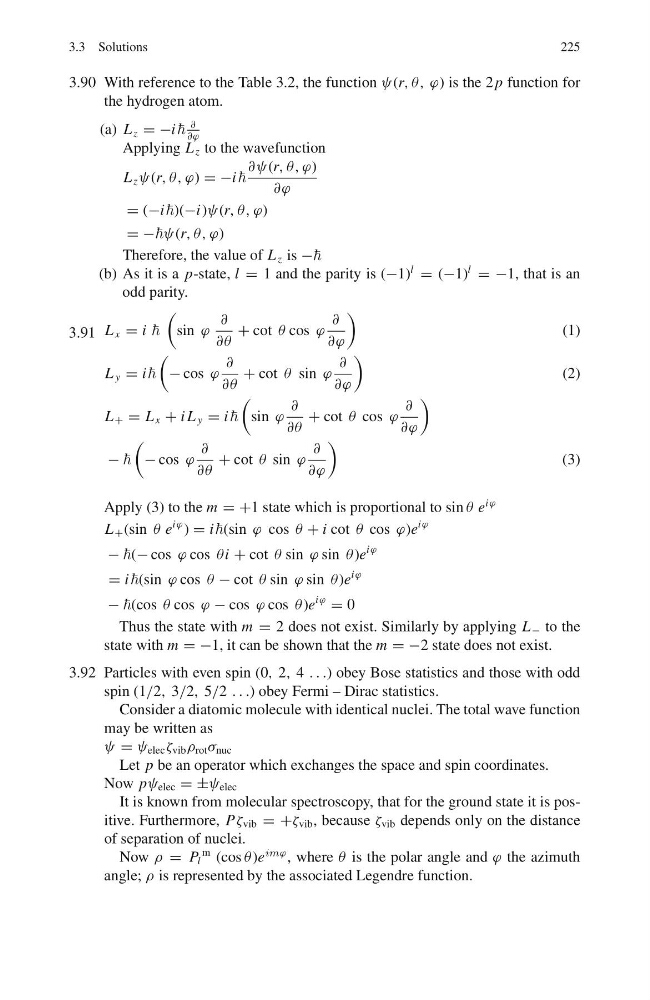
3.90 With reference to the Table 3.2, the function ψ(r, θ, ϕ) is the 2p function for
the hydrogen atom.
(a) L z = −i
∂
∂ϕ
Applying L z to the wavefunction
L z ψ(r, θ, ϕ) = −i
∂ψ(r, θ, ϕ)
∂ϕ
= (−i)(−i)ψ(r, θ, ϕ)
= −ψ(r, θ, ϕ)
Therefore, the value of L z is −
(b) As it is a p-state, l = 1 and the parity is (−1)
l
= (−1)
l
= −1, that is an
odd parity.
3.91 L x = i
sin ϕ
∂
∂θ
+ cot θ cos ϕ
∂
∂ϕ
(1)
L y = i
− cos ϕ
∂
∂θ
+ cot θ sin ϕ
∂
∂ϕ
(2)
L + = L x + i L y = i
sin ϕ
∂
∂θ
+ cot θ cos ϕ
∂
∂ϕ
−
− cos ϕ
∂
∂θ
+ cot θ sin ϕ
∂
∂ϕ
(3)
Apply (3) to the m = +1 state which is proportional to sin θ e
iϕ
L + (sin θ e
iϕ ) = i(sin ϕ cos θ + i cot θ cos ϕ)e
iϕ
− (− cos ϕ cos θi + cot θ sin ϕ sin θ)e
iϕ
= i(sin ϕ cos θ − cot θ sin ϕ sin θ)e
iϕ
− (cos θ cos ϕ − cos ϕ cos θ)e
iϕ
= 0
Thus the state with m = 2 does not exist. Similarly by applying L − to the
state with m = −1, it can be shown that the m = −2 state does not exist.
3.92 Particles with even spin (0, 2, 4 . . .) obey Bose statistics and those with odd
spin (1/2, 3/2, 5/2 . . .) obey Fermi – Dirac statistics.
Consider a diatomic molecule with identical nuclei. The total wave function
may be written as
ψ = ψ elec ζ vib ρ rot σ nuc
Let p be an operator which exchanges the space and spin coordinates.
Now pψ elec = ±ψ elec
It is known from molecular spectroscopy, that for the ground state it is positive. Furthermore, Pζ vib = +ζ vib , because ζ vib depends only on the distance
of separation of nuclei.
Now ρ = P l
m (cos θ)e
imϕ , where θ is the polar angle and ϕ the azimuth
angle; ρ is represented by the associated Legendre function.
225
3.90 With reference to the Table 3.2, the function ψ(r, θ, ϕ) is the 2p function for
the hydrogen atom.
(a) L z = −i
∂
∂ϕ
Applying L z to the wavefunction
L z ψ(r, θ, ϕ) = −i
∂ψ(r, θ, ϕ)
∂ϕ
= (−i)(−i)ψ(r, θ, ϕ)
= −ψ(r, θ, ϕ)
Therefore, the value of L z is −
(b) As it is a p-state, l = 1 and the parity is (−1)
l
= (−1)
l
= −1, that is an
odd parity.
3.91 L x = i
sin ϕ
∂
∂θ
+ cot θ cos ϕ
∂
∂ϕ
(1)
L y = i
− cos ϕ
∂
∂θ
+ cot θ sin ϕ
∂
∂ϕ
(2)
L + = L x + i L y = i
sin ϕ
∂
∂θ
+ cot θ cos ϕ
∂
∂ϕ
−
− cos ϕ
∂
∂θ
+ cot θ sin ϕ
∂
∂ϕ
(3)
Apply (3) to the m = +1 state which is proportional to sin θ e
iϕ
L + (sin θ e
iϕ ) = i(sin ϕ cos θ + i cot θ cos ϕ)e
iϕ
− (− cos ϕ cos θi + cot θ sin ϕ sin θ)e
iϕ
= i(sin ϕ cos θ − cot θ sin ϕ sin θ)e
iϕ
− (cos θ cos ϕ − cos ϕ cos θ)e
iϕ
= 0
Thus the state with m = 2 does not exist. Similarly by applying L − to the
state with m = −1, it can be shown that the m = −2 state does not exist.
3.92 Particles with even spin (0, 2, 4 . . .) obey Bose statistics and those with odd
spin (1/2, 3/2, 5/2 . . .) obey Fermi – Dirac statistics.
Consider a diatomic molecule with identical nuclei. The total wave function
may be written as
ψ = ψ elec ζ vib ρ rot σ nuc
Let p be an operator which exchanges the space and spin coordinates.
Now pψ elec = ±ψ elec
It is known from molecular spectroscopy, that for the ground state it is positive. Furthermore, Pζ vib = +ζ vib , because ζ vib depends only on the distance
of separation of nuclei.
Now ρ = P l
m (cos θ)e
imϕ , where θ is the polar angle and ϕ the azimuth
angle; ρ is represented by the associated Legendre function.