

3.3 Solutions
209
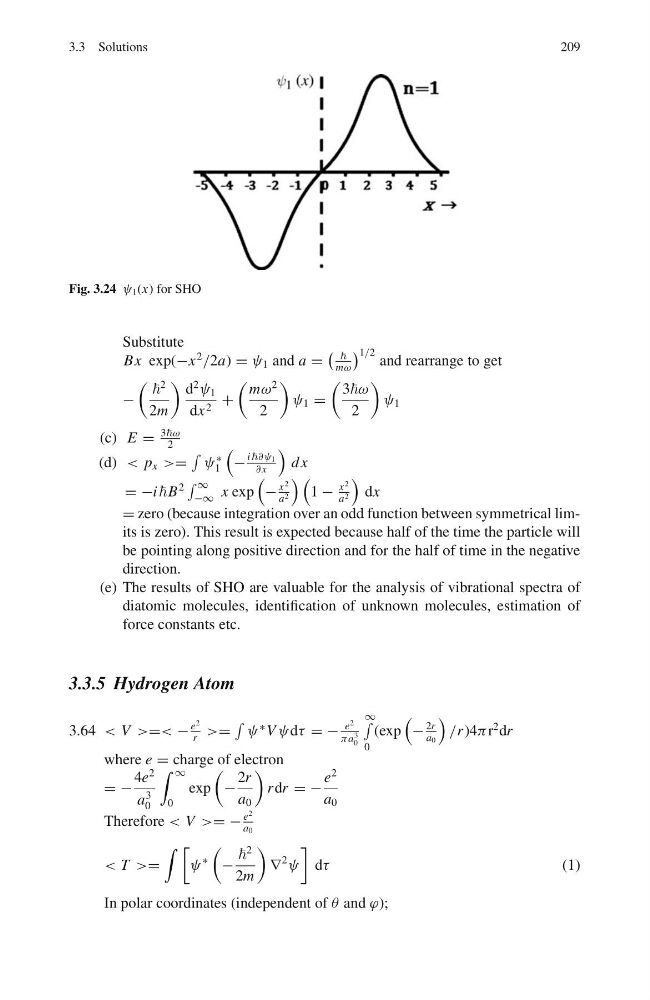
Fig. 3.24 ψ 1 (x) for SHO
Substitute
Bx exp(−x
2
/2a) = ψ 1 and a =
mω
1/2 and rearrange to get
−
2
2m
d
2
ψ 1
dx 2 +
mω
2
2
ψ 1 =
3ω
2
ψ 1
(c) E =
3ω
2
(d) < p x >=
ψ
∗
1
−
i∂ψ 1
∂ x
dx
= −iB
2
∞
−∞ x exp
−
x
2
a 2
1 −
x
2
a 2
dx
= zero (because integration over an odd function between symmetrical limits is zero). This result is expected because half of the time the particle will
be pointing along positive direction and for the half of time in the negative
direction.
(e) The results of SHO are valuable for the analysis of vibrational spectra of
diatomic molecules, identification of unknown molecules, estimation of
force constants etc.
3.3.5 Hydrogen Atom
3.64 < V >=< −
e
2
r
>=
ψ
∗ V ψdτ = −
e
2
πa
3
0
∞
0
(exp
−
2r
a 0
/r )4π r
2 dr
where e = charge of electron
= −
4e
2
a
3
0
∞
0
exp
−
2r
a 0
r dr = −
e
2
a 0
Therefore < V >= −
e
2
a 0
< T >=
ψ
∗
−
2
2m
∇
2
ψ
dτ
(1)
In polar coordinates (independent of θ and ϕ);
209
Fig. 3.24 ψ 1 (x) for SHO
Substitute
Bx exp(−x
2
/2a) = ψ 1 and a =
mω
1/2 and rearrange to get
−
2
2m
d
2
ψ 1
dx 2 +
mω
2
2
ψ 1 =
3ω
2
ψ 1
(c) E =
3ω
2
(d) < p x >=
ψ
∗
1
−
i∂ψ 1
∂ x
dx
= −iB
2
∞
−∞ x exp
−
x
2
a 2
1 −
x
2
a 2
dx
= zero (because integration over an odd function between symmetrical limits is zero). This result is expected because half of the time the particle will
be pointing along positive direction and for the half of time in the negative
direction.
(e) The results of SHO are valuable for the analysis of vibrational spectra of
diatomic molecules, identification of unknown molecules, estimation of
force constants etc.
3.3.5 Hydrogen Atom
3.64 < V >=< −
e
2
r
>=
ψ
∗ V ψdτ = −
e
2
πa
3
0
∞
0
(exp
−
2r
a 0
/r )4π r
2 dr
where e = charge of electron
= −
4e
2
a
3
0
∞
0
exp
−
2r
a 0
r dr = −
e
2
a 0
Therefore < V >= −
e
2
a 0
< T >=
ψ
∗
−
2
2m
∇
2
ψ
dτ
(1)
In polar coordinates (independent of θ and ϕ);