

3.3 Solutions
197
Fig. 3.19 Class I and Class II wave functions
3.49 The analysis for the reflection and transmission of stream of particles from
the square well potential is similar to that for a barrier (Problem 3.30) except
that the potential V b must be replaced by −V 0 and in the region 2, k 2 must be
replaced by ik 2 . Thus, from Eq. (9) of Problem 3.30, we get
τ =
4k 1 k 2 exp(−ik 1 a)
(k 2 + k 1 ) 2 exp(−ik 2 a) − (k 2 − k 1 ) 2 exp(ik 2 a)
The fraction of transmitted particles when k 2 a = nπ is determined by the
imaginary exponential terms in the denominator.
e
+inπ
= cos nπ ± i sin (nπ ) = cos nπ
= 1; (n = 0, 2, 4·)
= −1; (n = 1, 3, 5 . . .)
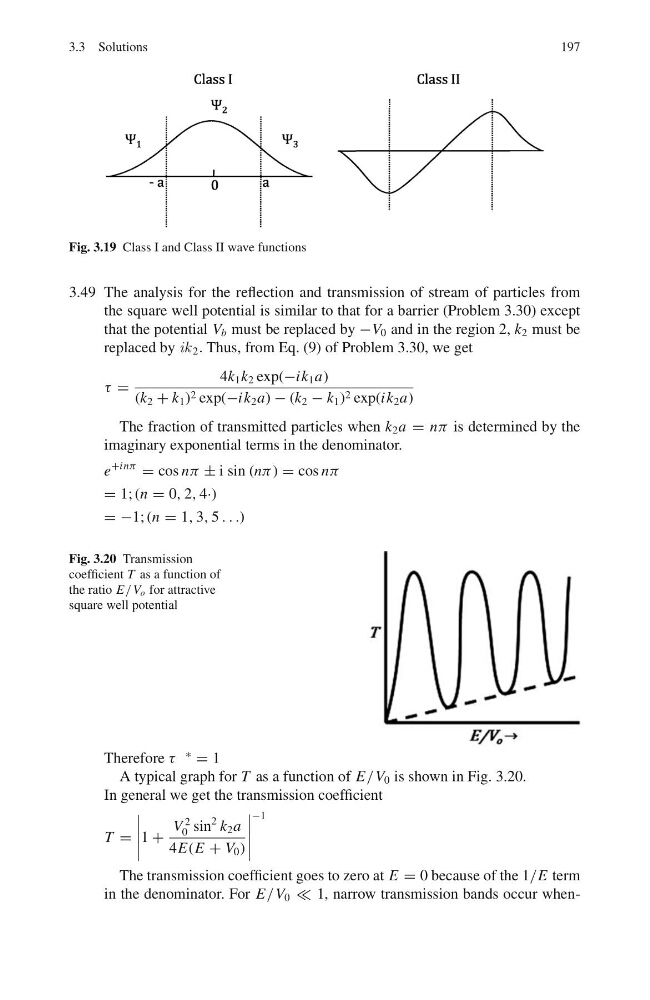
Fig. 3.20 Transmission
coefficient T as a function of
the ratio E/V o for attractive
square well potential
Therefore τ
∗
= 1
A typical graph for T as a function of E/V 0 is shown in Fig. 3.20.
In general we get the transmission coefficient
T =
1 +
V
2
0 sin
2 k 2 a
4E(E + V 0 )
−1
The transmission coefficient goes to zero at E = 0 because of the 1/E term
in the denominator. For E/V 0 1, narrow transmission bands occur when-
197
Fig. 3.19 Class I and Class II wave functions
3.49 The analysis for the reflection and transmission of stream of particles from
the square well potential is similar to that for a barrier (Problem 3.30) except
that the potential V b must be replaced by −V 0 and in the region 2, k 2 must be
replaced by ik 2 . Thus, from Eq. (9) of Problem 3.30, we get
τ =
4k 1 k 2 exp(−ik 1 a)
(k 2 + k 1 ) 2 exp(−ik 2 a) − (k 2 − k 1 ) 2 exp(ik 2 a)
The fraction of transmitted particles when k 2 a = nπ is determined by the
imaginary exponential terms in the denominator.
e
+inπ
= cos nπ ± i sin (nπ ) = cos nπ
= 1; (n = 0, 2, 4·)
= −1; (n = 1, 3, 5 . . .)
Fig. 3.20 Transmission
coefficient T as a function of
the ratio E/V o for attractive
square well potential
Therefore τ
∗
= 1
A typical graph for T as a function of E/V 0 is shown in Fig. 3.20.
In general we get the transmission coefficient
T =
1 +
V
2
0 sin
2 k 2 a
4E(E + V 0 )
−1
The transmission coefficient goes to zero at E = 0 because of the 1/E term
in the denominator. For E/V 0 1, narrow transmission bands occur when-