

3.3 Solutions
195
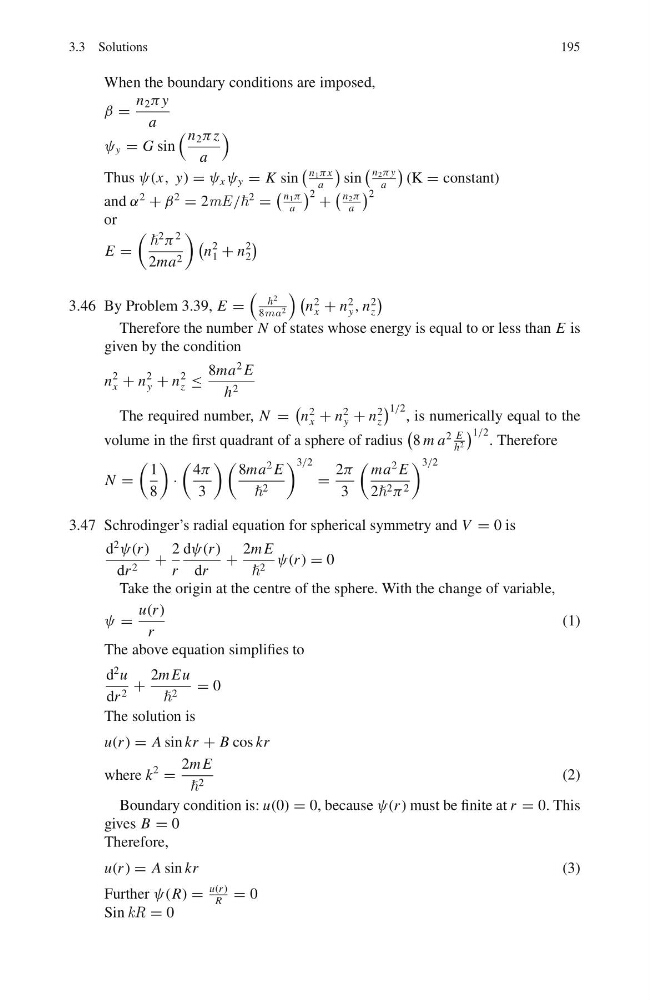
When the boundary conditions are imposed,
β =
n 2 π y
a
ψ y = G sin
n 2 π z
a
Thus ψ(x, y) = ψ x ψ y = K sin
n1π x
a
sin
n2π y
a
(K = constant)
and α
2
+ β
2
= 2mE /
2
=
n 1 π
a
2 +
n 2 π
a
2
or
E =
2
π
2
2ma 2
n
2
1 + n
2
2
3.46 By Problem 3.39, E =
h
2
8ma 2
n
2
x + n
2
y , n
2
z
Therefore the number N of states whose energy is equal to or less than E is
given by the condition
n
2
x + n
2
y + n
2
z ≤
8ma
2 E
h 2
The required number, N =
n
2
x + n
2
y + n
2
z
1/2 , is numerically equal to the
volume in the first quadrant of a sphere of radius
8 m a
2 E
h 2
1/2 . Therefore
N =
1
8
·
4π
3
8ma
2 E
2
3/2
=
2π
3
ma
2 E
2 2 π 2
3/2
3.47 Schrodinger’s radial equation for spherical symmetry and V = 0 is
d
2
ψ(r )
dr 2 +
2
r
dψ(r )
dr
+
2m E
2 ψ(r ) = 0
Take the origin at the centre of the sphere. With the change of variable,
ψ =
u(r )
r
(1)
The above equation simplifies to
d
2 u
dr 2 +
2m Eu
2 = 0
The solution is
u(r ) = A sin kr + B cos kr
where k
2
=
2m E
2
(2)
Boundary condition is: u(0) = 0, because ψ(r ) must be finite at r = 0. This
gives B = 0
Therefore,
u(r ) = A sin kr
(3)
Further ψ(R) =
u(r )
R
= 0
Sin kR = 0
195
When the boundary conditions are imposed,
β =
n 2 π y
a
ψ y = G sin
n 2 π z
a
Thus ψ(x, y) = ψ x ψ y = K sin
n1π x
a
sin
n2π y
a
(K = constant)
and α
2
+ β
2
= 2mE /
2
=
n 1 π
a
2 +
n 2 π
a
2
or
E =
2
π
2
2ma 2
n
2
1 + n
2
2
3.46 By Problem 3.39, E =
h
2
8ma 2
n
2
x + n
2
y , n
2
z
Therefore the number N of states whose energy is equal to or less than E is
given by the condition
n
2
x + n
2
y + n
2
z ≤
8ma
2 E
h 2
The required number, N =
n
2
x + n
2
y + n
2
z
1/2 , is numerically equal to the
volume in the first quadrant of a sphere of radius
8 m a
2 E
h 2
1/2 . Therefore
N =
1
8
·
4π
3
8ma
2 E
2
3/2
=
2π
3
ma
2 E
2 2 π 2
3/2
3.47 Schrodinger’s radial equation for spherical symmetry and V = 0 is
d
2
ψ(r )
dr 2 +
2
r
dψ(r )
dr
+
2m E
2 ψ(r ) = 0
Take the origin at the centre of the sphere. With the change of variable,
ψ =
u(r )
r
(1)
The above equation simplifies to
d
2 u
dr 2 +
2m Eu
2 = 0
The solution is
u(r ) = A sin kr + B cos kr
where k
2
=
2m E
2
(2)
Boundary condition is: u(0) = 0, because ψ(r ) must be finite at r = 0. This
gives B = 0
Therefore,
u(r ) = A sin kr
(3)
Further ψ(R) =
u(r )
R
= 0
Sin kR = 0