

192
3 Quantum Mechanics – II
This is a direct result of the fact that the current density is constant for a
steady state.
Thus | A 0 |
2
v 1 = |A|
2
v 1 + |B|
2
v 2
where v 1 =
k 1
m
and v 2 =
k 2
m
A
2
+ B
2
= 1 because the sum of the intensities of the reflected intensity and
transmitted intensities does not add up to unity. What is true is relation (9)
which is relevant to current densities.
3.43 (a) The wave function must be finite, single-valued and continous. At the
boundary this is ensured by requiring the magnitude and the first derivative
be equal.
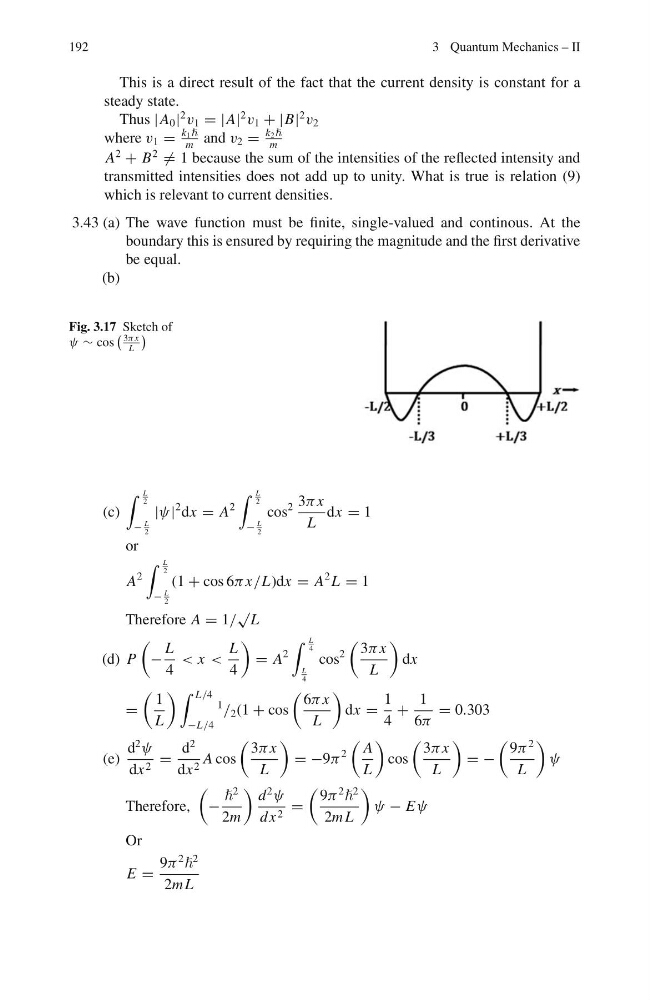
(b)
Fig. 3.17 Sketch of
ψ ∼ cos
3π x
L
(c)
L
2
−
L
2
|ψ|
2 dx = A
2
L
2
−
L
2
cos
2 3π x
L
dx = 1
or
A
2
L
2
−
L
2
(1 + cos 6π x/L)dx = A
2 L = 1
Therefore A = 1/
√
L
(d) P
−
L
4
< x <
L
4
= A
2
L
4
L
4
cos
2
3π x
L
dx
=
1
L
L/4
−L/4
1
/ 2 (1 + cos
6π x
L
dx =
1
4
+
1
6π
= 0.303
(e)
d
2
ψ
dx 2 =
d
2
dx 2 A cos
3π x
L
= −9π
2
A
L
cos
3π x
L
= −
9π
2
L
ψ
Therefore,
−
2
2m
d
2
ψ
dx 2 =
9π
2
2
2m L
ψ − Eψ
Or
E =
9π
2
2
2m L
3 Quantum Mechanics – II
This is a direct result of the fact that the current density is constant for a
steady state.
Thus | A 0 |
2
v 1 = |A|
2
v 1 + |B|
2
v 2
where v 1 =
k 1
m
and v 2 =
k 2
m
A
2
+ B
2
= 1 because the sum of the intensities of the reflected intensity and
transmitted intensities does not add up to unity. What is true is relation (9)
which is relevant to current densities.
3.43 (a) The wave function must be finite, single-valued and continous. At the
boundary this is ensured by requiring the magnitude and the first derivative
be equal.
(b)
Fig. 3.17 Sketch of
ψ ∼ cos
3π x
L
(c)
L
2
−
L
2
|ψ|
2 dx = A
2
L
2
−
L
2
cos
2 3π x
L
dx = 1
or
A
2
L
2
−
L
2
(1 + cos 6π x/L)dx = A
2 L = 1
Therefore A = 1/
√
L
(d) P
−
L
4
< x <
L
4
= A
2
L
4
L
4
cos
2
3π x
L
dx
=
1
L
L/4
−L/4
1
/ 2 (1 + cos
6π x
L
dx =
1
4
+
1
6π
= 0.303
(e)
d
2
ψ
dx 2 =
d
2
dx 2 A cos
3π x
L
= −9π
2
A
L
cos
3π x
L
= −
9π
2
L
ψ
Therefore,
−
2
2m
d
2
ψ
dx 2 =
9π
2
2
2m L
ψ − Eψ
Or
E =
9π
2
2
2m L