

3.3 Solutions
185
3.37 (a) u n =
2
L
1/2 sin
nπ x
L
< x >=
L
0
u
∗
n xu n dx =
2
L
L
0
x sin
2
nπ x
a
dx
=
L
2
+
L
4n 2 π 2
(cos(2nπ) − 1)
The second term on the RHS vanishes for any integral value of n. Thus
< x >=
L
2
Var x = σ
2
=< (x− < x >)
2
>=< x
2
> − < x >
2
=< x
2
> −
L
2
4
Now < x
2
>=
L
0
u
∗
n x
2 u n dx =
2
L
L
0
x
2 sin
2
nπ x
L
dx
=
L
2
3
−
L
2
2n 2 π 2
σ
2
=< x
2
> − < x >
2
=
L
2
3
−
L
2
2n 2 π 2 −
L
2
4
=
L
2
12
1 −
6
n 2 π 2
For n → ∞, < x >=
L
2
; σ
2
→ L
2
/12
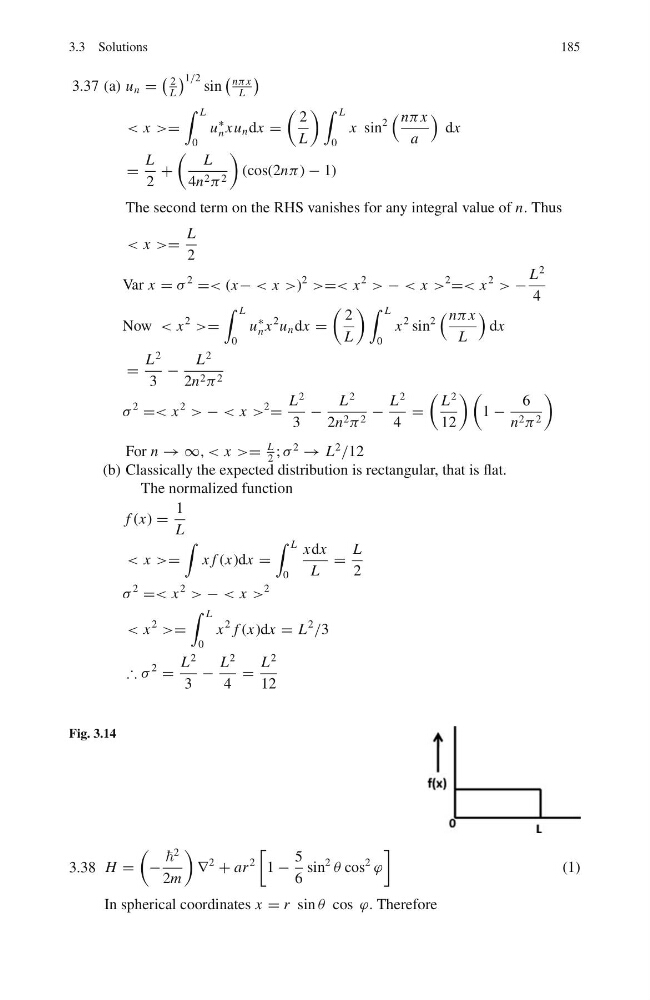
(b) Classically the expected distribution is rectangular, that is flat.
The normalized function
f (x) =
1
L
< x >=
x f (x)dx =
L
0
xdx
L
=
L
2
σ
2
=< x
2
> − < x >
2
< x
2
>=
L
0
x
2 f (x)dx = L
2
/3
∴ σ
2
=
L
2
3
−
L
2
4
=
L
2
12
Fig. 3.14
3.38 H =
−
2
2m
∇
2
+ ar
2
1 −
5
6
sin
2
θ cos
2
ϕ
(1)
In spherical coordinates x = r sin θ cos ϕ. Therefore
185
3.37 (a) u n =
2
L
1/2 sin
nπ x
L
< x >=
L
0
u
∗
n xu n dx =
2
L
L
0
x sin
2
nπ x
a
dx
=
L
2
+
L
4n 2 π 2
(cos(2nπ) − 1)
The second term on the RHS vanishes for any integral value of n. Thus
< x >=
L
2
Var x = σ
2
=< (x− < x >)
2
>=< x
2
> − < x >
2
=< x
2
> −
L
2
4
Now < x
2
>=
L
0
u
∗
n x
2 u n dx =
2
L
L
0
x
2 sin
2
nπ x
L
dx
=
L
2
3
−
L
2
2n 2 π 2
σ
2
=< x
2
> − < x >
2
=
L
2
3
−
L
2
2n 2 π 2 −
L
2
4
=
L
2
12
1 −
6
n 2 π 2
For n → ∞, < x >=
L
2
; σ
2
→ L
2
/12
(b) Classically the expected distribution is rectangular, that is flat.
The normalized function
f (x) =
1
L
< x >=
x f (x)dx =
L
0
xdx
L
=
L
2
σ
2
=< x
2
> − < x >
2
< x
2
>=
L
0
x
2 f (x)dx = L
2
/3
∴ σ
2
=
L
2
3
−
L
2
4
=
L
2
12
Fig. 3.14
3.38 H =
−
2
2m
∇
2
+ ar
2
1 −
5
6
sin
2
θ cos
2
ϕ
(1)
In spherical coordinates x = r sin θ cos ϕ. Therefore