

3.3 Solutions
183
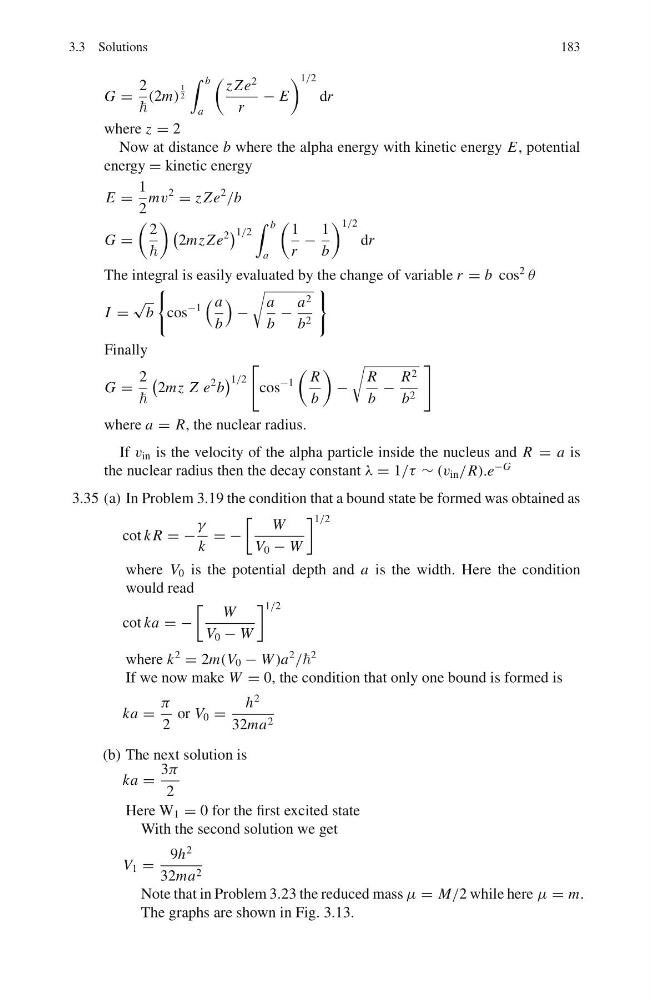
G =
2
(2m)
1
2
b
a
z Ze
2
r
− E
1/2
dr
where z = 2
Now at distance b where the alpha energy with kinetic energy E, potential
energy = kinetic energy
E =
1
2
mv
2
= z Ze
2
/b
G =
2
2mz Ze
2
1/2
b
a
1
r
−
1
b
1/2
dr
The integral is easily evaluated by the change of variable r = b cos
2
θ
I =
√
b
cos
−1
a
b
−
a
b
−
a 2
b 2
Finally
G =
2
2mz Z e
2 b
1/2
cos
−1
R
b
−
R
b
−
R 2
b 2
where a = R, the nuclear radius.
If v in is the velocity of the alpha particle inside the nucleus and R = a is
the nuclear radius then the decay constant λ = 1/τ ∼ (v in /R).e
−G
3.35 (a) In Problem 3.19 the condition that a bound state be formed was obtained as
cot k R = −
γ
k
= −
W
V 0 − W
1/2
where V 0 is the potential depth and a is the width. Here the condition
would read
cot ka = −
W
V 0 − W
1/2
where k
2
= 2m(V 0 − W )a
2
/
2
If we now make W = 0, the condition that only one bound is formed is
ka =
π
2
or V 0 =
h
2
32ma 2
(b) The next solution is
ka =
3π
2
Here W 1 = 0 for the first excited state
With the second solution we get
V 1 =
9h
2
32ma 2
Note that in Problem 3.23 the reduced mass μ = M/2 while here μ = m.
The graphs are shown in Fig. 3.13.
183
G =
2
(2m)
1
2
b
a
z Ze
2
r
− E
1/2
dr
where z = 2
Now at distance b where the alpha energy with kinetic energy E, potential
energy = kinetic energy
E =
1
2
mv
2
= z Ze
2
/b
G =
2
2mz Ze
2
1/2
b
a
1
r
−
1
b
1/2
dr
The integral is easily evaluated by the change of variable r = b cos
2
θ
I =
√
b
cos
−1
a
b
−
a
b
−
a 2
b 2
Finally
G =
2
2mz Z e
2 b
1/2
cos
−1
R
b
−
R
b
−
R 2
b 2
where a = R, the nuclear radius.
If v in is the velocity of the alpha particle inside the nucleus and R = a is
the nuclear radius then the decay constant λ = 1/τ ∼ (v in /R).e
−G
3.35 (a) In Problem 3.19 the condition that a bound state be formed was obtained as
cot k R = −
γ
k
= −
W
V 0 − W
1/2
where V 0 is the potential depth and a is the width. Here the condition
would read
cot ka = −
W
V 0 − W
1/2
where k
2
= 2m(V 0 − W )a
2
/
2
If we now make W = 0, the condition that only one bound is formed is
ka =
π
2
or V 0 =
h
2
32ma 2
(b) The next solution is
ka =
3π
2
Here W 1 = 0 for the first excited state
With the second solution we get
V 1 =
9h
2
32ma 2
Note that in Problem 3.23 the reduced mass μ = M/2 while here μ = m.
The graphs are shown in Fig. 3.13.