

3.3 Solutions
181
Using (11) in (9) and noting k
2
1 + k
2
2 =
2mV b
2
k
2
2 =
2mV b
2
and k
2
1 k
2
2 =
2m
2
2
E(V b − E)
we find
T =
1
1 +
V
2
b sin
2 k2a
4E(E−V b )
(13)
and
R =
1
1 +
4E(E−V0)
V
2
0 sin
2 k2a
(14)
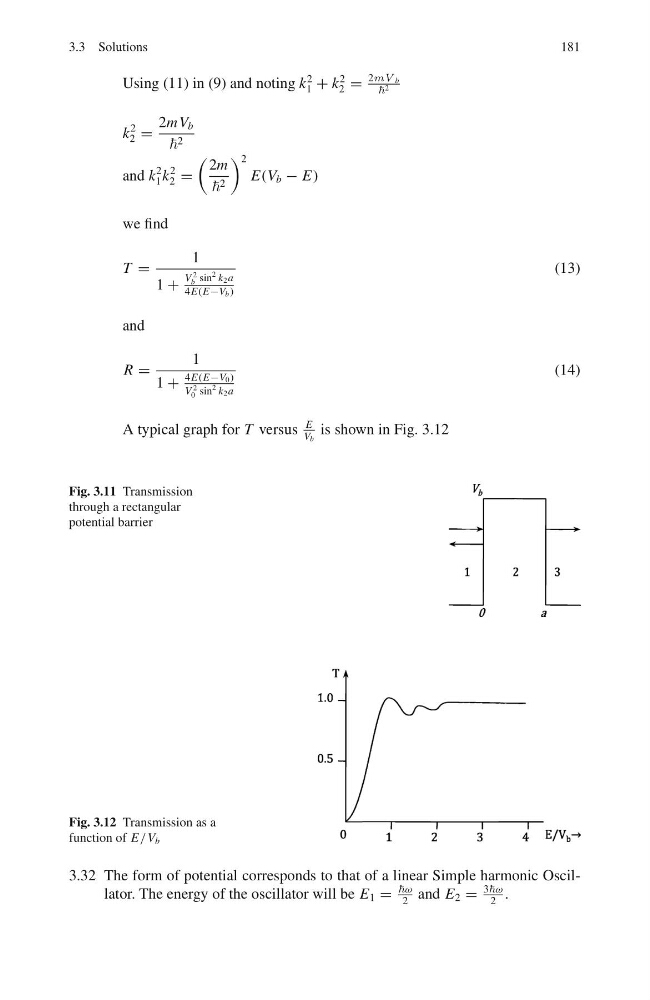
A typical graph for T versus
E
Vb
is shown in Fig. 3.12
Fig. 3.11 Transmission
through a rectangular
potential barrier
Fig. 3.12 Transmission as a
function of E/V b
3.32 The form of potential corresponds to that of a linear Simple harmonic Oscillator. The energy of the oscillator will be E 1 =
ω
2
and E 2 =
3ω
2
.
181
Using (11) in (9) and noting k
2
1 + k
2
2 =
2mV b
2
k
2
2 =
2mV b
2
and k
2
1 k
2
2 =
2m
2
2
E(V b − E)
we find
T =
1
1 +
V
2
b sin
2 k2a
4E(E−V b )
(13)
and
R =
1
1 +
4E(E−V0)
V
2
0 sin
2 k2a
(14)
A typical graph for T versus
E
Vb
is shown in Fig. 3.12
Fig. 3.11 Transmission
through a rectangular
potential barrier
Fig. 3.12 Transmission as a
function of E/V b
3.32 The form of potential corresponds to that of a linear Simple harmonic Oscillator. The energy of the oscillator will be E 1 =
ω
2
and E 2 =
3ω
2
.