

3.3 Solutions
179
α
2 a
2
=
2m Ea
2
2 =
n
2
π
2
4
E =
n
2
π
2
2
8ma 2 (n even)
Thus E =
n
2
π
2
2
8ma 2 , n = 1, 2, 3 . . .
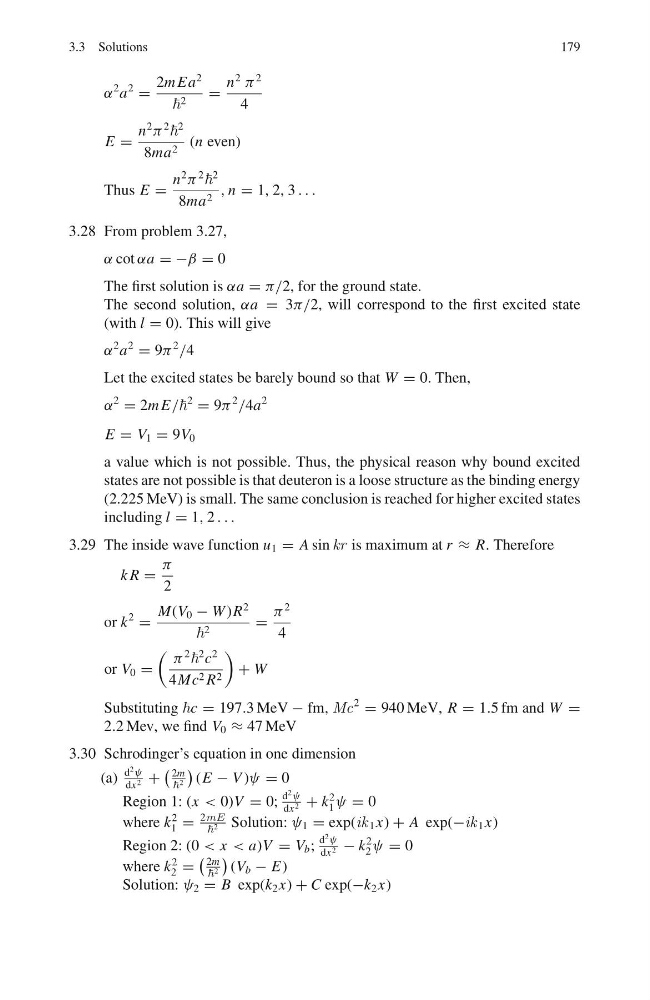
3.28 From problem 3.27,
α cot αa = −β = 0
The first solution is αa = π/2, for the ground state.
The second solution, αa = 3π/2, will correspond to the first excited state
(with l = 0). This will give
α
2 a
2
= 9π
2
/4
Let the excited states be barely bound so that W = 0. Then,
α
2
= 2m E/
2
= 9π
2
/4a
2
E = V 1 = 9V 0
a value which is not possible. Thus, the physical reason why bound excited
states are not possible is that deuteron is a loose structure as the binding energy
(2.225 MeV) is small. The same conclusion is reached for higher excited states
including l = 1, 2 . . .
3.29 The inside wave function u 1 = A sin kr is maximum at r ≈ R. Therefore
k R =
π
2
or k
2
=
M(V 0 − W )R
2
2
=
π
2
4
or V 0 =
π
2
2 c
2
4Mc 2 R 2
+ W
Substituting c = 197.3 MeV − fm, Mc
2
= 940 MeV, R = 1.5 fm and W =
2.2 Mev, we find V 0 ≈ 47 MeV
3.30 Schrodinger’s equation in one dimension
(a)
d
2 ψ
dx 2 +
2m
2
(E − V )ψ = 0
Region 1: (x < 0)V = 0;
d
2 ψ
dx 2 + k
2
1 ψ = 0
where k
2
1 =
2mE
2 Solution: ψ 1 = exp(ik 1 x) + A exp(−ik 1 x)
Region 2: (0 < x < a)V = V b ;
d
2 ψ
dx 2 − k
2
2 ψ = 0
where k
2
2 =
2m
2
(V b − E)
Solution: ψ 2 = B exp(k 2 x) + C exp(−k 2 x)
179
α
2 a
2
=
2m Ea
2
2 =
n
2
π
2
4
E =
n
2
π
2
2
8ma 2 (n even)
Thus E =
n
2
π
2
2
8ma 2 , n = 1, 2, 3 . . .
3.28 From problem 3.27,
α cot αa = −β = 0
The first solution is αa = π/2, for the ground state.
The second solution, αa = 3π/2, will correspond to the first excited state
(with l = 0). This will give
α
2 a
2
= 9π
2
/4
Let the excited states be barely bound so that W = 0. Then,
α
2
= 2m E/
2
= 9π
2
/4a
2
E = V 1 = 9V 0
a value which is not possible. Thus, the physical reason why bound excited
states are not possible is that deuteron is a loose structure as the binding energy
(2.225 MeV) is small. The same conclusion is reached for higher excited states
including l = 1, 2 . . .
3.29 The inside wave function u 1 = A sin kr is maximum at r ≈ R. Therefore
k R =
π
2
or k
2
=
M(V 0 − W )R
2
2
=
π
2
4
or V 0 =
π
2
2 c
2
4Mc 2 R 2
+ W
Substituting c = 197.3 MeV − fm, Mc
2
= 940 MeV, R = 1.5 fm and W =
2.2 Mev, we find V 0 ≈ 47 MeV
3.30 Schrodinger’s equation in one dimension
(a)
d
2 ψ
dx 2 +
2m
2
(E − V )ψ = 0
Region 1: (x < 0)V = 0;
d
2 ψ
dx 2 + k
2
1 ψ = 0
where k
2
1 =
2mE
2 Solution: ψ 1 = exp(ik 1 x) + A exp(−ik 1 x)
Region 2: (0 < x < a)V = V b ;
d
2 ψ
dx 2 − k
2
2 ψ = 0
where k
2
2 =
2m
2
(V b − E)
Solution: ψ 2 = B exp(k 2 x) + C exp(−k 2 x)