

2
1 Mathematical Physics
(b)
C A . dr
(c)
C A × dr
where φ is a scalar, A is a vector and r = x ˆ
i + y ˆ j + z ˆ
k, is the positive vector.
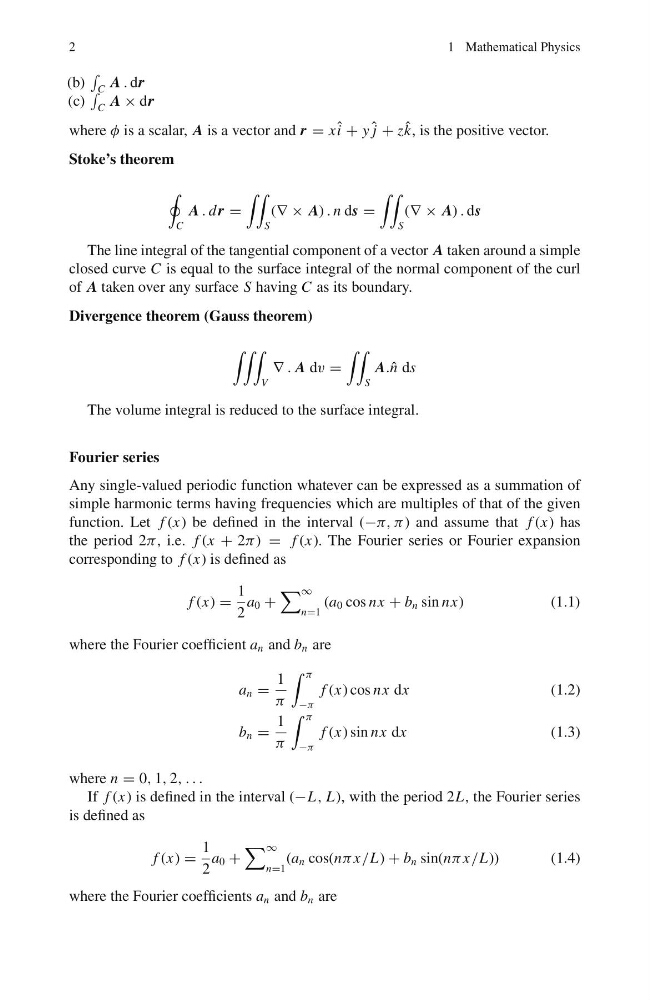
Stoke’s theorem
C
A . d r =
S
(∇ × A) . n ds =
S
(∇ × A) . ds
The line integral of the tangential component of a vector A taken around a simple
closed curve C is equal to the surface integral of the normal component of the curl
of A taken over any surface S having C as its boundary.
Divergence theorem (Gauss theorem)
V
∇ . A dv =
S
A. ˆ
n ds
The volume integral is reduced to the surface integral.
Fourier series
Any single-valued periodic function whatever can be expressed as a summation of
simple harmonic terms having frequencies which are multiples of that of the given
function. Let f (x) be defined in the interval (−π, π) and assume that f (x) has
the period 2π, i.e. f (x + 2π) = f (x). The Fourier series or Fourier expansion
corresponding to f (x) is defined as
f (x) =
1
2
a 0 +
∞
n=1
(a 0 cos nx + b n sin nx)
(1.1)
where the Fourier coefficient a n and b n are
a n =
1
π
π
−π
f (x) cos nx dx
(1.2)
b n =
1
π
π
−π
f (x) sin nx dx
(1.3)
where n = 0, 1, 2, . . .
If f (x) is defined in the interval (−L , L), with the period 2L, the Fourier series
is defined as
f (x) =
1
2
a 0 +
∞
n=1
(a n cos(nπ x/L) + b n sin(nπ x/L))
(1.4)
where the Fourier coefficients a n and b n are
1 Mathematical Physics
(b)
C A . dr
(c)
C A × dr
where φ is a scalar, A is a vector and r = x ˆ
i + y ˆ j + z ˆ
k, is the positive vector.
Stoke’s theorem
C
A . d r =
S
(∇ × A) . n ds =
S
(∇ × A) . ds
The line integral of the tangential component of a vector A taken around a simple
closed curve C is equal to the surface integral of the normal component of the curl
of A taken over any surface S having C as its boundary.
Divergence theorem (Gauss theorem)
V
∇ . A dv =
S
A. ˆ
n ds
The volume integral is reduced to the surface integral.
Fourier series
Any single-valued periodic function whatever can be expressed as a summation of
simple harmonic terms having frequencies which are multiples of that of the given
function. Let f (x) be defined in the interval (−π, π) and assume that f (x) has
the period 2π, i.e. f (x + 2π) = f (x). The Fourier series or Fourier expansion
corresponding to f (x) is defined as
f (x) =
1
2
a 0 +
∞
n=1
(a 0 cos nx + b n sin nx)
(1.1)
where the Fourier coefficient a n and b n are
a n =
1
π
π
−π
f (x) cos nx dx
(1.2)
b n =
1
π
π
−π
f (x) sin nx dx
(1.3)
where n = 0, 1, 2, . . .
If f (x) is defined in the interval (−L , L), with the period 2L, the Fourier series
is defined as
f (x) =
1
2
a 0 +
∞
n=1
(a n cos(nπ x/L) + b n sin(nπ x/L))
(1.4)
where the Fourier coefficients a n and b n are