

3.3 Solutions
159
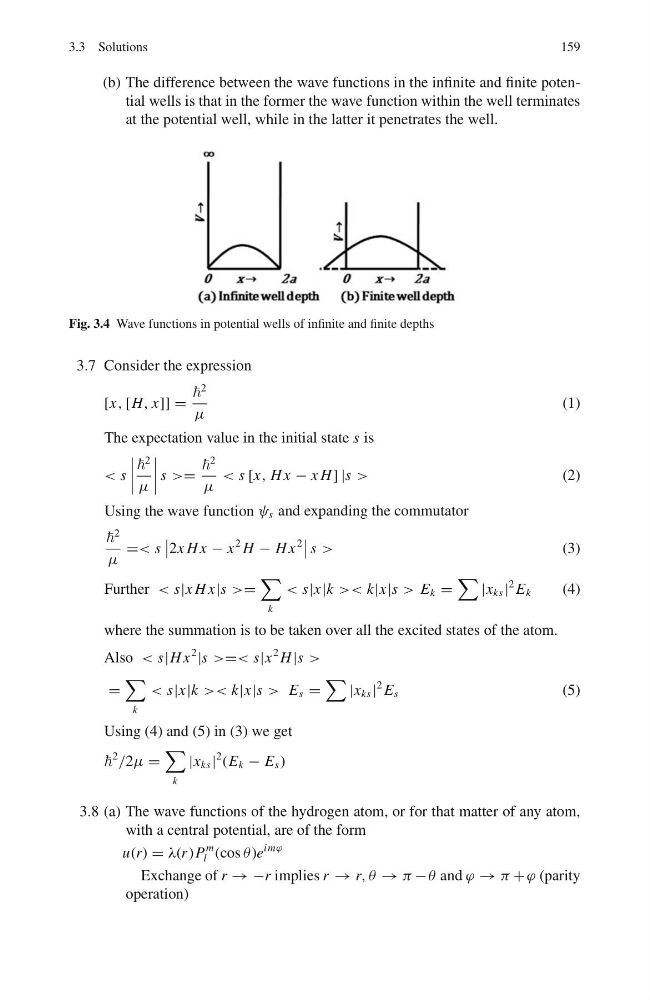
(b) The difference between the wave functions in the infinite and finite potential wells is that in the former the wave function within the well terminates
at the potential well, while in the latter it penetrates the well.
Fig. 3.4 Wave functions in potential wells of infinite and finite depths
3.7 Consider the expression
[x, [H, x]] =
2
μ
(1)
The expectation value in the initial state s is
< s
2
μ
s >=
2
μ
< s [x, H x − x H] |s >
(2)
Using the wave function ψ s and expanding the commutator
2
μ
=< s
2x H x − x
2 H − H x
2
s >
(3)
Further < s|x H x|s >=
k
< s|x|k >< k|x|s > E k =
|x ks |
2 E k
(4)
where the summation is to be taken over all the excited states of the atom.
Also < s|H x
2
|s >=< s|x
2 H |s >
=
k
< s|x|k >< k|x|s > E s =
|x ks |
2 E s
(5)
Using (4) and (5) in (3) we get
2
/2μ =
k
|x ks |
2 (E k − E s )
3.8 (a) The wave functions of the hydrogen atom, or for that matter of any atom,
with a central potential, are of the form
u(r) = λ(r )P
m
l (cos θ)e
imϕ
Exchange of r → −r implies r → r, θ → π − θ and ϕ → π + ϕ (parity
operation)
159
(b) The difference between the wave functions in the infinite and finite potential wells is that in the former the wave function within the well terminates
at the potential well, while in the latter it penetrates the well.
Fig. 3.4 Wave functions in potential wells of infinite and finite depths
3.7 Consider the expression
[x, [H, x]] =
2
μ
(1)
The expectation value in the initial state s is
< s
2
μ
s >=
2
μ
< s [x, H x − x H] |s >
(2)
Using the wave function ψ s and expanding the commutator
2
μ
=< s
2x H x − x
2 H − H x
2
s >
(3)
Further < s|x H x|s >=
k
< s|x|k >< k|x|s > E k =
|x ks |
2 E k
(4)
where the summation is to be taken over all the excited states of the atom.
Also < s|H x
2
|s >=< s|x
2 H |s >
=
k
< s|x|k >< k|x|s > E s =
|x ks |
2 E s
(5)
Using (4) and (5) in (3) we get
2
/2μ =
k
|x ks |
2 (E k − E s )
3.8 (a) The wave functions of the hydrogen atom, or for that matter of any atom,
with a central potential, are of the form
u(r) = λ(r )P
m
l (cos θ)e
imϕ
Exchange of r → −r implies r → r, θ → π − θ and ϕ → π + ϕ (parity
operation)