

3.2 Problems
155
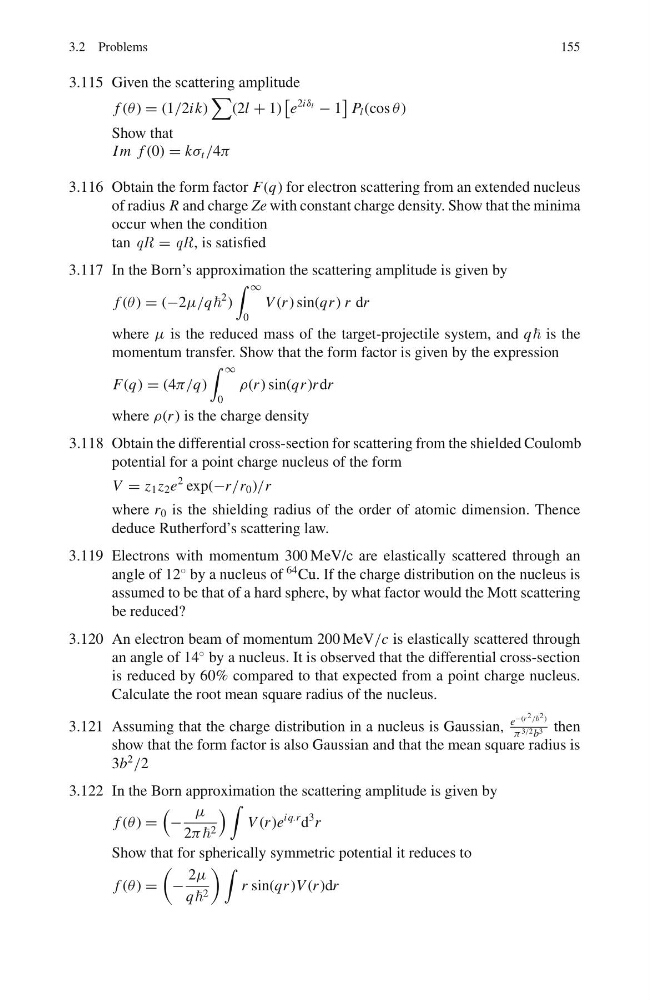
3.115 Given the scattering amplitude
f (θ ) = (1/2ik)
(2l + 1)
e
2iδl
− 1
P l (cos θ)
Show that
I m f (0) = kσ t /4π
3.116 Obtain the form factor F(q) for electron scattering from an extended nucleus
of radius R and charge Ze with constant charge density. Show that the minima
occur when the condition
tan qR = qR, is satisfied
3.117 In the Born’s approximation the scattering amplitude is given by
f (θ ) = (−2μ/q
2 )
∞
0
V (r ) sin(qr) r dr
where μ is the reduced mass of the target-projectile system, and q is the
momentum transfer. Show that the form factor is given by the expression
F(q) = (4π/q)
∞
0
ρ(r ) sin(qr)r dr
where ρ(r ) is the charge density
3.118 Obtain the differential cross-section for scattering from the shielded Coulomb
potential for a point charge nucleus of the form
V = z 1 z 2 e
2 exp(−r/r 0 )/r
where r 0 is the shielding radius of the order of atomic dimension. Thence
deduce Rutherford’s scattering law.
3.119 Electrons with momentum 300 MeV/c are elastically scattered through an
angle of 12
◦ by a nucleus of
64 Cu. If the charge distribution on the nucleus is
assumed to be that of a hard sphere, by what factor would the Mott scattering
be reduced?
3.120 An electron beam of momentum 200 MeV/c is elastically scattered through
an angle of 14
◦ by a nucleus. It is observed that the differential cross-section
is reduced by 60% compared to that expected from a point charge nucleus.
Calculate the root mean square radius of the nucleus.
3.121 Assuming that the charge distribution in a nucleus is Gaussian,
e
−(r 2 /b 2 )
π 3/2 b 3 then
show that the form factor is also Gaussian and that the mean square radius is
3b
2
/2
3.122 In the Born approximation the scattering amplitude is given by
f (θ ) =
−
μ
2π 2
V (r )e
iq.r d
3 r
Show that for spherically symmetric potential it reduces to
f (θ ) =
−
2μ
q 2
r sin(qr)V (r )dr
155
3.115 Given the scattering amplitude
f (θ ) = (1/2ik)
(2l + 1)
e
2iδl
− 1
P l (cos θ)
Show that
I m f (0) = kσ t /4π
3.116 Obtain the form factor F(q) for electron scattering from an extended nucleus
of radius R and charge Ze with constant charge density. Show that the minima
occur when the condition
tan qR = qR, is satisfied
3.117 In the Born’s approximation the scattering amplitude is given by
f (θ ) = (−2μ/q
2 )
∞
0
V (r ) sin(qr) r dr
where μ is the reduced mass of the target-projectile system, and q is the
momentum transfer. Show that the form factor is given by the expression
F(q) = (4π/q)
∞
0
ρ(r ) sin(qr)r dr
where ρ(r ) is the charge density
3.118 Obtain the differential cross-section for scattering from the shielded Coulomb
potential for a point charge nucleus of the form
V = z 1 z 2 e
2 exp(−r/r 0 )/r
where r 0 is the shielding radius of the order of atomic dimension. Thence
deduce Rutherford’s scattering law.
3.119 Electrons with momentum 300 MeV/c are elastically scattered through an
angle of 12
◦ by a nucleus of
64 Cu. If the charge distribution on the nucleus is
assumed to be that of a hard sphere, by what factor would the Mott scattering
be reduced?
3.120 An electron beam of momentum 200 MeV/c is elastically scattered through
an angle of 14
◦ by a nucleus. It is observed that the differential cross-section
is reduced by 60% compared to that expected from a point charge nucleus.
Calculate the root mean square radius of the nucleus.
3.121 Assuming that the charge distribution in a nucleus is Gaussian,
e
−(r 2 /b 2 )
π 3/2 b 3 then
show that the form factor is also Gaussian and that the mean square radius is
3b
2
/2
3.122 In the Born approximation the scattering amplitude is given by
f (θ ) =
−
μ
2π 2
V (r )e
iq.r d
3 r
Show that for spherically symmetric potential it reduces to
f (θ ) =
−
2μ
q 2
r sin(qr)V (r )dr