

152
3 Quantum Mechanics – II
3.2.7 Approximate Methods
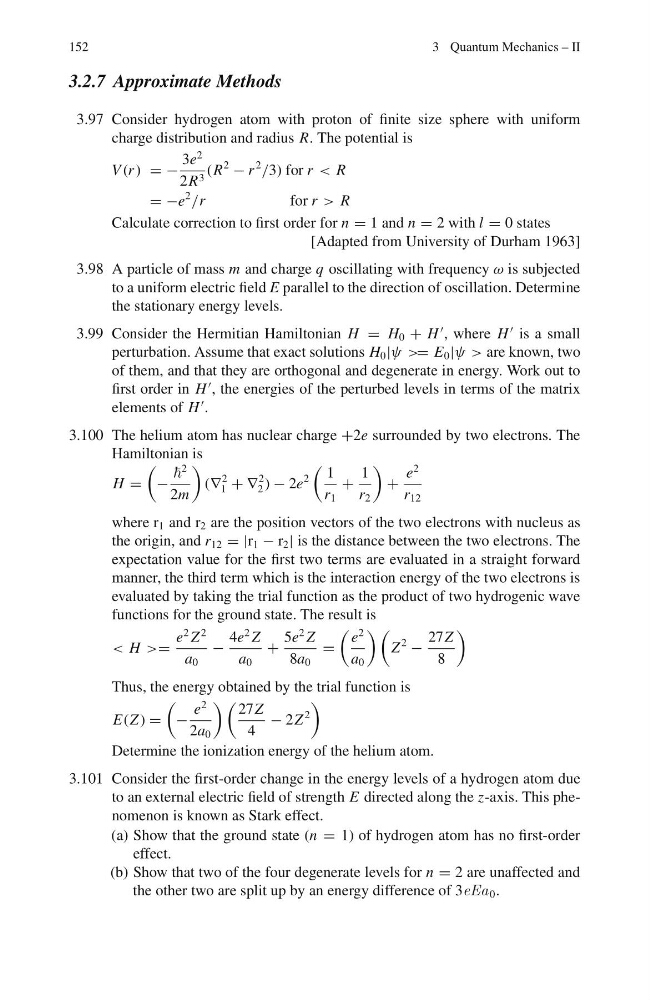
3.97 Consider hydrogen atom with proton of finite size sphere with uniform
charge distribution and radius R. The potential is
V (r ) = −
3e
2
2R 3 (R
2
− r
2
/3) for r < R
= −e
2
/r
for r > R
Calculate correction to first order for n = 1 and n = 2 with l = 0 states
[Adapted from University of Durham 1963]
3.98 A particle of mass m and charge q oscillating with frequency ω is subjected
to a uniform electric field E parallel to the direction of oscillation. Determine
the stationary energy levels.
3.99 Consider the Hermitian Hamiltonian H = H 0 + H
, where H
is a small
perturbation. Assume that exact solutions H 0 |ψ >= E 0 |ψ > are known, two
of them, and that they are orthogonal and degenerate in energy. Work out to
first order in H
, the energies of the perturbed levels in terms of the matrix
elements of H
.
3.100 The helium atom has nuclear charge +2e surrounded by two electrons. The
Hamiltonian is
H =
−
2
2m
(∇
2
1 + ∇
2
2 ) − 2e
2
1
r 1
+
1
r 2
+
e
2
r 12
where r 1 and r 2 are the position vectors of the two electrons with nucleus as
the origin, and r 12 = |r 1 − r 2 | is the distance between the two electrons. The
expectation value for the first two terms are evaluated in a straight forward
manner, the third term which is the interaction energy of the two electrons is
evaluated by taking the trial function as the product of two hydrogenic wave
functions for the ground state. The result is
< H >=
e
2 Z
2
a 0
−
4e
2 Z
a 0
+
5e
2 Z
8a 0
=
e
2
a 0
Z
2
−
27Z
8
Thus, the energy obtained by the trial function is
E(Z ) =
−
e
2
2a 0
27Z
4
− 2Z
2
Determine the ionization energy of the helium atom.
3.101 Consider the first-order change in the energy levels of a hydrogen atom due
to an external electric field of strength E directed along the z-axis. This phenomenon is known as Stark effect.
(a) Show that the ground state (n = 1) of hydrogen atom has no first-order
effect.
(b) Show that two of the four degenerate levels for n = 2 are unaffected and
the other two are split up by an energy difference of 3eEa 0 .
3 Quantum Mechanics – II
3.2.7 Approximate Methods
3.97 Consider hydrogen atom with proton of finite size sphere with uniform
charge distribution and radius R. The potential is
V (r ) = −
3e
2
2R 3 (R
2
− r
2
/3) for r < R
= −e
2
/r
for r > R
Calculate correction to first order for n = 1 and n = 2 with l = 0 states
[Adapted from University of Durham 1963]
3.98 A particle of mass m and charge q oscillating with frequency ω is subjected
to a uniform electric field E parallel to the direction of oscillation. Determine
the stationary energy levels.
3.99 Consider the Hermitian Hamiltonian H = H 0 + H
, where H
is a small
perturbation. Assume that exact solutions H 0 |ψ >= E 0 |ψ > are known, two
of them, and that they are orthogonal and degenerate in energy. Work out to
first order in H
, the energies of the perturbed levels in terms of the matrix
elements of H
.
3.100 The helium atom has nuclear charge +2e surrounded by two electrons. The
Hamiltonian is
H =
−
2
2m
(∇
2
1 + ∇
2
2 ) − 2e
2
1
r 1
+
1
r 2
+
e
2
r 12
where r 1 and r 2 are the position vectors of the two electrons with nucleus as
the origin, and r 12 = |r 1 − r 2 | is the distance between the two electrons. The
expectation value for the first two terms are evaluated in a straight forward
manner, the third term which is the interaction energy of the two electrons is
evaluated by taking the trial function as the product of two hydrogenic wave
functions for the ground state. The result is
< H >=
e
2 Z
2
a 0
−
4e
2 Z
a 0
+
5e
2 Z
8a 0
=
e
2
a 0
Z
2
−
27Z
8
Thus, the energy obtained by the trial function is
E(Z ) =
−
e
2
2a 0
27Z
4
− 2Z
2
Determine the ionization energy of the helium atom.
3.101 Consider the first-order change in the energy levels of a hydrogen atom due
to an external electric field of strength E directed along the z-axis. This phenomenon is known as Stark effect.
(a) Show that the ground state (n = 1) of hydrogen atom has no first-order
effect.
(b) Show that two of the four degenerate levels for n = 2 are unaffected and
the other two are split up by an energy difference of 3eEa 0 .