

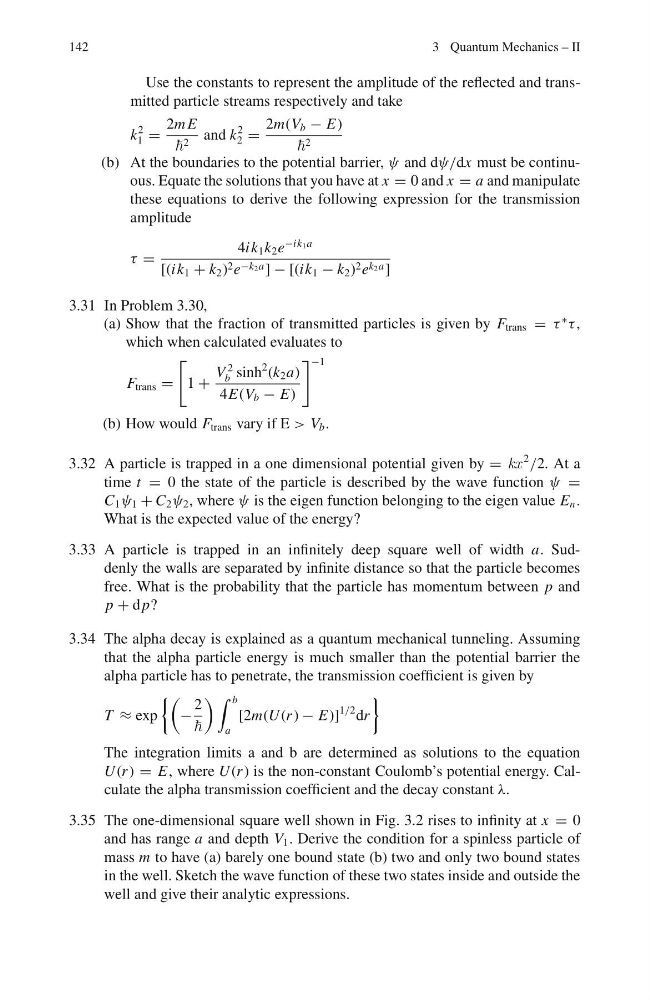
142
3 Quantum Mechanics – II
Use the constants to represent the amplitude of the reflected and transmitted particle streams respectively and take
k
2
1 =
2m E
2 and k
2
2 =
2m(V b − E)
2
(b) At the boundaries to the potential barrier, ψ and dψ/dx must be continuous. Equate the solutions that you have at x = 0 and x = a and manipulate
these equations to derive the following expression for the transmission
amplitude
τ =
4ik 1 k 2 e
−ik1a
[(ik 1 + k 2 ) 2 e −k2a ] − [(ik 1 − k 2 ) 2 e k2a ]
3.31 In Problem 3.30,
(a) Show that the fraction of transmitted particles is given by F trans = τ
∗
τ ,
which when calculated evaluates to
F trans =
1 +
V
2
b sinh
2 (k 2 a)
4E(V b − E)
−1
(b) How would F trans vary if E > V b .
3.32 A particle is trapped in a one dimensional potential given by = kx
2
/2. At a
time t = 0 the state of the particle is described by the wave function ψ =
C 1 ψ 1 + C 2 ψ 2 , where ψ is the eigen function belonging to the eigen value E n .
What is the expected value of the energy?
3.33 A particle is trapped in an infinitely deep square well of width a. Suddenly the walls are separated by infinite distance so that the particle becomes
free. What is the probability that the particle has momentum between p and
p + d p?
3.34 The alpha decay is explained as a quantum mechanical tunneling. Assuming
that the alpha particle energy is much smaller than the potential barrier the
alpha particle has to penetrate, the transmission coefficient is given by
T ≈ exp
−
2
b
a
[2m(U (r ) − E)]
1/2 dr
The integration limits a and b are determined as solutions to the equation
U (r ) = E, where U (r ) is the non-constant Coulomb’s potential energy. Calculate the alpha transmission coefficient and the decay constant λ.
3.35 The one-dimensional square well shown in Fig. 3.2 rises to infinity at x = 0
and has range a and depth V 1 . Derive the condition for a spinless particle of
mass m to have (a) barely one bound state (b) two and only two bound states
in the well. Sketch the wave function of these two states inside and outside the
well and give their analytic expressions.
3 Quantum Mechanics – II
Use the constants to represent the amplitude of the reflected and transmitted particle streams respectively and take
k
2
1 =
2m E
2 and k
2
2 =
2m(V b − E)
2
(b) At the boundaries to the potential barrier, ψ and dψ/dx must be continuous. Equate the solutions that you have at x = 0 and x = a and manipulate
these equations to derive the following expression for the transmission
amplitude
τ =
4ik 1 k 2 e
−ik1a
[(ik 1 + k 2 ) 2 e −k2a ] − [(ik 1 − k 2 ) 2 e k2a ]
3.31 In Problem 3.30,
(a) Show that the fraction of transmitted particles is given by F trans = τ
∗
τ ,
which when calculated evaluates to
F trans =
1 +
V
2
b sinh
2 (k 2 a)
4E(V b − E)
−1
(b) How would F trans vary if E > V b .
3.32 A particle is trapped in a one dimensional potential given by = kx
2
/2. At a
time t = 0 the state of the particle is described by the wave function ψ =
C 1 ψ 1 + C 2 ψ 2 , where ψ is the eigen function belonging to the eigen value E n .
What is the expected value of the energy?
3.33 A particle is trapped in an infinitely deep square well of width a. Suddenly the walls are separated by infinite distance so that the particle becomes
free. What is the probability that the particle has momentum between p and
p + d p?
3.34 The alpha decay is explained as a quantum mechanical tunneling. Assuming
that the alpha particle energy is much smaller than the potential barrier the
alpha particle has to penetrate, the transmission coefficient is given by
T ≈ exp
−
2
b
a
[2m(U (r ) − E)]
1/2 dr
The integration limits a and b are determined as solutions to the equation
U (r ) = E, where U (r ) is the non-constant Coulomb’s potential energy. Calculate the alpha transmission coefficient and the decay constant λ.
3.35 The one-dimensional square well shown in Fig. 3.2 rises to infinity at x = 0
and has range a and depth V 1 . Derive the condition for a spinless particle of
mass m to have (a) barely one bound state (b) two and only two bound states
in the well. Sketch the wave function of these two states inside and outside the
well and give their analytic expressions.