

3.2 Problems
137
The Born approximation
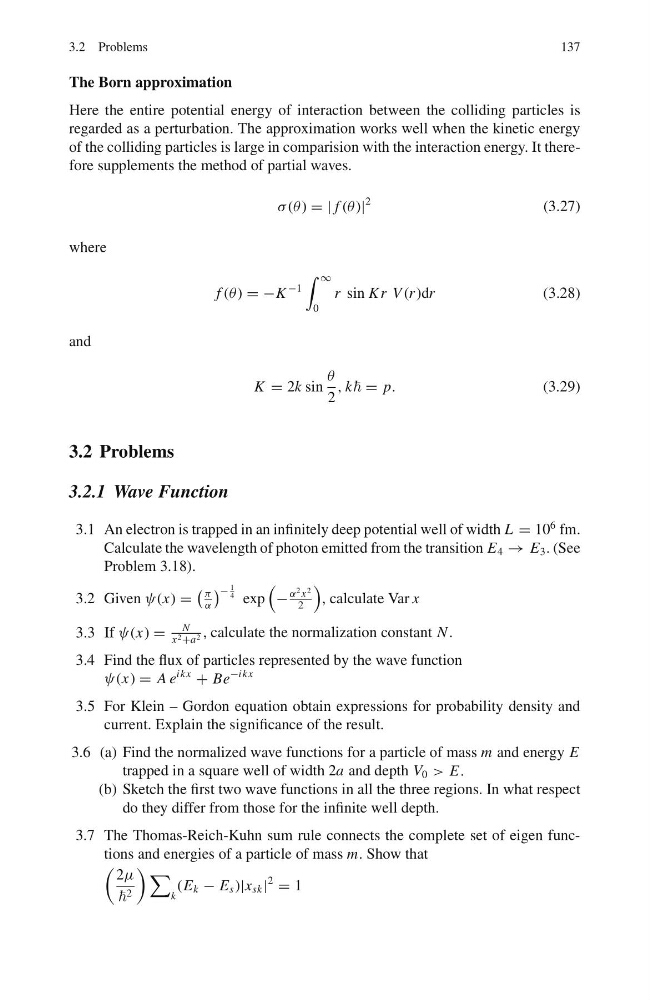
Here the entire potential energy of interaction between the colliding particles is
regarded as a perturbation. The approximation works well when the kinetic energy
of the colliding particles is large in comparision with the interaction energy. It therefore supplements the method of partial waves.
σ (θ ) = | f (θ )|
2
(3.27)
where
f (θ ) = −K
−1
∞
0
r sin K r V (r )dr
(3.28)
and
K = 2k sin
θ
2
, k = p.
(3.29)
3.2 Problems
3.2.1 Wave Function
3.1 An electron is trapped in an infinitely deep potential well of width L = 10
6 fm.
Calculate the wavelength of photon emitted from the transition E 4 → E 3 . (See
Problem 3.18).
3.2 Given ψ(x) =
π
α
−
1
4 exp
−
α
2 x
2
2
, calculate Var x
3.3 If ψ(x) =
N
x 2 +a 2 , calculate the normalization constant N .
3.4 Find the flux of particles represented by the wave function
ψ(x) = A e
ikx
+ Be
−ikx
3.5 For Klein – Gordon equation obtain expressions for probability density and
current. Explain the significance of the result.
3.6 (a) Find the normalized wave functions for a particle of mass m and energy E
trapped in a square well of width 2a and depth V 0 > E.
(b) Sketch the first two wave functions in all the three regions. In what respect
do they differ from those for the infinite well depth.
3.7 The Thomas-Reich-Kuhn sum rule connects the complete set of eigen functions and energies of a particle of mass m. Show that
2μ
2
k
(E k − E s )|x sk |
2
= 1
137
The Born approximation
Here the entire potential energy of interaction between the colliding particles is
regarded as a perturbation. The approximation works well when the kinetic energy
of the colliding particles is large in comparision with the interaction energy. It therefore supplements the method of partial waves.
σ (θ ) = | f (θ )|
2
(3.27)
where
f (θ ) = −K
−1
∞
0
r sin K r V (r )dr
(3.28)
and
K = 2k sin
θ
2
, k = p.
(3.29)
3.2 Problems
3.2.1 Wave Function
3.1 An electron is trapped in an infinitely deep potential well of width L = 10
6 fm.
Calculate the wavelength of photon emitted from the transition E 4 → E 3 . (See
Problem 3.18).
3.2 Given ψ(x) =
π
α
−
1
4 exp
−
α
2 x
2
2
, calculate Var x
3.3 If ψ(x) =
N
x 2 +a 2 , calculate the normalization constant N .
3.4 Find the flux of particles represented by the wave function
ψ(x) = A e
ikx
+ Be
−ikx
3.5 For Klein – Gordon equation obtain expressions for probability density and
current. Explain the significance of the result.
3.6 (a) Find the normalized wave functions for a particle of mass m and energy E
trapped in a square well of width 2a and depth V 0 > E.
(b) Sketch the first two wave functions in all the three regions. In what respect
do they differ from those for the infinite well depth.
3.7 The Thomas-Reich-Kuhn sum rule connects the complete set of eigen functions and energies of a particle of mass m. Show that
2μ
2
k
(E k − E s )|x sk |
2
= 1