

134
3 Quantum Mechanics – II
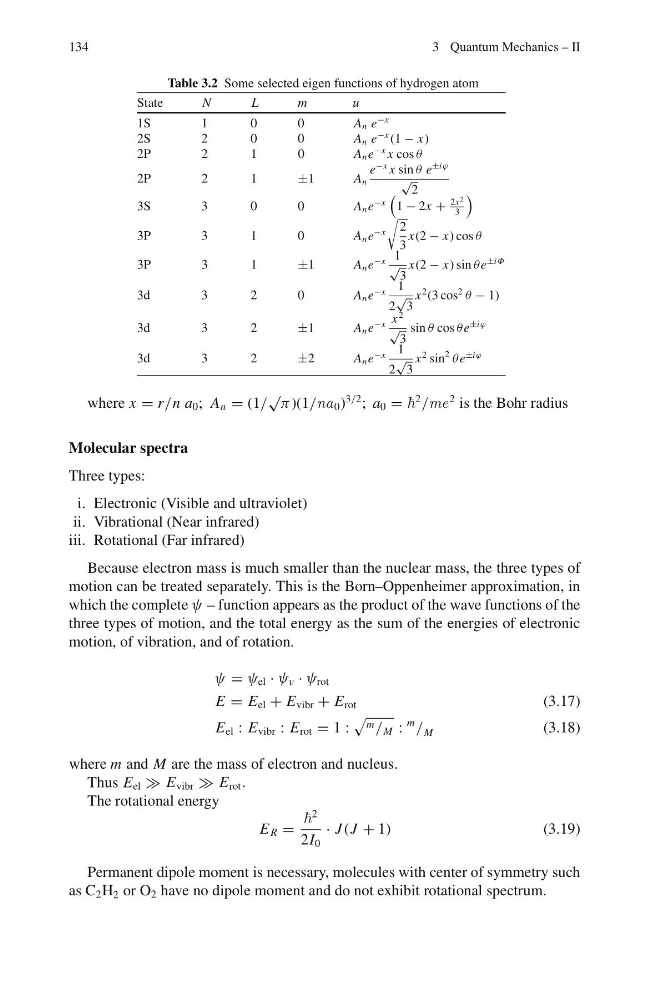
Table 3.2 Some selected eigen functions of hydrogen atom
State
N
L
m
u
1S
1
0
0
A n e
−x
2S
2
0
0
A n e
−x (1 − x)
2P
2
1
0
A n e
−x x cos θ
2P
2
1
±1
A n
e
−x x sin θ e
±iϕ
√
2
3S
3
0
0
A n e
−x
1 − 2x +
2x
2
3
3P
3
1
0
A n e
−x
2
3
x(2 − x) cos θ
3P
3
1
±1
A n e
−x 1
√
3
x(2 − x) sin θ e
±iΦ
3d
3
2
0
A n e
−x 1
2
√
3
x
2 (3 cos
2 θ − 1)
3d
3
2
±1
A n e
−x x
2
√
3
sin θ cos θ e
±iϕ
3d
3
2
±2
A n e
−x 1
2
√
3
x
2 sin
2 θ e
±iϕ
where x = r/n a 0 ; A n = (1/
√ π)(1/na 0 )
3/2 ; a 0 =
2
/me
2 is the Bohr radius
Molecular spectra
Three types:
i. Electronic (Visible and ultraviolet)
ii. Vibrational (Near infrared)
iii. Rotational (Far infrared)
Because electron mass is much smaller than the nuclear mass, the three types of
motion can be treated separately. This is the Born–Oppenheimer approximation, in
which the complete ψ – function appears as the product of the wave functions of the
three types of motion, and the total energy as the sum of the energies of electronic
motion, of vibration, and of rotation.
ψ = ψ el · ψ v · ψ rot
E = E el + E vibr + E rot
(3.17)
E el : E vibr : E rot = 1 :
m / M :
m
/ M
(3.18)
where m and M are the mass of electron and nucleus.
Thus E el E vibr E rot .
The rotational energy
E R =
2
2I 0
· J (J + 1)
(3.19)
Permanent dipole moment is necessary, molecules with center of symmetry such
as C 2 H 2 or O 2 have no dipole moment and do not exhibit rotational spectrum.
3 Quantum Mechanics – II
Table 3.2 Some selected eigen functions of hydrogen atom
State
N
L
m
u
1S
1
0
0
A n e
−x
2S
2
0
0
A n e
−x (1 − x)
2P
2
1
0
A n e
−x x cos θ
2P
2
1
±1
A n
e
−x x sin θ e
±iϕ
√
2
3S
3
0
0
A n e
−x
1 − 2x +
2x
2
3
3P
3
1
0
A n e
−x
2
3
x(2 − x) cos θ
3P
3
1
±1
A n e
−x 1
√
3
x(2 − x) sin θ e
±iΦ
3d
3
2
0
A n e
−x 1
2
√
3
x
2 (3 cos
2 θ − 1)
3d
3
2
±1
A n e
−x x
2
√
3
sin θ cos θ e
±iϕ
3d
3
2
±2
A n e
−x 1
2
√
3
x
2 sin
2 θ e
±iϕ
where x = r/n a 0 ; A n = (1/
√ π)(1/na 0 )
3/2 ; a 0 =
2
/me
2 is the Bohr radius
Molecular spectra
Three types:
i. Electronic (Visible and ultraviolet)
ii. Vibrational (Near infrared)
iii. Rotational (Far infrared)
Because electron mass is much smaller than the nuclear mass, the three types of
motion can be treated separately. This is the Born–Oppenheimer approximation, in
which the complete ψ – function appears as the product of the wave functions of the
three types of motion, and the total energy as the sum of the energies of electronic
motion, of vibration, and of rotation.
ψ = ψ el · ψ v · ψ rot
E = E el + E vibr + E rot
(3.17)
E el : E vibr : E rot = 1 :
m / M :
m
/ M
(3.18)
where m and M are the mass of electron and nucleus.
Thus E el E vibr E rot .
The rotational energy
E R =
2
2I 0
· J (J + 1)
(3.19)
Permanent dipole moment is necessary, molecules with center of symmetry such
as C 2 H 2 or O 2 have no dipole moment and do not exhibit rotational spectrum.