

2.3 Solutions
129
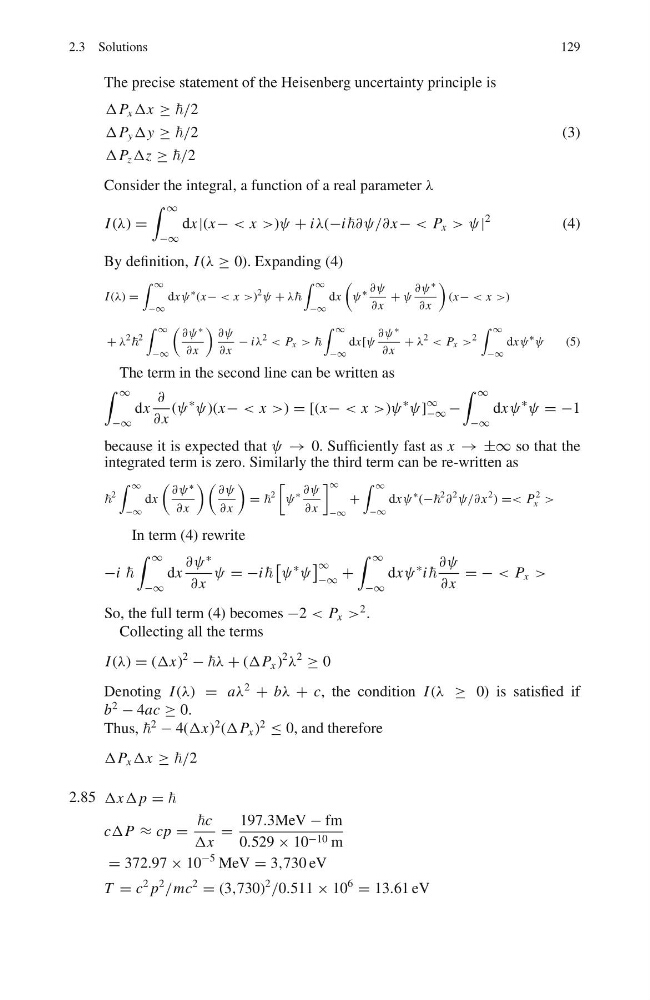
The precise statement of the Heisenberg uncertainty principle is
ΔP x Δx ≥ /2
ΔP y Δy ≥ /2
( 3 )
ΔP z Δz ≥ /2
Consider the integral, a function of a real parameter λ
I (λ) =
∞
−∞
dx|(x− < x >)ψ + iλ(−i∂ψ/∂x− < P x > ψ|
2
(4)
By definition, I (λ ≥ 0). Expanding (4)
I (λ) =
∞
−∞
dxψ
∗ (x− < x >)
2 ψ + λ
∞
−∞
dx
ψ
∗ ∂ψ
∂ x
+ ψ
∂ψ ∗
∂ x
(x− < x >)
+ λ
2
2
∞
−∞
∂ψ ∗
∂ x
∂ψ
∂ x
− iλ
2 < P x >
∞
−∞
dx[ψ
∂ψ ∗
∂ x
+ λ
2 < P x >
2
∞
−∞
dxψ
∗ ψ
(5)
The term in the second line can be written as
∞
−∞
dx
∂
∂ x
(ψ
∗
ψ)(x− < x >) = [(x− < x >)ψ
∗
ψ]
∞
−∞ −
∞
−∞
dxψ
∗
ψ = −1
because it is expected that ψ → 0. Sufficiently fast as x → ±∞ so that the
integrated term is zero. Similarly the third term can be re-written as
2
∞
−∞
dx
∂ψ
∗
∂ x
∂ψ
∂ x
=
2
ψ
∗ ∂ψ
∂ x
∞
−∞
+
∞
−∞
dxψ
∗ (−
2 ∂
2 ψ/∂ x
2 ) =< P
2
x >
In term (4) rewrite
−i
∞
−∞
dx
∂ψ
∗
∂ x
ψ = −i
ψ
∗
ψ
∞
−∞
+
∞
−∞
dxψ
∗ i
∂ψ
∂ x
= − < P x >
So, the full term (4) becomes −2 < P x >
2 .
Collecting all the terms
I (λ) = (Δx)
2
− λ + (ΔP x )
2
λ
2
≥ 0
Denoting I (λ) = aλ
2
+ bλ + c, the condition I (λ ≥ 0) is satisfied if
b
2
− 4ac ≥ 0.
Thus,
2
− 4(Δx)
2 (ΔP x )
2
≤ 0, and therefore
ΔP x Δx ≥ /2
2.85 ΔxΔ p =
cΔP ≈ cp =
c
Δx
=
197.3MeV − fm
0.529 × 10 −10 m
= 372.97 × 10
−5 MeV = 3,730 eV
T = c
2 p
2
/mc
2
= (3,730)
2
/0.511 × 10
6
= 13.61 eV
129
The precise statement of the Heisenberg uncertainty principle is
ΔP x Δx ≥ /2
ΔP y Δy ≥ /2
( 3 )
ΔP z Δz ≥ /2
Consider the integral, a function of a real parameter λ
I (λ) =
∞
−∞
dx|(x− < x >)ψ + iλ(−i∂ψ/∂x− < P x > ψ|
2
(4)
By definition, I (λ ≥ 0). Expanding (4)
I (λ) =
∞
−∞
dxψ
∗ (x− < x >)
2 ψ + λ
∞
−∞
dx
ψ
∗ ∂ψ
∂ x
+ ψ
∂ψ ∗
∂ x
(x− < x >)
+ λ
2
2
∞
−∞
∂ψ ∗
∂ x
∂ψ
∂ x
− iλ
2 < P x >
∞
−∞
dx[ψ
∂ψ ∗
∂ x
+ λ
2 < P x >
2
∞
−∞
dxψ
∗ ψ
(5)
The term in the second line can be written as
∞
−∞
dx
∂
∂ x
(ψ
∗
ψ)(x− < x >) = [(x− < x >)ψ
∗
ψ]
∞
−∞ −
∞
−∞
dxψ
∗
ψ = −1
because it is expected that ψ → 0. Sufficiently fast as x → ±∞ so that the
integrated term is zero. Similarly the third term can be re-written as
2
∞
−∞
dx
∂ψ
∗
∂ x
∂ψ
∂ x
=
2
ψ
∗ ∂ψ
∂ x
∞
−∞
+
∞
−∞
dxψ
∗ (−
2 ∂
2 ψ/∂ x
2 ) =< P
2
x >
In term (4) rewrite
−i
∞
−∞
dx
∂ψ
∗
∂ x
ψ = −i
ψ
∗
ψ
∞
−∞
+
∞
−∞
dxψ
∗ i
∂ψ
∂ x
= − < P x >
So, the full term (4) becomes −2 < P x >
2 .
Collecting all the terms
I (λ) = (Δx)
2
− λ + (ΔP x )
2
λ
2
≥ 0
Denoting I (λ) = aλ
2
+ bλ + c, the condition I (λ ≥ 0) is satisfied if
b
2
− 4ac ≥ 0.
Thus,
2
− 4(Δx)
2 (ΔP x )
2
≤ 0, and therefore
ΔP x Δx ≥ /2
2.85 ΔxΔ p =
cΔP ≈ cp =
c
Δx
=
197.3MeV − fm
0.529 × 10 −10 m
= 372.97 × 10
−5 MeV = 3,730 eV
T = c
2 p
2
/mc
2
= (3,730)
2
/0.511 × 10
6
= 13.61 eV