

2.3 Solutions
103
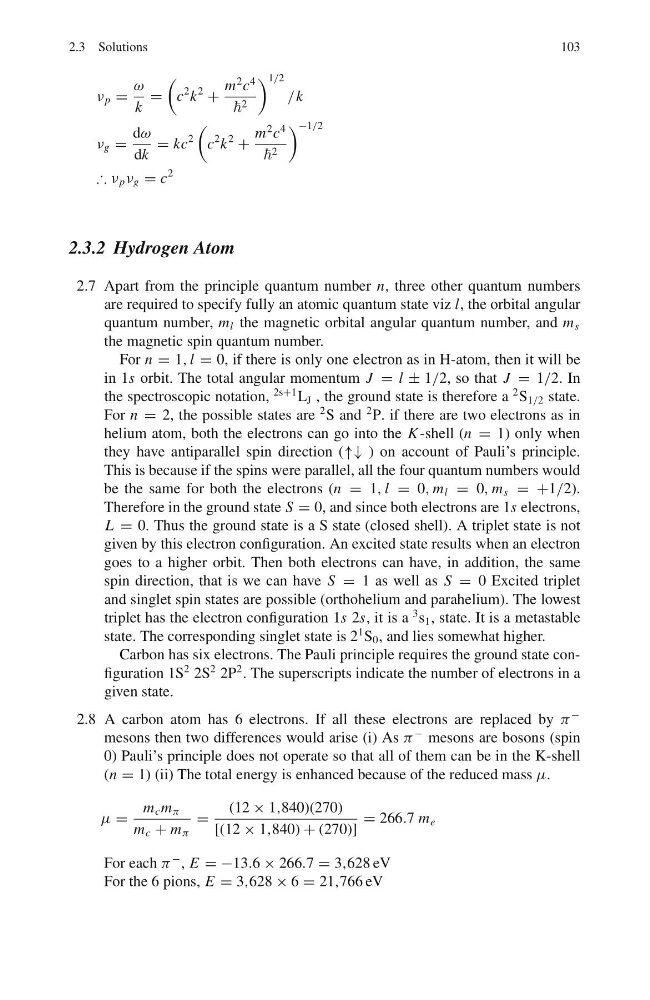
ν p =
ω
k
=
c
2 k
2
+
m
2 c
4
2
1/2
/k
ν g =
dω
dk
= kc
2
c
2 k
2
+
m
2 c
4
2
−1/2
∴ ν p ν g = c
2
2.3.2 Hydrogen Atom
2.7 Apart from the principle quantum number n, three other quantum numbers
are required to specify fully an atomic quantum state viz l, the orbital angular
quantum number, m l the magnetic orbital angular quantum number, and m s
the magnetic spin quantum number.
For n = 1, l = 0, if there is only one electron as in H-atom, then it will be
in 1s orbit. The total angular momentum J = l ± 1/2, so that J = 1/2. In
the spectroscopic notation,
2s+1 L J , the ground state is therefore a
2 S 1/2 state.
For n = 2, the possible states are
2 S and
2 P. if there are two electrons as in
helium atom, both the electrons can go into the K -shell (n = 1) only when
they have antiparallel spin direction (↑↓ ) on account of Pauli’s principle.
This is because if the spins were parallel, all the four quantum numbers would
be the same for both the electrons (n = 1, l = 0, m l = 0, m s = +1/2).
Therefore in the ground state S = 0, and since both electrons are 1s electrons,
L = 0. Thus the ground state is a S state (closed shell). A triplet state is not
given by this electron configuration. An excited state results when an electron
goes to a higher orbit. Then both electrons can have, in addition, the same
spin direction, that is we can have S = 1 as well as S = 0 Excited triplet
and singlet spin states are possible (orthohelium and parahelium). The lowest
triplet has the electron configuration 1s 2s, it is a
3 s 1 , state. It is a metastable
state. The corresponding singlet state is 2
1 S 0 , and lies somewhat higher.
Carbon has six electrons. The Pauli principle requires the ground state configuration 1S
2 2S
2 2P
2 . The superscripts indicate the number of electrons in a
given state.
2.8 A carbon atom has 6 electrons. If all these electrons are replaced by π
−
mesons then two differences would arise (i) As π
− mesons are bosons (spin
0) Pauli’s principle does not operate so that all of them can be in the K-shell
(n = 1) (ii) The total energy is enhanced because of the reduced mass μ.
μ =
m c m π
m c + m π
=
(12 × 1,840)(270)
[(12 × 1,840) + (270)]
= 266.7 m e
For each π
−
, E = −13.6 × 266.7 = 3,628 eV
For the 6 pions, E = 3,628 × 6 = 21,766 eV
103
ν p =
ω
k
=
c
2 k
2
+
m
2 c
4
2
1/2
/k
ν g =
dω
dk
= kc
2
c
2 k
2
+
m
2 c
4
2
−1/2
∴ ν p ν g = c
2
2.3.2 Hydrogen Atom
2.7 Apart from the principle quantum number n, three other quantum numbers
are required to specify fully an atomic quantum state viz l, the orbital angular
quantum number, m l the magnetic orbital angular quantum number, and m s
the magnetic spin quantum number.
For n = 1, l = 0, if there is only one electron as in H-atom, then it will be
in 1s orbit. The total angular momentum J = l ± 1/2, so that J = 1/2. In
the spectroscopic notation,
2s+1 L J , the ground state is therefore a
2 S 1/2 state.
For n = 2, the possible states are
2 S and
2 P. if there are two electrons as in
helium atom, both the electrons can go into the K -shell (n = 1) only when
they have antiparallel spin direction (↑↓ ) on account of Pauli’s principle.
This is because if the spins were parallel, all the four quantum numbers would
be the same for both the electrons (n = 1, l = 0, m l = 0, m s = +1/2).
Therefore in the ground state S = 0, and since both electrons are 1s electrons,
L = 0. Thus the ground state is a S state (closed shell). A triplet state is not
given by this electron configuration. An excited state results when an electron
goes to a higher orbit. Then both electrons can have, in addition, the same
spin direction, that is we can have S = 1 as well as S = 0 Excited triplet
and singlet spin states are possible (orthohelium and parahelium). The lowest
triplet has the electron configuration 1s 2s, it is a
3 s 1 , state. It is a metastable
state. The corresponding singlet state is 2
1 S 0 , and lies somewhat higher.
Carbon has six electrons. The Pauli principle requires the ground state configuration 1S
2 2S
2 2P
2 . The superscripts indicate the number of electrons in a
given state.
2.8 A carbon atom has 6 electrons. If all these electrons are replaced by π
−
mesons then two differences would arise (i) As π
− mesons are bosons (spin
0) Pauli’s principle does not operate so that all of them can be in the K-shell
(n = 1) (ii) The total energy is enhanced because of the reduced mass μ.
μ =
m c m π
m c + m π
=
(12 × 1,840)(270)
[(12 × 1,840) + (270)]
= 266.7 m e
For each π
−
, E = −13.6 × 266.7 = 3,628 eV
For the 6 pions, E = 3,628 × 6 = 21,766 eV