

90
2 Quantum Mechanics – I
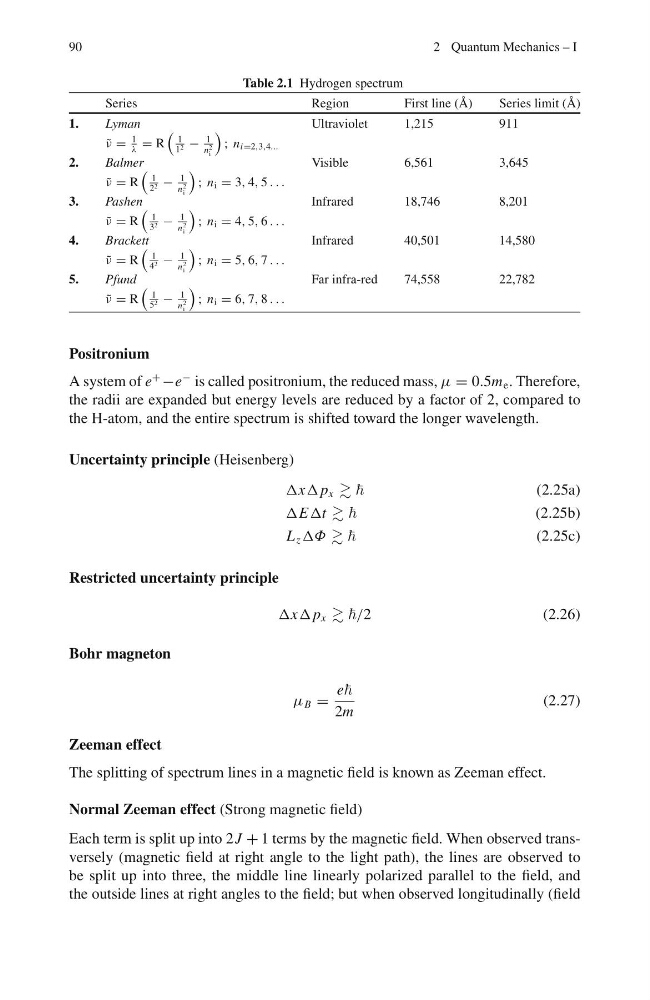
Table 2.1 Hydrogen spectrum
Series
Region
First line ( ˚
A)
Series limit ( ˚
A)
1.
Lyman
Ultraviolet
1,215
911
˜
ν =
1
λ
= R
1
1 2 −
1
n
2
i
; n i=2,3,4...
2.
Balmer
Visible
6,561
3,645
˜
ν = R
1
2 2 −
1
n
2
i
; n i = 3, 4, 5 . . .
3.
Pashen
Infrared
18,746
8,201
˜
ν = R
1
3 2 −
1
n
2
i
; n i = 4, 5, 6 . . .
4.
Brackett
Infrared
40,501
14,580
˜
ν = R
1
4 2 −
1
n
2
i
; n i = 5, 6, 7 . . .
5.
Pfund
Far infra-red
74,558
22,782
˜
ν = R
1
5 2 −
1
n
2
i
; n i = 6, 7, 8 . . .
Positronium
A system of e
+
−e
− is called positronium, the reduced mass, μ = 0.5m e . Therefore,
the radii are expanded but energy levels are reduced by a factor of 2, compared to
the H-atom, and the entire spectrum is shifted toward the longer wavelength.
Uncertainty principle (Heisenberg)
ΔxΔ p x
(2.25a)
ΔEΔt
(2.25b)
L z ΔΦ
(2.25c)
Restricted uncertainty principle
ΔxΔ p x /2
(2.26)
Bohr magneton
μ B =
e
2m
(2.27)
Zeeman effect
The splitting of spectrum lines in a magnetic field is known as Zeeman effect.
Normal Zeeman effect (Strong magnetic field)
Each term is split up into 2J + 1 terms by the magnetic field. When observed transversely (magnetic field at right angle to the light path), the lines are observed to
be split up into three, the middle line linearly polarized parallel to the field, and
the outside lines at right angles to the field; but when observed longitudinally (field
2 Quantum Mechanics – I
Table 2.1 Hydrogen spectrum
Series
Region
First line ( ˚
A)
Series limit ( ˚
A)
1.
Lyman
Ultraviolet
1,215
911
˜
ν =
1
λ
= R
1
1 2 −
1
n
2
i
; n i=2,3,4...
2.
Balmer
Visible
6,561
3,645
˜
ν = R
1
2 2 −
1
n
2
i
; n i = 3, 4, 5 . . .
3.
Pashen
Infrared
18,746
8,201
˜
ν = R
1
3 2 −
1
n
2
i
; n i = 4, 5, 6 . . .
4.
Brackett
Infrared
40,501
14,580
˜
ν = R
1
4 2 −
1
n
2
i
; n i = 5, 6, 7 . . .
5.
Pfund
Far infra-red
74,558
22,782
˜
ν = R
1
5 2 −
1
n
2
i
; n i = 6, 7, 8 . . .
Positronium
A system of e
+
−e
− is called positronium, the reduced mass, μ = 0.5m e . Therefore,
the radii are expanded but energy levels are reduced by a factor of 2, compared to
the H-atom, and the entire spectrum is shifted toward the longer wavelength.
Uncertainty principle (Heisenberg)
ΔxΔ p x
(2.25a)
ΔEΔt
(2.25b)
L z ΔΦ
(2.25c)
Restricted uncertainty principle
ΔxΔ p x /2
(2.26)
Bohr magneton
μ B =
e
2m
(2.27)
Zeeman effect
The splitting of spectrum lines in a magnetic field is known as Zeeman effect.
Normal Zeeman effect (Strong magnetic field)
Each term is split up into 2J + 1 terms by the magnetic field. When observed transversely (magnetic field at right angle to the light path), the lines are observed to
be split up into three, the middle line linearly polarized parallel to the field, and
the outside lines at right angles to the field; but when observed longitudinally (field