

1.3 Solutions
85
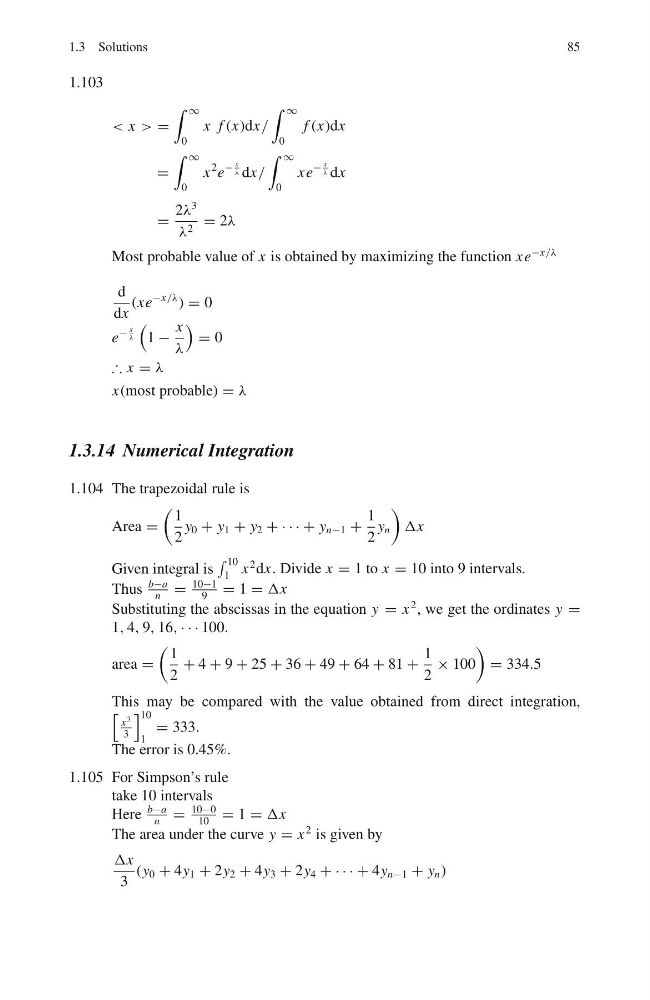
1.103
< x > =
∞
0
x f (x)dx/
∞
0
f (x)dx
=
∞
0
x
2 e
−
x
λ dx/
∞
0
xe
−
x
λ dx
=
2λ
3
λ 2 = 2λ
Most probable value of x is obtained by maximizing the function xe
−x/λ
d
dx
(xe
−x/λ ) = 0
e
−
x
λ
1 −
x
λ
= 0
∴ x = λ
x(most probable) = λ
1.3.14 Numerical Integration
1.104 The trapezoidal rule is
Area =
1
2
y 0 + y 1 + y 2 + · · · + y n−1 +
1
2
y n
Δx
Given integral is
10
1 x
2 dx. Divide x = 1 to x = 10 into 9 intervals.
Thus
b−a
n
=
10−1
9
= 1 = Δx
Substituting the abscissas in the equation y = x
2 , we get the ordinates y =
1, 4, 9, 16, · · · 100.
area =
1
2
+ 4 + 9 + 25 + 36 + 49 + 64 + 81 +
1
2
× 100
= 334.5
This may be compared with the value obtained from direct integration,
x
3
3
10
1
= 333.
The error is 0.45%.
1.105 For Simpson’s rule
take 10 intervals
Here
b−a
n
=
10−0
10
= 1 = Δx
The area under the curve y = x
2 is given by
Δx
3
(y 0 + 4y 1 + 2y 2 + 4y 3 + 2y 4 + · · · + 4y n−1 + y n )
85
1.103
< x > =
∞
0
x f (x)dx/
∞
0
f (x)dx
=
∞
0
x
2 e
−
x
λ dx/
∞
0
xe
−
x
λ dx
=
2λ
3
λ 2 = 2λ
Most probable value of x is obtained by maximizing the function xe
−x/λ
d
dx
(xe
−x/λ ) = 0
e
−
x
λ
1 −
x
λ
= 0
∴ x = λ
x(most probable) = λ
1.3.14 Numerical Integration
1.104 The trapezoidal rule is
Area =
1
2
y 0 + y 1 + y 2 + · · · + y n−1 +
1
2
y n
Δx
Given integral is
10
1 x
2 dx. Divide x = 1 to x = 10 into 9 intervals.
Thus
b−a
n
=
10−1
9
= 1 = Δx
Substituting the abscissas in the equation y = x
2 , we get the ordinates y =
1, 4, 9, 16, · · · 100.
area =
1
2
+ 4 + 9 + 25 + 36 + 49 + 64 + 81 +
1
2
× 100
= 334.5
This may be compared with the value obtained from direct integration,
x
3
3
10
1
= 333.
The error is 0.45%.
1.105 For Simpson’s rule
take 10 intervals
Here
b−a
n
=
10−0
10
= 1 = Δx
The area under the curve y = x
2 is given by
Δx
3
(y 0 + 4y 1 + 2y 2 + 4y 3 + 2y 4 + · · · + 4y n−1 + y n )