

11 Forces in the Standard Model and Symmetries
81
11.3 Symmetries and Symmetry Breaking
What is a symmetry? In any environment around us we see a lot of situations
which display symmetries, meaning the system looks the same when looked at
in different ways. As a simple example, if you are driving along the road and
see a stop sign, it is an eight-sided red polygon with the word “STOP” written
horizontally in the middle. Suppose they put up a stop sign without the word
“STOP,” then the red polygon would look the same. It will still have symmetry
when you rotate it by 45
◦ in either direction, as well as if you flip it back and
forth along any line joining the middle of two opposite sides. The no “STOP”
stop sign has many symmetries. On the other hand, as soon as you put the
word “STOP” in the middle as in a regular stop sign, the symmetry is broken.
If you now rotate the stop sign by 45
◦ , the word “STOP” also rotates and makes
the sign look different, i.e. it is not the same as before and that means there is
no symmetry. This situation in physics is called “symmetry breaking,” i.e. the
symmetry of the eight-sided stop sign is broken by the letter “STOP.” Both
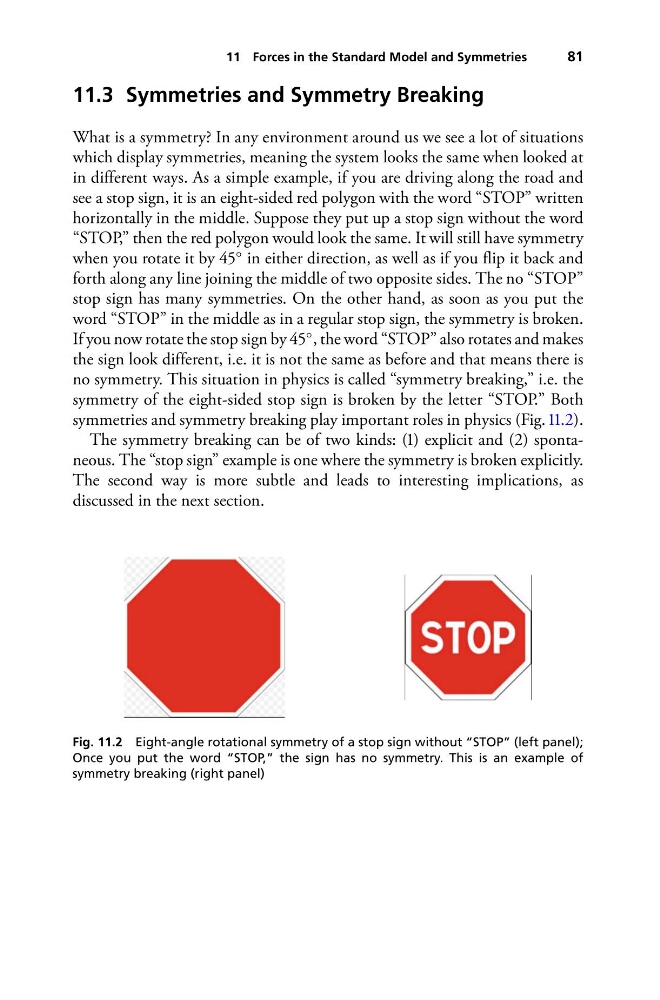
symmetries and symmetry breaking play important roles in physics (Fig. 11.2).
The symmetry breaking can be of two kinds: (1) explicit and (2) spontaneous. The “stop sign” example is one where the symmetry is broken explicitly.
The second way is more subtle and leads to interesting implications, as
discussed in the next section.
Fig. 11.2 Eight-angle rotational symmetry of a stop sign without “STOP” (left panel);
Once you put the word “STOP,” the sign has no symmetry. This is an example of
symmetry breaking (right panel)
81
11.3 Symmetries and Symmetry Breaking
What is a symmetry? In any environment around us we see a lot of situations
which display symmetries, meaning the system looks the same when looked at
in different ways. As a simple example, if you are driving along the road and
see a stop sign, it is an eight-sided red polygon with the word “STOP” written
horizontally in the middle. Suppose they put up a stop sign without the word
“STOP,” then the red polygon would look the same. It will still have symmetry
when you rotate it by 45
◦ in either direction, as well as if you flip it back and
forth along any line joining the middle of two opposite sides. The no “STOP”
stop sign has many symmetries. On the other hand, as soon as you put the
word “STOP” in the middle as in a regular stop sign, the symmetry is broken.
If you now rotate the stop sign by 45
◦ , the word “STOP” also rotates and makes
the sign look different, i.e. it is not the same as before and that means there is
no symmetry. This situation in physics is called “symmetry breaking,” i.e. the
symmetry of the eight-sided stop sign is broken by the letter “STOP.” Both
symmetries and symmetry breaking play important roles in physics (Fig. 11.2).
The symmetry breaking can be of two kinds: (1) explicit and (2) spontaneous. The “stop sign” example is one where the symmetry is broken explicitly.
The second way is more subtle and leads to interesting implications, as
discussed in the next section.
Fig. 11.2 Eight-angle rotational symmetry of a stop sign without “STOP” (left panel);
Once you put the word “STOP,” the sign has no symmetry. This is an example of
symmetry breaking (right panel)