

10 Standard Model of the Particles and Forces
75
u
d
p
p –
s
u
d
d
u
0
u
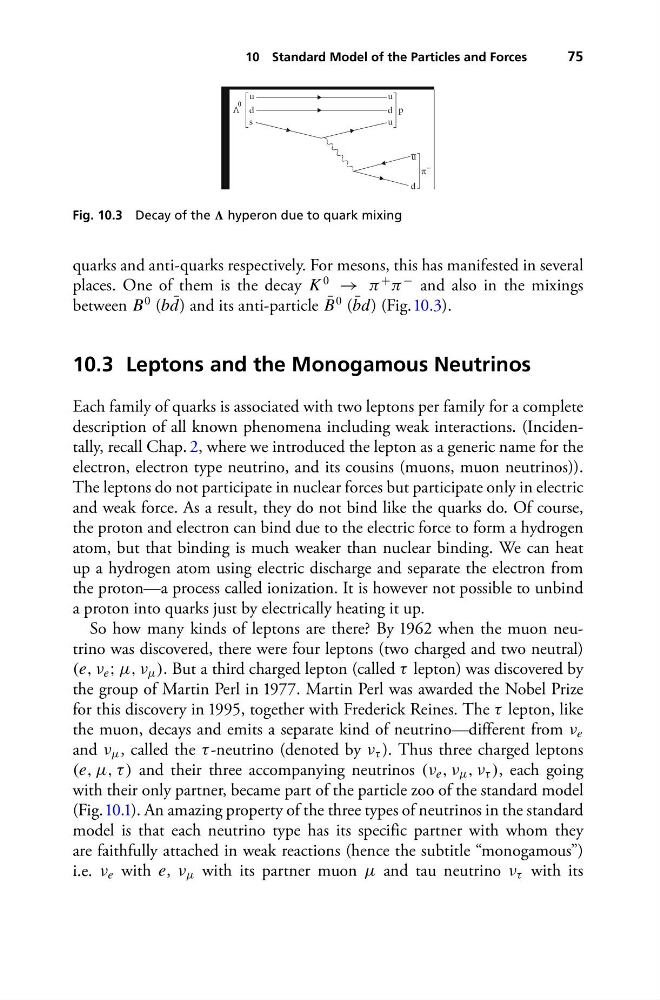
Fig. 10.3 Decay of the hyperon due to quark mixing
quarks and anti-quarks respectively. For mesons, this has manifested in several
places. One of them is the decay K
0
→ π
+ π
− and also in the mixings
between B
0 (b ¯
d) and its anti-particle ¯
B
0 ( ¯
bd) (Fig. 10.3).
10.3 Leptons and the Monogamous Neutrinos
Each family of quarks is associated with two leptons per family for a complete
description of all known phenomena including weak interactions. (Incidentally, recall Chap. 2, where we introduced the lepton as a generic name for the
electron, electron type neutrino, and its cousins (muons, muon neutrinos)).
The leptons do not participate in nuclear forces but participate only in electric
and weak force. As a result, they do not bind like the quarks do. Of course,
the proton and electron can bind due to the electric force to form a hydrogen
atom, but that binding is much weaker than nuclear binding. We can heat
up a hydrogen atom using electric discharge and separate the electron from
the proton—a process called ionization. It is however not possible to unbind
a proton into quarks just by electrically heating it up.
So how many kinds of leptons are there? By 1962 when the muon neutrino was discovered, there were four leptons (two charged and two neutral)
(e, ν e ; μ, ν μ ). But a third charged lepton (called τ lepton) was discovered by
the group of Martin Perl in 1977. Martin Perl was awarded the Nobel Prize
for this discovery in 1995, together with Frederick Reines. The τ lepton, like
the muon, decays and emits a separate kind of neutrino—different from ν e
and ν μ , called the τ -neutrino (denoted by ν τ ). Thus three charged leptons
(e, μ, τ ) and their three accompanying neutrinos (ν e , ν μ , ν τ ), each going
with their only partner, became part of the particle zoo of the standard model
(Fig. 10.1). An amazing property of the three types of neutrinos in the standard
model is that each neutrino type has its specific partner with whom they
are faithfully attached in weak reactions (hence the subtitle “monogamous”)
i.e. ν e with e, ν μ with its partner muon μ and tau neutrino ν τ with its
75
u
d
p
p –
s
u
d
d
u
0
u
Fig. 10.3 Decay of the hyperon due to quark mixing
quarks and anti-quarks respectively. For mesons, this has manifested in several
places. One of them is the decay K
0
→ π
+ π
− and also in the mixings
between B
0 (b ¯
d) and its anti-particle ¯
B
0 ( ¯
bd) (Fig. 10.3).
10.3 Leptons and the Monogamous Neutrinos
Each family of quarks is associated with two leptons per family for a complete
description of all known phenomena including weak interactions. (Incidentally, recall Chap. 2, where we introduced the lepton as a generic name for the
electron, electron type neutrino, and its cousins (muons, muon neutrinos)).
The leptons do not participate in nuclear forces but participate only in electric
and weak force. As a result, they do not bind like the quarks do. Of course,
the proton and electron can bind due to the electric force to form a hydrogen
atom, but that binding is much weaker than nuclear binding. We can heat
up a hydrogen atom using electric discharge and separate the electron from
the proton—a process called ionization. It is however not possible to unbind
a proton into quarks just by electrically heating it up.
So how many kinds of leptons are there? By 1962 when the muon neutrino was discovered, there were four leptons (two charged and two neutral)
(e, ν e ; μ, ν μ ). But a third charged lepton (called τ lepton) was discovered by
the group of Martin Perl in 1977. Martin Perl was awarded the Nobel Prize
for this discovery in 1995, together with Frederick Reines. The τ lepton, like
the muon, decays and emits a separate kind of neutrino—different from ν e
and ν μ , called the τ -neutrino (denoted by ν τ ). Thus three charged leptons
(e, μ, τ ) and their three accompanying neutrinos (ν e , ν μ , ν τ ), each going
with their only partner, became part of the particle zoo of the standard model
(Fig. 10.1). An amazing property of the three types of neutrinos in the standard
model is that each neutrino type has its specific partner with whom they
are faithfully attached in weak reactions (hence the subtitle “monogamous”)
i.e. ν e with e, ν μ with its partner muon μ and tau neutrino ν τ with its