

9 The Neutrino is Discovered
67
Fig. 9.3 T. D. Lee and C. N. Yang, who proposed that weak interactions violate mirror
symmetry (parity)
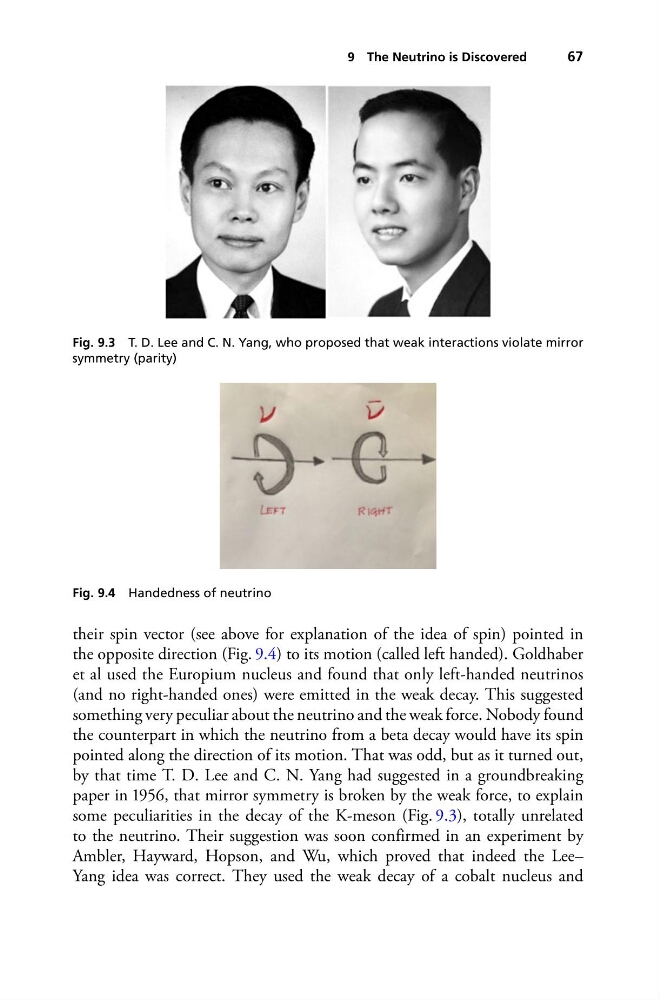
Fig. 9.4 Handedness of neutrino
their spin vector (see above for explanation of the idea of spin) pointed in
the opposite direction (Fig. 9.4) to its motion (called left handed). Goldhaber
et al used the Europium nucleus and found that only left-handed neutrinos
(and no right-handed ones) were emitted in the weak decay. This suggested
something very peculiar about the neutrino and the weak force. Nobody found
the counterpart in which the neutrino from a beta decay would have its spin
pointed along the direction of its motion. That was odd, but as it turned out,
by that time T. D. Lee and C. N. Yang had suggested in a groundbreaking
paper in 1956, that mirror symmetry is broken by the weak force, to explain
some peculiarities in the decay of the K-meson (Fig. 9.3), totally unrelated
to the neutrino. Their suggestion was soon confirmed in an experiment by
Ambler, Hayward, Hopson, and Wu, which proved that indeed the Lee–
Yang idea was correct. They used the weak decay of a cobalt nucleus and
67
Fig. 9.3 T. D. Lee and C. N. Yang, who proposed that weak interactions violate mirror
symmetry (parity)
Fig. 9.4 Handedness of neutrino
their spin vector (see above for explanation of the idea of spin) pointed in
the opposite direction (Fig. 9.4) to its motion (called left handed). Goldhaber
et al used the Europium nucleus and found that only left-handed neutrinos
(and no right-handed ones) were emitted in the weak decay. This suggested
something very peculiar about the neutrino and the weak force. Nobody found
the counterpart in which the neutrino from a beta decay would have its spin
pointed along the direction of its motion. That was odd, but as it turned out,
by that time T. D. Lee and C. N. Yang had suggested in a groundbreaking
paper in 1956, that mirror symmetry is broken by the weak force, to explain
some peculiarities in the decay of the K-meson (Fig. 9.3), totally unrelated
to the neutrino. Their suggestion was soon confirmed in an experiment by
Ambler, Hayward, Hopson, and Wu, which proved that indeed the Lee–
Yang idea was correct. They used the weak decay of a cobalt nucleus and