

4 Order in the Zoo and Quarks
29
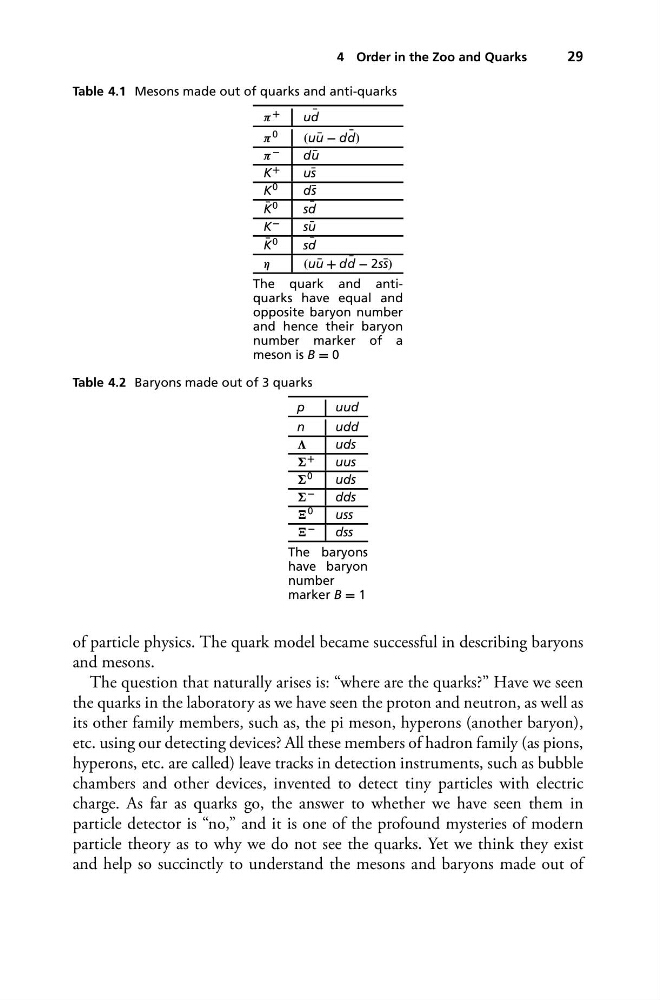
Table 4.1 Mesons made out of quarks and anti-quarks
π +
u ¯
d
π 0
(u ¯
u − d ¯
d)
π −
d ¯
u
K +
u¯ s
K 0
d¯ s
¯
K 0
s ¯
d
K −
s ¯
u
¯
K 0
s ¯
d
η
(u ¯
u + d ¯
d − 2s¯ s)
The quark and antiquarks have equal and
opposite baryon number
and hence their baryon
number marker of a
meson is B = 0
Table 4.2 Baryons made out of 3 quarks
p
uud
n
udd
uds
+
uus
0
uds
−
dds
0
uss
−
dss
The baryons
have baryon
number
marker B = 1
of particle physics. The quark model became successful in describing baryons
and mesons.
The question that naturally arises is: “where are the quarks?” Have we seen
the quarks in the laboratory as we have seen the proton and neutron, as well as
its other family members, such as, the pi meson, hyperons (another baryon),
etc. using our detecting devices? All these members of hadron family (as pions,
hyperons, etc. are called) leave tracks in detection instruments, such as bubble
chambers and other devices, invented to detect tiny particles with electric
charge. As far as quarks go, the answer to whether we have seen them in
particle detector is “no,” and it is one of the profound mysteries of modern
particle theory as to why we do not see the quarks. Yet we think they exist
and help so succinctly to understand the mesons and baryons made out of
29
Table 4.1 Mesons made out of quarks and anti-quarks
π +
u ¯
d
π 0
(u ¯
u − d ¯
d)
π −
d ¯
u
K +
u¯ s
K 0
d¯ s
¯
K 0
s ¯
d
K −
s ¯
u
¯
K 0
s ¯
d
η
(u ¯
u + d ¯
d − 2s¯ s)
The quark and antiquarks have equal and
opposite baryon number
and hence their baryon
number marker of a
meson is B = 0
Table 4.2 Baryons made out of 3 quarks
p
uud
n
udd
uds
+
uus
0
uds
−
dds
0
uss
−
dss
The baryons
have baryon
number
marker B = 1
of particle physics. The quark model became successful in describing baryons
and mesons.
The question that naturally arises is: “where are the quarks?” Have we seen
the quarks in the laboratory as we have seen the proton and neutron, as well as
its other family members, such as, the pi meson, hyperons (another baryon),
etc. using our detecting devices? All these members of hadron family (as pions,
hyperons, etc. are called) leave tracks in detection instruments, such as bubble
chambers and other devices, invented to detect tiny particles with electric
charge. As far as quarks go, the answer to whether we have seen them in
particle detector is “no,” and it is one of the profound mysteries of modern
particle theory as to why we do not see the quarks. Yet we think they exist
and help so succinctly to understand the mesons and baryons made out of