

26 Anthropic Principle
201
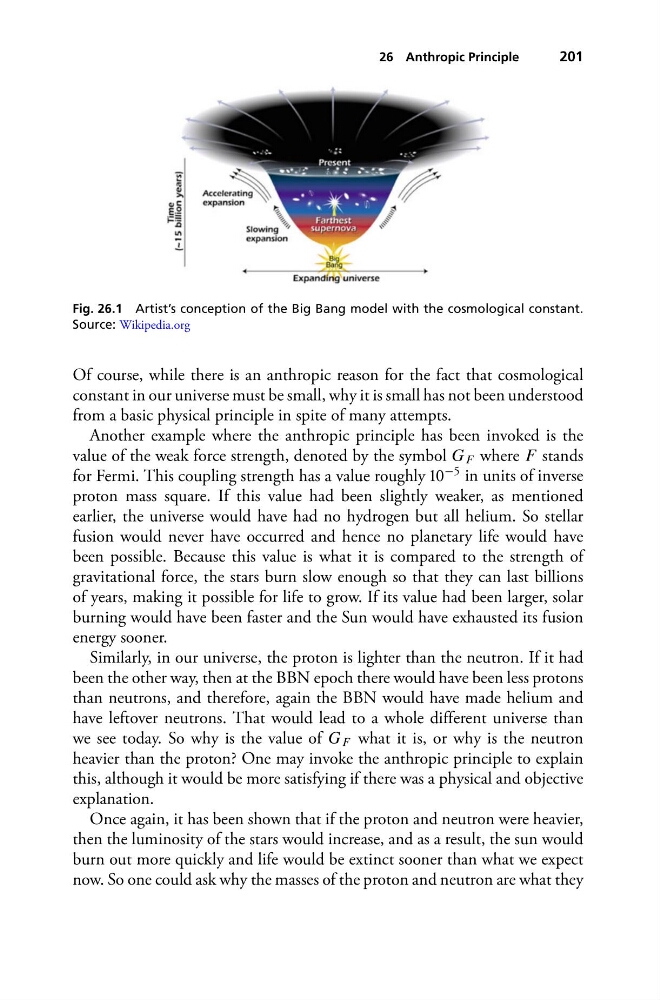
Fig. 26.1 Artist’s conception of the Big Bang model with the cosmological constant.
Source: Wikipedia.org
Of course, while there is an anthropic reason for the fact that cosmological
constant in our universe must be small, why it is small has not been understood
from a basic physical principle in spite of many attempts.
Another example where the anthropic principle has been invoked is the
value of the weak force strength, denoted by the symbol G F where F stands
for Fermi. This coupling strength has a value roughly 10
−5 in units of inverse
proton mass square. If this value had been slightly weaker, as mentioned
earlier, the universe would have had no hydrogen but all helium. So stellar
fusion would never have occurred and hence no planetary life would have
been possible. Because this value is what it is compared to the strength of
gravitational force, the stars burn slow enough so that they can last billions
of years, making it possible for life to grow. If its value had been larger, solar
burning would have been faster and the Sun would have exhausted its fusion
energy sooner.
Similarly, in our universe, the proton is lighter than the neutron. If it had
been the other way, then at the BBN epoch there would have been less protons
than neutrons, and therefore, again the BBN would have made helium and
have leftover neutrons. That would lead to a whole different universe than
we see today. So why is the value of G F what it is, or why is the neutron
heavier than the proton? One may invoke the anthropic principle to explain
this, although it would be more satisfying if there was a physical and objective
explanation.
Once again, it has been shown that if the proton and neutron were heavier,
then the luminosity of the stars would increase, and as a result, the sun would
burn out more quickly and life would be extinct sooner than what we expect
now. So one could ask why the masses of the proton and neutron are what they
201
Fig. 26.1 Artist’s conception of the Big Bang model with the cosmological constant.
Source: Wikipedia.org
Of course, while there is an anthropic reason for the fact that cosmological
constant in our universe must be small, why it is small has not been understood
from a basic physical principle in spite of many attempts.
Another example where the anthropic principle has been invoked is the
value of the weak force strength, denoted by the symbol G F where F stands
for Fermi. This coupling strength has a value roughly 10
−5 in units of inverse
proton mass square. If this value had been slightly weaker, as mentioned
earlier, the universe would have had no hydrogen but all helium. So stellar
fusion would never have occurred and hence no planetary life would have
been possible. Because this value is what it is compared to the strength of
gravitational force, the stars burn slow enough so that they can last billions
of years, making it possible for life to grow. If its value had been larger, solar
burning would have been faster and the Sun would have exhausted its fusion
energy sooner.
Similarly, in our universe, the proton is lighter than the neutron. If it had
been the other way, then at the BBN epoch there would have been less protons
than neutrons, and therefore, again the BBN would have made helium and
have leftover neutrons. That would lead to a whole different universe than
we see today. So why is the value of G F what it is, or why is the neutron
heavier than the proton? One may invoke the anthropic principle to explain
this, although it would be more satisfying if there was a physical and objective
explanation.
Once again, it has been shown that if the proton and neutron were heavier,
then the luminosity of the stars would increase, and as a result, the sun would
burn out more quickly and life would be extinct sooner than what we expect
now. So one could ask why the masses of the proton and neutron are what they