

24 Dark Universe
181
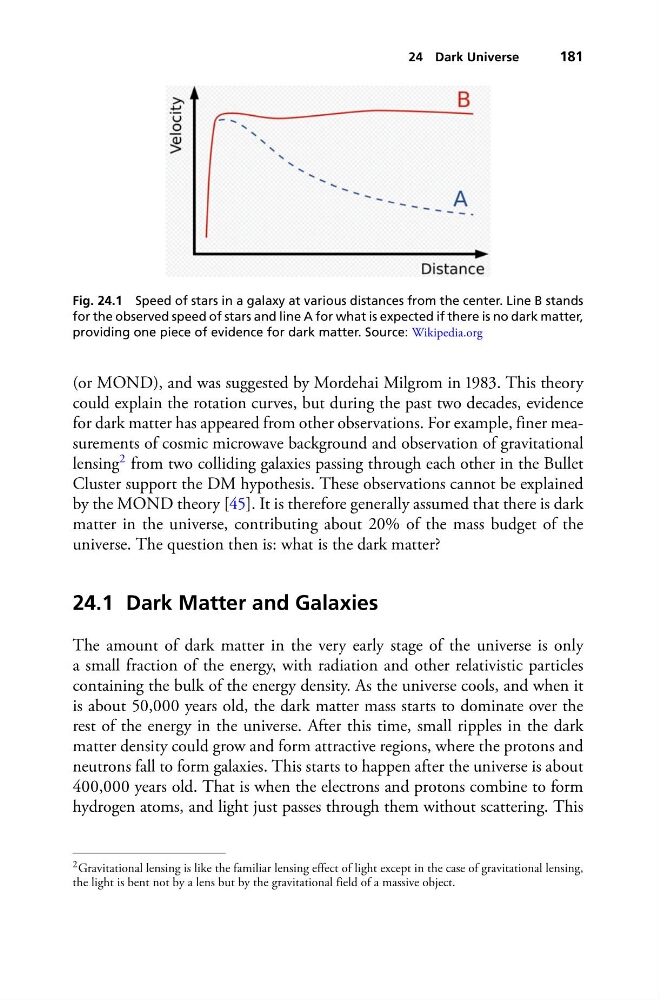
Fig. 24.1 Speed of stars in a galaxy at various distances from the center. Line B stands
for the observed speed of stars and line A for what is expected if there is no dark matter,
providing one piece of evidence for dark matter. Source: Wikipedia.org
(or MOND), and was suggested by Mordehai Milgrom in 1983. This theory
could explain the rotation curves, but during the past two decades, evidence
for dark matter has appeared from other observations. For example, finer measurements of cosmic microwave background and observation of gravitational
lensing
2 from two colliding galaxies passing through each other in the Bullet
Cluster support the DM hypothesis. These observations cannot be explained
by the MOND theory [45]. It is therefore generally assumed that there is dark
matter in the universe, contributing about 20% of the mass budget of the
universe. The question then is: what is the dark matter?
24.1 Dark Matter and Galaxies
The amount of dark matter in the very early stage of the universe is only
a small fraction of the energy, with radiation and other relativistic particles
containing the bulk of the energy density. As the universe cools, and when it
is about 50,000 years old, the dark matter mass starts to dominate over the
rest of the energy in the universe. After this time, small ripples in the dark
matter density could grow and form attractive regions, where the protons and
neutrons fall to form galaxies. This starts to happen after the universe is about
400,000 years old. That is when the electrons and protons combine to form
hydrogen atoms, and light just passes through them without scattering. This
2 Gravitational lensing is like the familiar lensing effect of light except in the case of gravitational lensing,
the light is bent not by a lens but by the gravitational field of a massive object.
181
Fig. 24.1 Speed of stars in a galaxy at various distances from the center. Line B stands
for the observed speed of stars and line A for what is expected if there is no dark matter,
providing one piece of evidence for dark matter. Source: Wikipedia.org
(or MOND), and was suggested by Mordehai Milgrom in 1983. This theory
could explain the rotation curves, but during the past two decades, evidence
for dark matter has appeared from other observations. For example, finer measurements of cosmic microwave background and observation of gravitational
lensing
2 from two colliding galaxies passing through each other in the Bullet
Cluster support the DM hypothesis. These observations cannot be explained
by the MOND theory [45]. It is therefore generally assumed that there is dark
matter in the universe, contributing about 20% of the mass budget of the
universe. The question then is: what is the dark matter?
24.1 Dark Matter and Galaxies
The amount of dark matter in the very early stage of the universe is only
a small fraction of the energy, with radiation and other relativistic particles
containing the bulk of the energy density. As the universe cools, and when it
is about 50,000 years old, the dark matter mass starts to dominate over the
rest of the energy in the universe. After this time, small ripples in the dark
matter density could grow and form attractive regions, where the protons and
neutrons fall to form galaxies. This starts to happen after the universe is about
400,000 years old. That is when the electrons and protons combine to form
hydrogen atoms, and light just passes through them without scattering. This
2 Gravitational lensing is like the familiar lensing effect of light except in the case of gravitational lensing,
the light is bent not by a lens but by the gravitational field of a massive object.