

23 The Origin of Matter and Neutrinos
177
23.3 Neutrino Seesaw and Baryon Asymmetry
Is there a connection between neutrinos and the matter–anti-matter asymmetry? It was pointed out in 1986 [52] that proton decay may not be a key
ingredient in the generation of this asymmetry. Instead, the seesaw picture
of neutrino masses discussed above may present a simple way to produce
matter–anti-matter asymmetry. It arises from the decay of the heavy righthanded neutrinos. Since the heavy right-handed neutrinos are their own
anti-particles (or are Majorana fermions), the lightest of them can decay to
produce both leptons with Higgs bosons and anti-leptons with the anti-Higgs
boson. In combination with matter–anti-matter asymmetric (CP violating)
forces present in the right-handed neutrino decay, leptons and anti-leptons
will appear in different numbers i.e. there will be a lepton asymmetry. The
conversion of the lepton excess to baryon excess comes from a different source.
Fortunately, it comes from a theoretical possibility that exists in the standard
model.
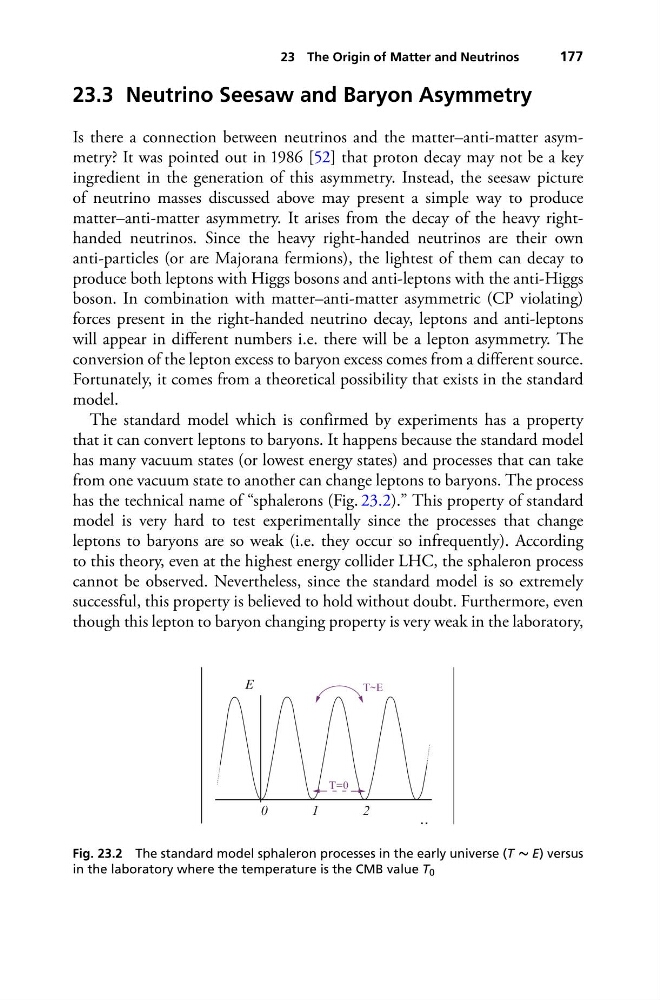
The standard model which is confirmed by experiments has a property
that it can convert leptons to baryons. It happens because the standard model
has many vacuum states (or lowest energy states) and processes that can take
from one vacuum state to another can change leptons to baryons. The process
has the technical name of “sphalerons (Fig. 23.2).” This property of standard
model is very hard to test experimentally since the processes that change
leptons to baryons are so weak (i.e. they occur so infrequently). According
to this theory, even at the highest energy collider LHC, the sphaleron process
cannot be observed. Nevertheless, since the standard model is so extremely
successful, this property is believed to hold without doubt. Furthermore, even
though this lepton to baryon changing property is very weak in the laboratory,
E
0
1
T=0
..
T~E
2
Fig. 23.2 The standard model sphaleron processes in the early universe (T ∼ E) versus
in the laboratory where the temperature is the CMB value T 0
177
23.3 Neutrino Seesaw and Baryon Asymmetry
Is there a connection between neutrinos and the matter–anti-matter asymmetry? It was pointed out in 1986 [52] that proton decay may not be a key
ingredient in the generation of this asymmetry. Instead, the seesaw picture
of neutrino masses discussed above may present a simple way to produce
matter–anti-matter asymmetry. It arises from the decay of the heavy righthanded neutrinos. Since the heavy right-handed neutrinos are their own
anti-particles (or are Majorana fermions), the lightest of them can decay to
produce both leptons with Higgs bosons and anti-leptons with the anti-Higgs
boson. In combination with matter–anti-matter asymmetric (CP violating)
forces present in the right-handed neutrino decay, leptons and anti-leptons
will appear in different numbers i.e. there will be a lepton asymmetry. The
conversion of the lepton excess to baryon excess comes from a different source.
Fortunately, it comes from a theoretical possibility that exists in the standard
model.
The standard model which is confirmed by experiments has a property
that it can convert leptons to baryons. It happens because the standard model
has many vacuum states (or lowest energy states) and processes that can take
from one vacuum state to another can change leptons to baryons. The process
has the technical name of “sphalerons (Fig. 23.2).” This property of standard
model is very hard to test experimentally since the processes that change
leptons to baryons are so weak (i.e. they occur so infrequently). According
to this theory, even at the highest energy collider LHC, the sphaleron process
cannot be observed. Nevertheless, since the standard model is so extremely
successful, this property is believed to hold without doubt. Furthermore, even
though this lepton to baryon changing property is very weak in the laboratory,
E
0
1
T=0
..
T~E
2
Fig. 23.2 The standard model sphaleron processes in the early universe (T ∼ E) versus
in the laboratory where the temperature is the CMB value T 0