

168
R. N. Mohapatra
0
0
10
20
30
40
50
60
5
1/a 1
MSSM
1/a 2
1/a 3
10
15
10 log Q
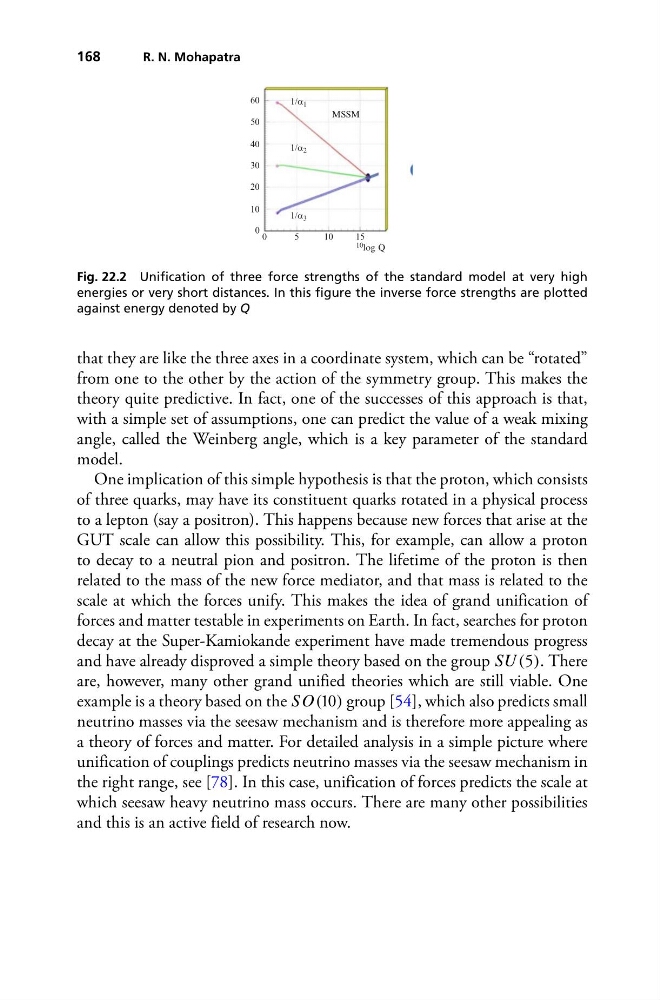
Fig. 22.2 Unification of three force strengths of the standard model at very high
energies or very short distances. In this figure the inverse force strengths are plotted
against energy denoted by Q
that they are like the three axes in a coordinate system, which can be “rotated”
from one to the other by the action of the symmetry group. This makes the
theory quite predictive. In fact, one of the successes of this approach is that,
with a simple set of assumptions, one can predict the value of a weak mixing
angle, called the Weinberg angle, which is a key parameter of the standard
model.
One implication of this simple hypothesis is that the proton, which consists
of three quarks, may have its constituent quarks rotated in a physical process
to a lepton (say a positron). This happens because new forces that arise at the
GUT scale can allow this possibility. This, for example, can allow a proton
to decay to a neutral pion and positron. The lifetime of the proton is then
related to the mass of the new force mediator, and that mass is related to the
scale at which the forces unify. This makes the idea of grand unification of
forces and matter testable in experiments on Earth. In fact, searches for proton
decay at the Super-Kamiokande experiment have made tremendous progress
and have already disproved a simple theory based on the group SU (5). There
are, however, many other grand unified theories which are still viable. One
example is a theory based on the SO(10) group [54], which also predicts small
neutrino masses via the seesaw mechanism and is therefore more appealing as
a theory of forces and matter. For detailed analysis in a simple picture where
unification of couplings predicts neutrino masses via the seesaw mechanism in
the right range, see [78]. In this case, unification of forces predicts the scale at
which seesaw heavy neutrino mass occurs. There are many other possibilities
and this is an active field of research now.
R. N. Mohapatra
0
0
10
20
30
40
50
60
5
1/a 1
MSSM
1/a 2
1/a 3
10
15
10 log Q
Fig. 22.2 Unification of three force strengths of the standard model at very high
energies or very short distances. In this figure the inverse force strengths are plotted
against energy denoted by Q
that they are like the three axes in a coordinate system, which can be “rotated”
from one to the other by the action of the symmetry group. This makes the
theory quite predictive. In fact, one of the successes of this approach is that,
with a simple set of assumptions, one can predict the value of a weak mixing
angle, called the Weinberg angle, which is a key parameter of the standard
model.
One implication of this simple hypothesis is that the proton, which consists
of three quarks, may have its constituent quarks rotated in a physical process
to a lepton (say a positron). This happens because new forces that arise at the
GUT scale can allow this possibility. This, for example, can allow a proton
to decay to a neutral pion and positron. The lifetime of the proton is then
related to the mass of the new force mediator, and that mass is related to the
scale at which the forces unify. This makes the idea of grand unification of
forces and matter testable in experiments on Earth. In fact, searches for proton
decay at the Super-Kamiokande experiment have made tremendous progress
and have already disproved a simple theory based on the group SU (5). There
are, however, many other grand unified theories which are still viable. One
example is a theory based on the SO(10) group [54], which also predicts small
neutrino masses via the seesaw mechanism and is therefore more appealing as
a theory of forces and matter. For detailed analysis in a simple picture where
unification of couplings predicts neutrino masses via the seesaw mechanism in
the right range, see [78]. In this case, unification of forces predicts the scale at
which seesaw heavy neutrino mass occurs. There are many other possibilities
and this is an active field of research now.