

21 Mirror Symmetric Weak Force and Neutrino Mass
161
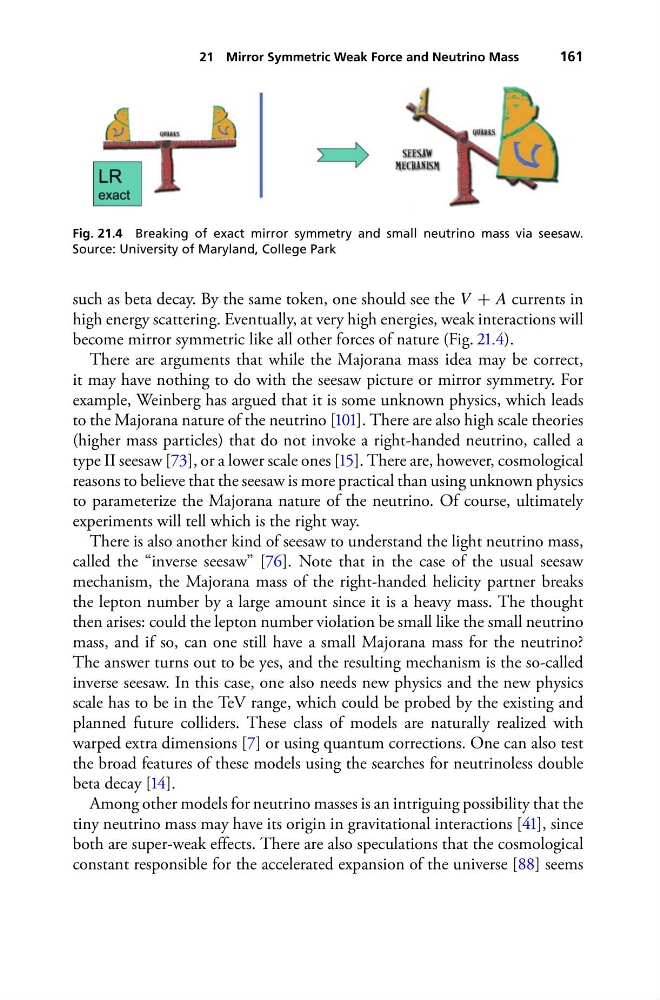
Fig. 21.4 Breaking of exact mirror symmetry and small neutrino mass via seesaw.
Source: University of Maryland, College Park
such as beta decay. By the same token, one should see the V + A currents in
high energy scattering. Eventually, at very high energies, weak interactions will
become mirror symmetric like all other forces of nature (Fig. 21.4).
There are arguments that while the Majorana mass idea may be correct,
it may have nothing to do with the seesaw picture or mirror symmetry. For
example, Weinberg has argued that it is some unknown physics, which leads
to the Majorana nature of the neutrino [101]. There are also high scale theories
(higher mass particles) that do not invoke a right-handed neutrino, called a
type II seesaw [73], or a lower scale ones [15]. There are, however, cosmological
reasons to believe that the seesaw is more practical than using unknown physics
to parameterize the Majorana nature of the neutrino. Of course, ultimately
experiments will tell which is the right way.
There is also another kind of seesaw to understand the light neutrino mass,
called the “inverse seesaw” [76]. Note that in the case of the usual seesaw
mechanism, the Majorana mass of the right-handed helicity partner breaks
the lepton number by a large amount since it is a heavy mass. The thought
then arises: could the lepton number violation be small like the small neutrino
mass, and if so, can one still have a small Majorana mass for the neutrino?
The answer turns out to be yes, and the resulting mechanism is the so-called
inverse seesaw. In this case, one also needs new physics and the new physics
scale has to be in the TeV range, which could be probed by the existing and
planned future colliders. These class of models are naturally realized with
warped extra dimensions [7] or using quantum corrections. One can also test
the broad features of these models using the searches for neutrinoless double
beta decay [14].
Among other models for neutrino masses is an intriguing possibility that the
tiny neutrino mass may have its origin in gravitational interactions [41], since
both are super-weak effects. There are also speculations that the cosmological
constant responsible for the accelerated expansion of the universe [88] seems
161
Fig. 21.4 Breaking of exact mirror symmetry and small neutrino mass via seesaw.
Source: University of Maryland, College Park
such as beta decay. By the same token, one should see the V + A currents in
high energy scattering. Eventually, at very high energies, weak interactions will
become mirror symmetric like all other forces of nature (Fig. 21.4).
There are arguments that while the Majorana mass idea may be correct,
it may have nothing to do with the seesaw picture or mirror symmetry. For
example, Weinberg has argued that it is some unknown physics, which leads
to the Majorana nature of the neutrino [101]. There are also high scale theories
(higher mass particles) that do not invoke a right-handed neutrino, called a
type II seesaw [73], or a lower scale ones [15]. There are, however, cosmological
reasons to believe that the seesaw is more practical than using unknown physics
to parameterize the Majorana nature of the neutrino. Of course, ultimately
experiments will tell which is the right way.
There is also another kind of seesaw to understand the light neutrino mass,
called the “inverse seesaw” [76]. Note that in the case of the usual seesaw
mechanism, the Majorana mass of the right-handed helicity partner breaks
the lepton number by a large amount since it is a heavy mass. The thought
then arises: could the lepton number violation be small like the small neutrino
mass, and if so, can one still have a small Majorana mass for the neutrino?
The answer turns out to be yes, and the resulting mechanism is the so-called
inverse seesaw. In this case, one also needs new physics and the new physics
scale has to be in the TeV range, which could be probed by the existing and
planned future colliders. These class of models are naturally realized with
warped extra dimensions [7] or using quantum corrections. One can also test
the broad features of these models using the searches for neutrinoless double
beta decay [14].
Among other models for neutrino masses is an intriguing possibility that the
tiny neutrino mass may have its origin in gravitational interactions [41], since
both are super-weak effects. There are also speculations that the cosmological
constant responsible for the accelerated expansion of the universe [88] seems