

18 From Quarks to Protons and Neutrons...
137
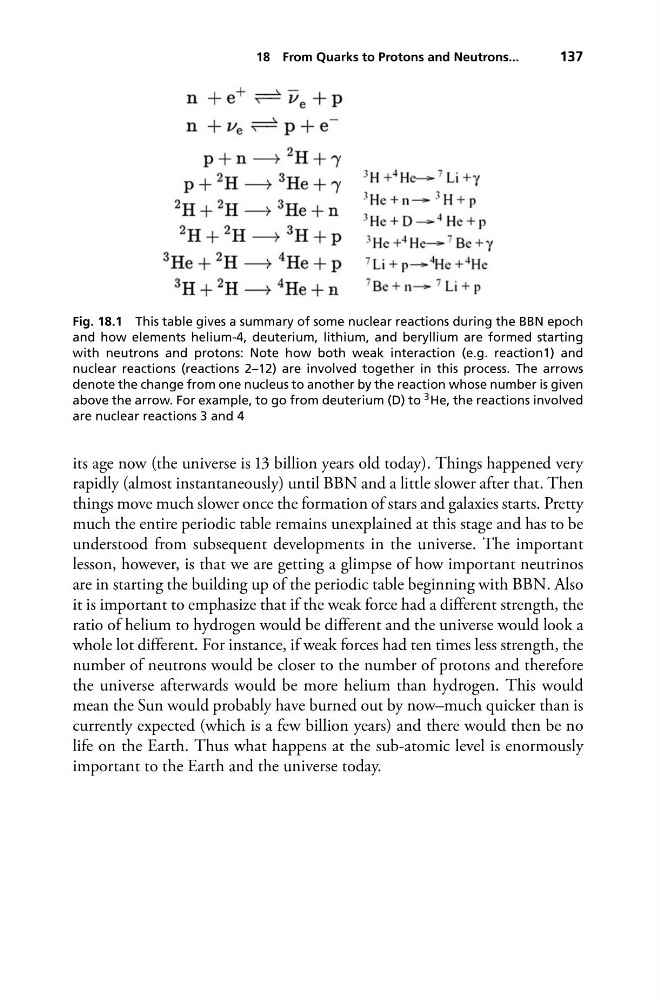
Fig. 18.1 This table gives a summary of some nuclear reactions during the BBN epoch
and how elements helium-4, deuterium, lithium, and beryllium are formed starting
with neutrons and protons: Note how both weak interaction (e.g. reaction1) and
nuclear reactions (reactions 2–12) are involved together in this process. The arrows
denote the change from one nucleus to another by the reaction whose number is given
above the arrow. For example, to go from deuterium (D) to 3 He, the reactions involved
are nuclear reactions 3 and 4
its age now (the universe is 13 billion years old today). Things happened very
rapidly (almost instantaneously) until BBN and a little slower after that. Then
things move much slower once the formation of stars and galaxies starts. Pretty
much the entire periodic table remains unexplained at this stage and has to be
understood from subsequent developments in the universe. The important
lesson, however, is that we are getting a glimpse of how important neutrinos
are in starting the building up of the periodic table beginning with BBN. Also
it is important to emphasize that if the weak force had a different strength, the
ratio of helium to hydrogen would be different and the universe would look a
whole lot different. For instance, if weak forces had ten times less strength, the
number of neutrons would be closer to the number of protons and therefore
the universe afterwards would be more helium than hydrogen. This would
mean the Sun would probably have burned out by now–much quicker than is
currently expected (which is a few billion years) and there would then be no
life on the Earth. Thus what happens at the sub-atomic level is enormously
important to the Earth and the universe today.
137
Fig. 18.1 This table gives a summary of some nuclear reactions during the BBN epoch
and how elements helium-4, deuterium, lithium, and beryllium are formed starting
with neutrons and protons: Note how both weak interaction (e.g. reaction1) and
nuclear reactions (reactions 2–12) are involved together in this process. The arrows
denote the change from one nucleus to another by the reaction whose number is given
above the arrow. For example, to go from deuterium (D) to 3 He, the reactions involved
are nuclear reactions 3 and 4
its age now (the universe is 13 billion years old today). Things happened very
rapidly (almost instantaneously) until BBN and a little slower after that. Then
things move much slower once the formation of stars and galaxies starts. Pretty
much the entire periodic table remains unexplained at this stage and has to be
understood from subsequent developments in the universe. The important
lesson, however, is that we are getting a glimpse of how important neutrinos
are in starting the building up of the periodic table beginning with BBN. Also
it is important to emphasize that if the weak force had a different strength, the
ratio of helium to hydrogen would be different and the universe would look a
whole lot different. For instance, if weak forces had ten times less strength, the
number of neutrons would be closer to the number of protons and therefore
the universe afterwards would be more helium than hydrogen. This would
mean the Sun would probably have burned out by now–much quicker than is
currently expected (which is a few billion years) and there would then be no
life on the Earth. Thus what happens at the sub-atomic level is enormously
important to the Earth and the universe today.