

58
STEREOCHEMISTRY
as is possible. This is when the dihedral angle
between the C–H bonds of the front and rear methyls
is 60
◦ , as exists in the left-hand conformer. This
conformation is termed the staggered conformation.
On the other hand, electronic repulsion will be
greatest when the C–H bonds are aligned, as in the
right-hand conformer. This conformation is termed
the eclipsed conformation. In between these two
extremes there will be other conformers of varying
energies, depending upon the degree of rotation.
Energies for these will be greater than that of
the staggered conformer, but less than that of the
eclipsed conformer. Indeed, if one considers a gradual
rotation about the C–C bond, the energy diagram will
take the form of a sine wave, because rotations of
either 120
◦ or 240
◦ will produce an indistinguishable
conformer of identical energy. This is shown in
Figure 3.1.
It follows that the preferred conformation of ethane
is a staggered one; but, since the energy barrier to
rotation is relatively small, at room temperature there
will be free rotation about the C–C bond.
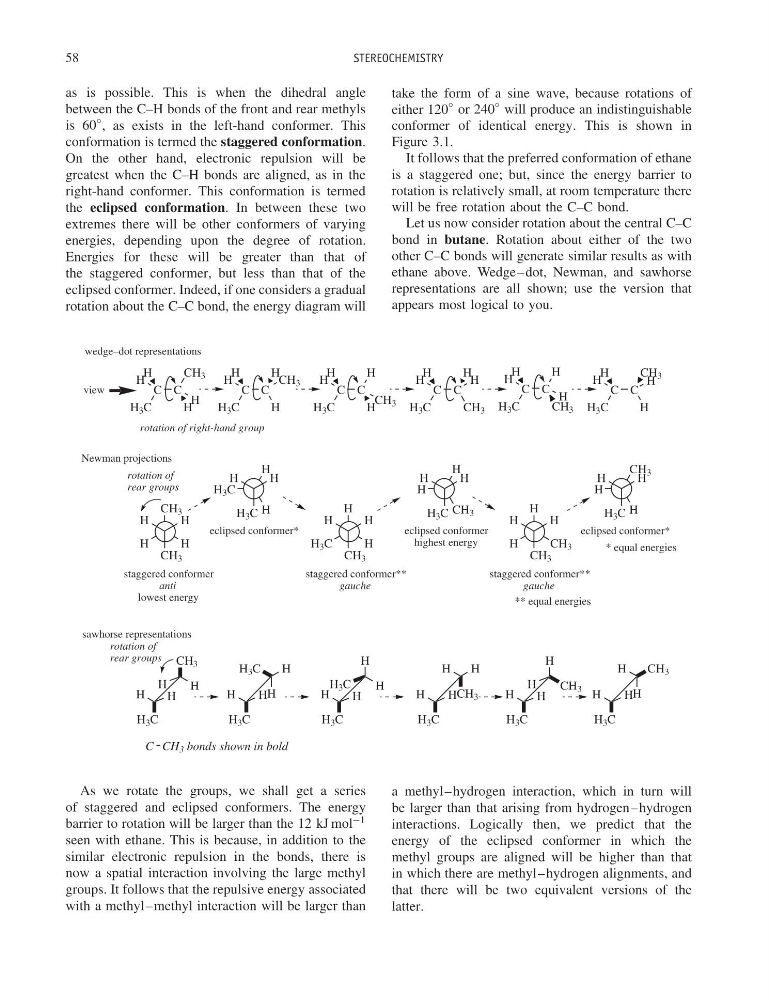
Let us now consider rotation about the central C–C
bond in butane. Rotation about either of the two
other C–C bonds will generate similar results as with
ethane above. Wedge–dot, Newman, and sawhorse
representations are all shown; use the version that
appears most logical to you.
C C
H 3 C
CH 3
H
H
H
H
C C
H 3 C
H
H
H
CH 3
H
C C
H 3 C
H
CH 3
H
H
H
view
staggered conformer
anti
lowest energy
staggered conformer**
gauche
staggered conformer**
gauche
* equal energies
C C
H 3 C
H
H
H
CH 3
H
C C
H 3 C
H
H
H
H
CH 3
C C
H 3 C
H
H
CH 3
H
H
eclipsed conformer*
eclipsed conformer*
eclipsed conformer
highest energy
** equal energies
rotation of
rear groups
CH 3
H
H
H
CH 3
H
H
H 3 C
H
H 3 C
H
H
H
H 3 C
H
H
CH 3
H
CH 3
H
H
H 3 C
H
H
H
H
CH 3
H
CH 3
H
H
H
CH 3
H 3 C
H
H
H 3 C
H
H
H
H
CH 3
H
H
CH 3
H 3 C
H
H
H 3 C
H
H
CH 3
H
H
H
H 3 C
H
H 3 C
H
H
H 3 C
H
H
H
H 3 C
H
CH 3
H
H
H 3 C
H
H
wedge–dot representations
Newman projections
sawhorse representations
rotation of right-hand group
rotation of
rear groups
C CH 3 bonds shown in bold
As we rotate the groups, we shall get a series
of staggered and eclipsed conformers. The energy
barrier to rotation will be larger than the 12 kJ mol
−1
seen with ethane. This is because, in addition to the
similar electronic repulsion in the bonds, there is
now a spatial interaction involving the large methyl
groups. It follows that the repulsive energy associated
with a methyl–methyl interaction will be larger than
a methyl–hydrogen interaction, which in turn will
be larger than that arising from hydrogen–hydrogen
interactions. Logically then, we predict that the
energy of the eclipsed conformer in which the
methyl groups are aligned will be higher than that
in which there are methyl–hydrogen alignments, and
that there will be two equivalent versions of the
latter.
STEREOCHEMISTRY
as is possible. This is when the dihedral angle
between the C–H bonds of the front and rear methyls
is 60
◦ , as exists in the left-hand conformer. This
conformation is termed the staggered conformation.
On the other hand, electronic repulsion will be
greatest when the C–H bonds are aligned, as in the
right-hand conformer. This conformation is termed
the eclipsed conformation. In between these two
extremes there will be other conformers of varying
energies, depending upon the degree of rotation.
Energies for these will be greater than that of
the staggered conformer, but less than that of the
eclipsed conformer. Indeed, if one considers a gradual
rotation about the C–C bond, the energy diagram will
take the form of a sine wave, because rotations of
either 120
◦ or 240
◦ will produce an indistinguishable
conformer of identical energy. This is shown in
Figure 3.1.
It follows that the preferred conformation of ethane
is a staggered one; but, since the energy barrier to
rotation is relatively small, at room temperature there
will be free rotation about the C–C bond.
Let us now consider rotation about the central C–C
bond in butane. Rotation about either of the two
other C–C bonds will generate similar results as with
ethane above. Wedge–dot, Newman, and sawhorse
representations are all shown; use the version that
appears most logical to you.
C C
H 3 C
CH 3
H
H
H
H
C C
H 3 C
H
H
H
CH 3
H
C C
H 3 C
H
CH 3
H
H
H
view
staggered conformer
anti
lowest energy
staggered conformer**
gauche
staggered conformer**
gauche
* equal energies
C C
H 3 C
H
H
H
CH 3
H
C C
H 3 C
H
H
H
H
CH 3
C C
H 3 C
H
H
CH 3
H
H
eclipsed conformer*
eclipsed conformer*
eclipsed conformer
highest energy
** equal energies
rotation of
rear groups
CH 3
H
H
H
CH 3
H
H
H 3 C
H
H 3 C
H
H
H
H 3 C
H
H
CH 3
H
CH 3
H
H
H 3 C
H
H
H
H
CH 3
H
CH 3
H
H
H
CH 3
H 3 C
H
H
H 3 C
H
H
H
H
CH 3
H
H
CH 3
H 3 C
H
H
H 3 C
H
H
CH 3
H
H
H
H 3 C
H
H 3 C
H
H
H 3 C
H
H
H
H 3 C
H
CH 3
H
H
H 3 C
H
H
wedge–dot representations
Newman projections
sawhorse representations
rotation of right-hand group
rotation of
rear groups
C CH 3 bonds shown in bold
As we rotate the groups, we shall get a series
of staggered and eclipsed conformers. The energy
barrier to rotation will be larger than the 12 kJ mol
−1
seen with ethane. This is because, in addition to the
similar electronic repulsion in the bonds, there is
now a spatial interaction involving the large methyl
groups. It follows that the repulsive energy associated
with a methyl–methyl interaction will be larger than
a methyl–hydrogen interaction, which in turn will
be larger than that arising from hydrogen–hydrogen
interactions. Logically then, we predict that the
energy of the eclipsed conformer in which the
methyl groups are aligned will be higher than that
in which there are methyl–hydrogen alignments, and
that there will be two equivalent versions of the
latter.