

56
STEREOCHEMISTRY
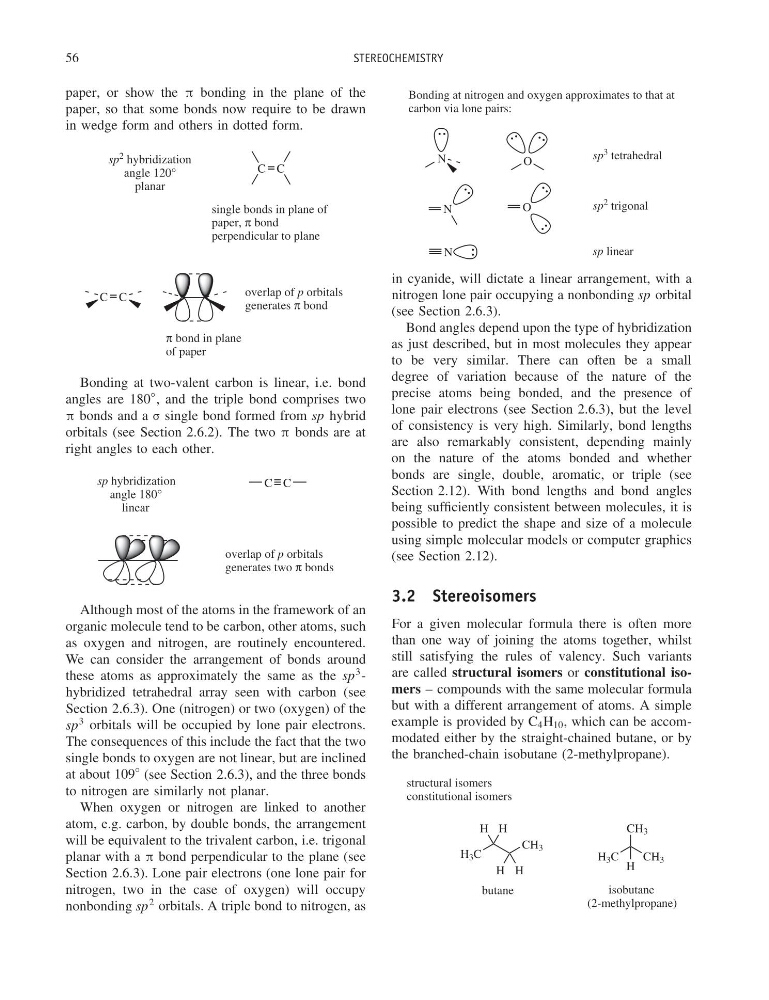
paper, or show the π bonding in the plane of the
paper, so that some bonds now require to be drawn
in wedge form and others in dotted form.
C C
sp 2 hybridization
angle 120°
planar
overlap of p orbitals
generates π bond
C C
single bonds in plane of
paper, π bond
perpendicular to plane
π bond in plane
of paper
Bonding at two-valent carbon is linear, i.e. bond
angles are 180
◦ , and the triple bond comprises two
π bonds and a σ single bond formed from sp hybrid
orbitals (see Section 2.6.2). The two π bonds are at
right angles to each other.
C C
sp hybridization
angle 180°
linear
overlap of p orbitals
generates two π bonds
Although most of the atoms in the framework of an
organic molecule tend to be carbon, other atoms, such
as oxygen and nitrogen, are routinely encountered.
We can consider the arrangement of bonds around
these atoms as approximately the same as the sp
3 -
hybridized tetrahedral array seen with carbon (see
Section 2.6.3). One (nitrogen) or two (oxygen) of the
sp
3 orbitals will be occupied by lone pair electrons.
The consequences of this include the fact that the two
single bonds to oxygen are not linear, but are inclined
at about 109
◦ (see Section 2.6.3), and the three bonds
to nitrogen are similarly not planar.
When oxygen or nitrogen are linked to another
atom, e.g. carbon, by double bonds, the arrangement
will be equivalent to the trivalent carbon, i.e. trigonal
planar with a π bond perpendicular to the plane (see
Section 2.6.3). Lone pair electrons (one lone pair for
nitrogen, two in the case of oxygen) will occupy
nonbonding sp
2 orbitals. A triple bond to nitrogen, as
O
N
Bonding at nitrogen and oxygen approximates to that at
carbon via lone pairs:
N
O
N
sp 3 tetrahedral
sp
2 trigonal
sp linear
in cyanide, will dictate a linear arrangement, with a
nitrogen lone pair occupying a nonbonding sp orbital
(see Section 2.6.3).
Bond angles depend upon the type of hybridization
as just described, but in most molecules they appear
to be very similar. There can often be a small
degree of variation because of the nature of the
precise atoms being bonded, and the presence of
lone pair electrons (see Section 2.6.3), but the level
of consistency is very high. Similarly, bond lengths
are also remarkably consistent, depending mainly
on the nature of the atoms bonded and whether
bonds are single, double, aromatic, or triple (see
Section 2.12). With bond lengths and bond angles
being sufficiently consistent between molecules, it is
possible to predict the shape and size of a molecule
using simple molecular models or computer graphics
(see Section 2.12).
3.2 Stereoisomers
For a given molecular formula there is often more
than one way of joining the atoms together, whilst
still satisfying the rules of valency. Such variants
are called structural isomers or constitutional isomers – compounds with the same molecular formula
but with a different arrangement of atoms. A simple
example is provided by C 4 H 10 , which can be accommodated either by the straight-chained butane, or by
the branched-chain isobutane (2-methylpropane).
butane
isobutane
(2-methylpropane)
structural isomers
constitutional isomers
H 3 C
CH 3
CH 3
H 3 C
CH 3
H
H
H
H
H
STEREOCHEMISTRY
paper, or show the π bonding in the plane of the
paper, so that some bonds now require to be drawn
in wedge form and others in dotted form.
C C
sp 2 hybridization
angle 120°
planar
overlap of p orbitals
generates π bond
C C
single bonds in plane of
paper, π bond
perpendicular to plane
π bond in plane
of paper
Bonding at two-valent carbon is linear, i.e. bond
angles are 180
◦ , and the triple bond comprises two
π bonds and a σ single bond formed from sp hybrid
orbitals (see Section 2.6.2). The two π bonds are at
right angles to each other.
C C
sp hybridization
angle 180°
linear
overlap of p orbitals
generates two π bonds
Although most of the atoms in the framework of an
organic molecule tend to be carbon, other atoms, such
as oxygen and nitrogen, are routinely encountered.
We can consider the arrangement of bonds around
these atoms as approximately the same as the sp
3 -
hybridized tetrahedral array seen with carbon (see
Section 2.6.3). One (nitrogen) or two (oxygen) of the
sp
3 orbitals will be occupied by lone pair electrons.
The consequences of this include the fact that the two
single bonds to oxygen are not linear, but are inclined
at about 109
◦ (see Section 2.6.3), and the three bonds
to nitrogen are similarly not planar.
When oxygen or nitrogen are linked to another
atom, e.g. carbon, by double bonds, the arrangement
will be equivalent to the trivalent carbon, i.e. trigonal
planar with a π bond perpendicular to the plane (see
Section 2.6.3). Lone pair electrons (one lone pair for
nitrogen, two in the case of oxygen) will occupy
nonbonding sp
2 orbitals. A triple bond to nitrogen, as
O
N
Bonding at nitrogen and oxygen approximates to that at
carbon via lone pairs:
N
O
N
sp 3 tetrahedral
sp
2 trigonal
sp linear
in cyanide, will dictate a linear arrangement, with a
nitrogen lone pair occupying a nonbonding sp orbital
(see Section 2.6.3).
Bond angles depend upon the type of hybridization
as just described, but in most molecules they appear
to be very similar. There can often be a small
degree of variation because of the nature of the
precise atoms being bonded, and the presence of
lone pair electrons (see Section 2.6.3), but the level
of consistency is very high. Similarly, bond lengths
are also remarkably consistent, depending mainly
on the nature of the atoms bonded and whether
bonds are single, double, aromatic, or triple (see
Section 2.12). With bond lengths and bond angles
being sufficiently consistent between molecules, it is
possible to predict the shape and size of a molecule
using simple molecular models or computer graphics
(see Section 2.12).
3.2 Stereoisomers
For a given molecular formula there is often more
than one way of joining the atoms together, whilst
still satisfying the rules of valency. Such variants
are called structural isomers or constitutional isomers – compounds with the same molecular formula
but with a different arrangement of atoms. A simple
example is provided by C 4 H 10 , which can be accommodated either by the straight-chained butane, or by
the branched-chain isobutane (2-methylpropane).
butane
isobutane
(2-methylpropane)
structural isomers
constitutional isomers
H 3 C
CH 3
CH 3
H 3 C
CH 3
H
H
H
H
H