

WORKED PROBLEMS
631
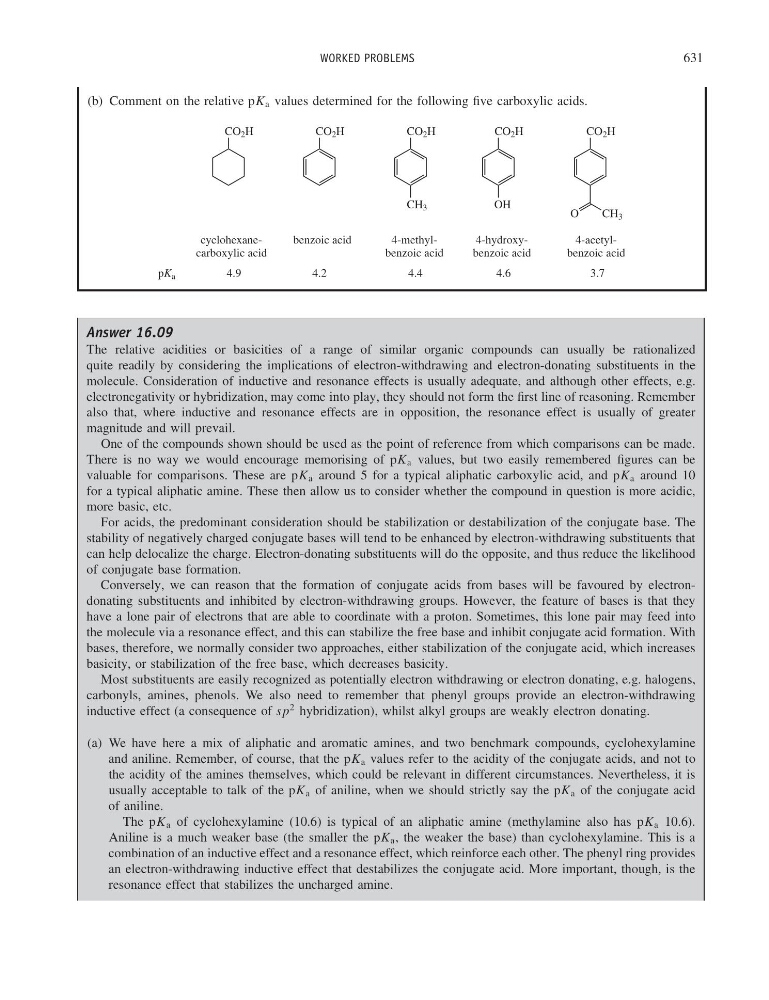
(b) Comment on the relative pK a values determined for the following five carboxylic acids.
CO 2 H
CO 2 H
OH
4.6
4.2
CO 2 H
4.9
pK a
CO 2 H
O
CH 3
3.7
CO 2 H
CH 3
4.4
cyclohexanecarboxylic acid
benzoic acid
4-methylbenzoic acid
4-hydroxybenzoic acid
4-acetylbenzoic acid
Answer 16.09
The relative acidities or basicities of a range of similar organic compounds can usually be rationalized
quite readily by considering the implications of electron-withdrawing and electron-donating substituents in the
molecule. Consideration of inductive and resonance effects is usually adequate, and although other effects, e.g.
electronegativity or hybridization, may come into play, they should not form the first line of reasoning. Remember
also that, where inductive and resonance effects are in opposition, the resonance effect is usually of greater
magnitude and will prevail.
One of the compounds shown should be used as the point of reference from which comparisons can be made.
There is no way we would encourage memorising of pK a values, but two easily remembered figures can be
valuable for comparisons. These are pK a around 5 for a typical aliphatic carboxylic acid, and pK a around 10
for a typical aliphatic amine. These then allow us to consider whether the compound in question is more acidic,
more basic, etc.
For acids, the predominant consideration should be stabilization or destabilization of the conjugate base. The
stability of negatively charged conjugate bases will tend to be enhanced by electron-withdrawing substituents that
can help delocalize the charge. Electron-donating substituents will do the opposite, and thus reduce the likelihood
of conjugate base formation.
Conversely, we can reason that the formation of conjugate acids from bases will be favoured by electrondonating substituents and inhibited by electron-withdrawing groups. However, the feature of bases is that they
have a lone pair of electrons that are able to coordinate with a proton. Sometimes, this lone pair may feed into
the molecule via a resonance effect, and this can stabilize the free base and inhibit conjugate acid formation. With
bases, therefore, we normally consider two approaches, either stabilization of the conjugate acid, which increases
basicity, or stabilization of the free base, which decreases basicity.
Most substituents are easily recognized as potentially electron withdrawing or electron donating, e.g. halogens,
carbonyls, amines, phenols. We also need to remember that phenyl groups provide an electron-withdrawing
inductive effect (a consequence of sp
2 hybridization), whilst alkyl groups are weakly electron donating.
(a) We have here a mix of aliphatic and aromatic amines, and two benchmark compounds, cyclohexylamine
and aniline. Remember, of course, that the pK a values refer to the acidity of the conjugate acids, and not to
the acidity of the amines themselves, which could be relevant in different circumstances. Nevertheless, it is
usually acceptable to talk of the pK a of aniline, when we should strictly say the pK a of the conjugate acid
of aniline.
The pK a of cyclohexylamine (10.6) is typical of an aliphatic amine (methylamine also has pK a 10.6).
Aniline is a much weaker base (the smaller the pK a , the weaker the base) than cyclohexylamine. This is a
combination of an inductive effect and a resonance effect, which reinforce each other. The phenyl ring provides
an electron-withdrawing inductive effect that destabilizes the conjugate acid. More important, though, is the
resonance effect that stabilizes the uncharged amine.