

WORKED PROBLEMS
613
as the nucleophilic reagent. In the latter case, a
requirement for a proton, perhaps to finish off a
mechanism, will probably be met by abstracting it
from a solvent molecule, such as water or alcohol.
• There are stability considerations with carbocations, with tertiary carbocations being more stable
than secondary ones; if your mechanism includes
CH 3
+ or RCH 2
+ , it is almost certainly wrong! Carbocation mechanisms are also going to be much
more likely under acidic conditions (H
+ ) rather
than under basic conditions (HO
− ).
• Do not even consider radical reactions unless
there is some obvious pointer from the reagents,
e.g. a radical initiator such as a peroxide or
electromagnetic radiation.
• After each step of the mechanism, write out the
intermediate structure that will be produced. Do
not try to include more than one such change
per step. Always try to develop the mechanism
logically, working forwards so that the product
you end up with turns out to be identical to that
in the question. It is rather less satisfactory, and
definitely more risky, to apply the reverse strategy,
i.e. aiming for the product and trying to manipulate
the reagents. If a proposed mechanism starts to
get complex or overcomplicated, then stop – it is
probably wrong. Check it through, first ensuring
that the structure is transposed correctly at each
stage. If this does not show up an error, go back
to the essentials – electronegativity, nucleophiles,
electrophiles, leaving groups.
16.3 Worked problems
These problems are typical examination questions,
though perhaps longer than most, and have been
graded as level 1 or level 2. Based on a 2-year
period of study to cover most of the content of this
book, level-1 questions might be answered after year1 studies, whereas the level-2 questions are more
appropriate for year-2 studies.
Purists might criticize the avoidance of equilibrium arrows in the mechanisms shown. Some reactions, e.g. hemiacetal formation or acid-catalysed
ester hydrolysis, are undoubtedly reversible, yet we
have shown them as proceeding only in the forward
direction. We believe it is more important to develop
the skills for predicting a rational mechanism rather
than remembering whether the reaction is reversible
or not. Unless there is any specific comment regarding reversible reactions, we should concentrate on the
reaction in the sense given in the question.
Note also that we illustrated some common
mistakes in drawing mechanisms, all taken from
students’ examination answers, in Box 5.1.
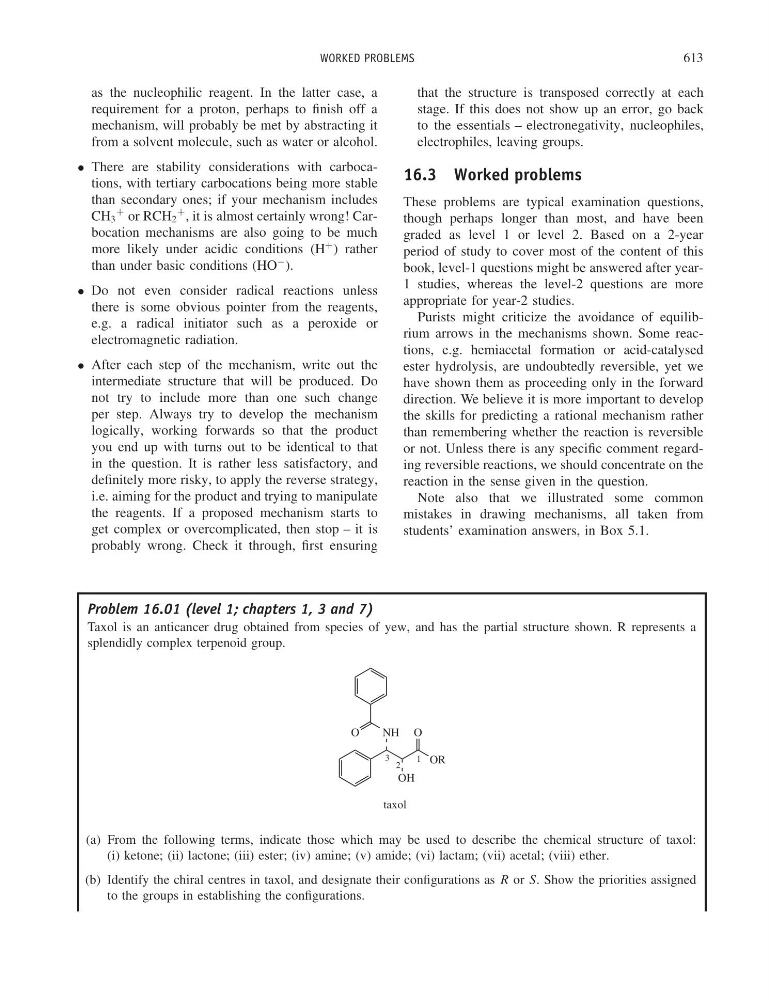
Problem 16.01 (level 1; chapters 1, 3 and 7)
Taxol is an anticancer drug obtained from species of yew, and has the partial structure shown. R represents a
splendidly complex terpenoid group.
OR
O
OH
NH
O
1
2
3
taxol
(a) From the following terms, indicate those which may be used to describe the chemical structure of taxol:
(i) ketone; (ii) lactone; (iii) ester; (iv) amine; (v) amide; (vi) lactam; (vii) acetal; (viii) ether.
(b) Identify the chiral centres in taxol, and designate their configurations as R or S. Show the priorities assigned
to the groups in establishing the configurations.