

RESONANCE STRUCTURES AND CURLY ARROWS
47
C
C
C
N
N
N
O
O
C
C
C
N
N
N
O
O
C
C
C
N
N
O
formal charge +1
formal charge 0
formal charge −1
X
X
X
X = F, Cl, Br, I
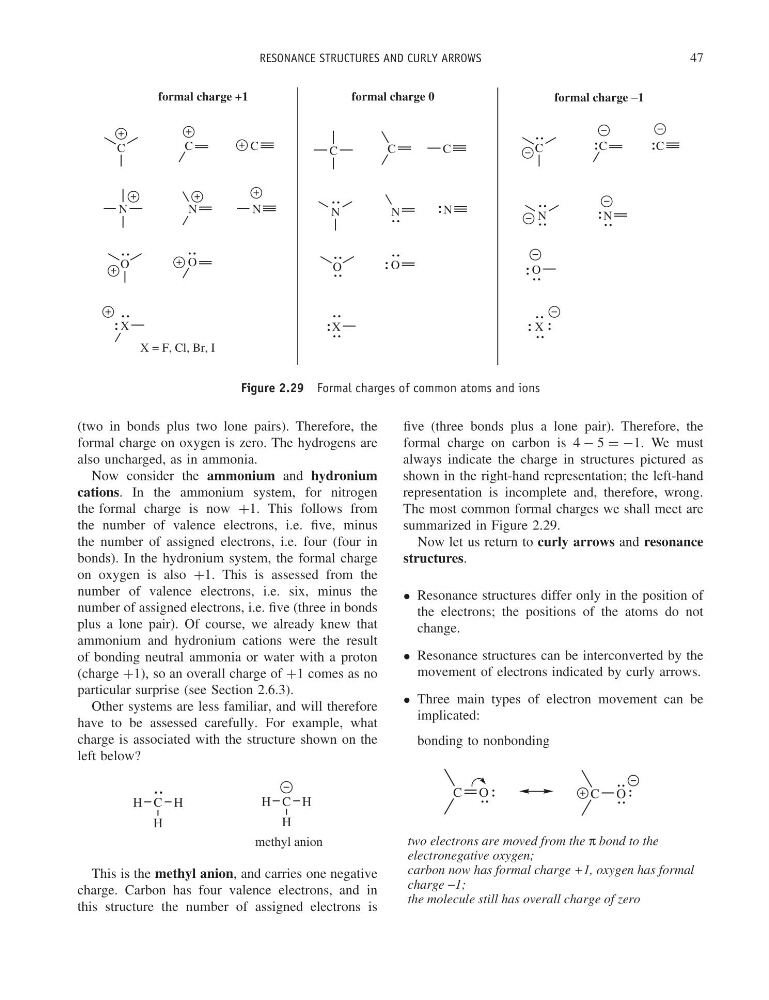
Figure 2.29 Formal charges of common atoms and ions
(two in bonds plus two lone pairs). Therefore, the
formal charge on oxygen is zero. The hydrogens are
also uncharged, as in ammonia.
Now consider the ammonium and hydronium
cations. In the ammonium system, for nitrogen
the formal charge is now +1. This follows from
the number of valence electrons, i.e. five, minus
the number of assigned electrons, i.e. four (four in
bonds). In the hydronium system, the formal charge
on oxygen is also +1. This is assessed from the
number of valence electrons, i.e. six, minus the
number of assigned electrons, i.e. five (three in bonds
plus a lone pair). Of course, we already knew that
ammonium and hydronium cations were the result
of bonding neutral ammonia or water with a proton
(charge +1), so an overall charge of +1 comes as no
particular surprise (see Section 2.6.3).
Other systems are less familiar, and will therefore
have to be assessed carefully. For example, what
charge is associated with the structure shown on the
left below?
H C H
H
H C H
H
methyl anion
This is the methyl anion, and carries one negative
charge. Carbon has four valence electrons, and in
this structure the number of assigned electrons is
five (three bonds plus a lone pair). Therefore, the
formal charge on carbon is 4 − 5 = −1. We must
always indicate the charge in structures pictured as
shown in the right-hand representation; the left-hand
representation is incomplete and, therefore, wrong.
The most common formal charges we shall meet are
summarized in Figure 2.29.
Now let us return to curly arrows and resonance
structures.
• Resonance structures differ only in the position of
the electrons; the positions of the atoms do not
change.
• Resonance structures can be interconverted by the
movement of electrons indicated by curly arrows.
• Three main types of electron movement can be
implicated:
bonding to nonbonding
C O
C O
two electrons are moved from the π bond to the
electronegative oxygen;
carbon now has formal charge +1, oxygen has formal
charge −1;
the molecule still has overall charge of zero
47
C
C
C
N
N
N
O
O
C
C
C
N
N
N
O
O
C
C
C
N
N
O
formal charge +1
formal charge 0
formal charge −1
X
X
X
X = F, Cl, Br, I
Figure 2.29 Formal charges of common atoms and ions
(two in bonds plus two lone pairs). Therefore, the
formal charge on oxygen is zero. The hydrogens are
also uncharged, as in ammonia.
Now consider the ammonium and hydronium
cations. In the ammonium system, for nitrogen
the formal charge is now +1. This follows from
the number of valence electrons, i.e. five, minus
the number of assigned electrons, i.e. four (four in
bonds). In the hydronium system, the formal charge
on oxygen is also +1. This is assessed from the
number of valence electrons, i.e. six, minus the
number of assigned electrons, i.e. five (three in bonds
plus a lone pair). Of course, we already knew that
ammonium and hydronium cations were the result
of bonding neutral ammonia or water with a proton
(charge +1), so an overall charge of +1 comes as no
particular surprise (see Section 2.6.3).
Other systems are less familiar, and will therefore
have to be assessed carefully. For example, what
charge is associated with the structure shown on the
left below?
H C H
H
H C H
H
methyl anion
This is the methyl anion, and carries one negative
charge. Carbon has four valence electrons, and in
this structure the number of assigned electrons is
five (three bonds plus a lone pair). Therefore, the
formal charge on carbon is 4 − 5 = −1. We must
always indicate the charge in structures pictured as
shown in the right-hand representation; the left-hand
representation is incomplete and, therefore, wrong.
The most common formal charges we shall meet are
summarized in Figure 2.29.
Now let us return to curly arrows and resonance
structures.
• Resonance structures differ only in the position of
the electrons; the positions of the atoms do not
change.
• Resonance structures can be interconverted by the
movement of electrons indicated by curly arrows.
• Three main types of electron movement can be
implicated:
bonding to nonbonding
C O
C O
two electrons are moved from the π bond to the
electronegative oxygen;
carbon now has formal charge +1, oxygen has formal
charge −1;
the molecule still has overall charge of zero