

15
The organic chemistry of intermediary
metabolism
15.1 Intermediary metabolism
Intermediary metabolism is the all-encompassing
name given to the highly integrated network of chemical reactions by which organisms obtain energy from
their environment and synthesize those molecules
necessary for their continued well being and existence. These are the reactions that we consider to
comprise ‘biochemistry’, and they are usually studied as part of a biochemistry course. However, if we
choose to study these reactions as part of organic
chemistry, we shall see some interesting, elaborate,
and often quite complex transformations taking place.
Two very important characteristics differentiate these
reactions from those we have already encountered.
First, they are almost always enzyme-mediated reactions, and thus take place readily at near-neutral
pH and at ambient temperatures. Second, they are
also highly regulated, and their participation can be
switched on or off, or otherwise finely controlled by
the organism according to its needs.
As we look at some of the reactions of intermediary
metabolism, we shall rationalize them in terms of the
chemistry that is taking place. In general, we shall
not consider here the involvement of the enzyme
itself, the binding of substrates to the enzyme,
or the role played by the enzyme’s amino acid
side-chains. In Chapter 13 we looked at specific
examples where we know just how an enzyme is
able to catalyse a reaction. Examples such as aldolase
and triose phosphate isomerase, enzymes of the
glycolytic pathway, and citrate synthase from the
Krebs cycle were considered in some detail. It may
be advantageous to look back at these examples in
order to underline the participation of an enzyme.
A large proportion of the substrates used in intermediary metabolism are in the form of phosphates.
Phosphates are favoured in nature since they usually
confer water solubility on the compound, and provide
a functional group that is able to bind to enzymes
through simple electrostatic bonding. In many cases,
the phosphate group may also feature as a chemically
reactive functional group – phosphates are good leaving groups (see Section 7.13.2). In many structures,
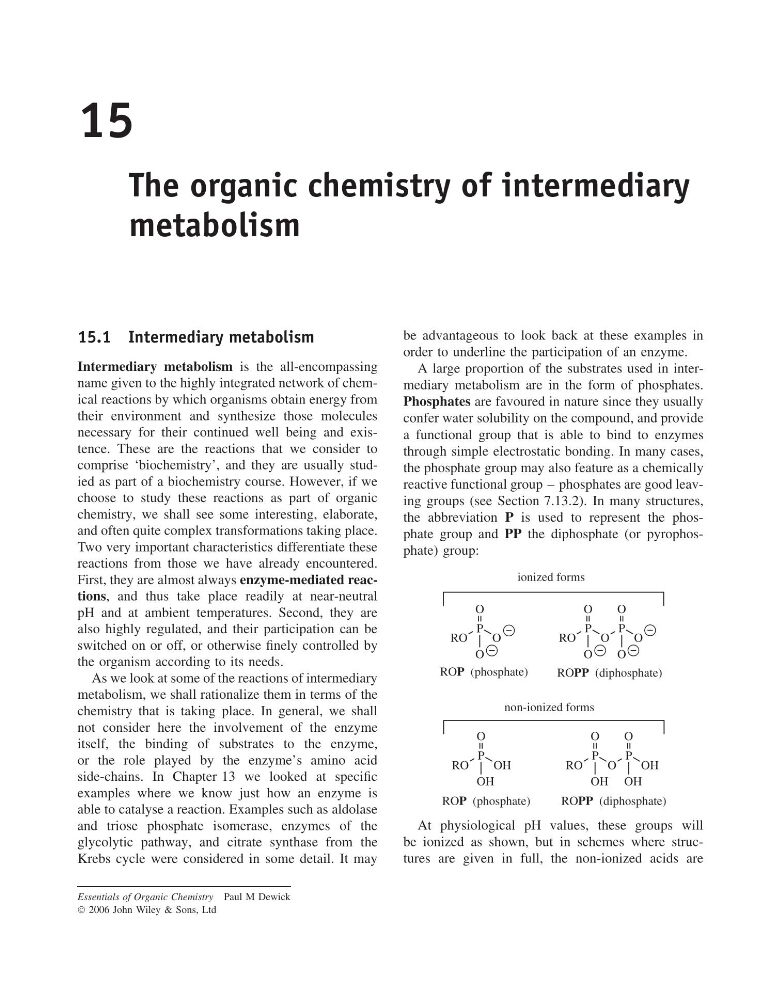
the abbreviation P is used to represent the phosphate group and PP the diphosphate (or pyrophosphate) group:
ROP (phosphate)
ROPP (diphosphate)
ROP (phosphate)
ROPP (diphosphate)
ionized forms
non-ionized forms
O
P
RO
O
O
O
P
RO
O
P
O
O
O
O
O
P
RO
OH
OH
O
P
RO
O
P
OH
O
OH OH
At physiological pH values, these groups will
be ionized as shown, but in schemes where structures are given in full, the non-ionized acids are
Essentials of Organic Chemistry Paul M Dewick
© 2006 John Wiley & Sons, Ltd
The organic chemistry of intermediary
metabolism
15.1 Intermediary metabolism
Intermediary metabolism is the all-encompassing
name given to the highly integrated network of chemical reactions by which organisms obtain energy from
their environment and synthesize those molecules
necessary for their continued well being and existence. These are the reactions that we consider to
comprise ‘biochemistry’, and they are usually studied as part of a biochemistry course. However, if we
choose to study these reactions as part of organic
chemistry, we shall see some interesting, elaborate,
and often quite complex transformations taking place.
Two very important characteristics differentiate these
reactions from those we have already encountered.
First, they are almost always enzyme-mediated reactions, and thus take place readily at near-neutral
pH and at ambient temperatures. Second, they are
also highly regulated, and their participation can be
switched on or off, or otherwise finely controlled by
the organism according to its needs.
As we look at some of the reactions of intermediary
metabolism, we shall rationalize them in terms of the
chemistry that is taking place. In general, we shall
not consider here the involvement of the enzyme
itself, the binding of substrates to the enzyme,
or the role played by the enzyme’s amino acid
side-chains. In Chapter 13 we looked at specific
examples where we know just how an enzyme is
able to catalyse a reaction. Examples such as aldolase
and triose phosphate isomerase, enzymes of the
glycolytic pathway, and citrate synthase from the
Krebs cycle were considered in some detail. It may
be advantageous to look back at these examples in
order to underline the participation of an enzyme.
A large proportion of the substrates used in intermediary metabolism are in the form of phosphates.
Phosphates are favoured in nature since they usually
confer water solubility on the compound, and provide
a functional group that is able to bind to enzymes
through simple electrostatic bonding. In many cases,
the phosphate group may also feature as a chemically
reactive functional group – phosphates are good leaving groups (see Section 7.13.2). In many structures,
the abbreviation P is used to represent the phosphate group and PP the diphosphate (or pyrophosphate) group:
ROP (phosphate)
ROPP (diphosphate)
ROP (phosphate)
ROPP (diphosphate)
ionized forms
non-ionized forms
O
P
RO
O
O
O
P
RO
O
P
O
O
O
O
O
P
RO
OH
OH
O
P
RO
O
P
OH
O
OH OH
At physiological pH values, these groups will
be ionized as shown, but in schemes where structures are given in full, the non-ionized acids are
Essentials of Organic Chemistry Paul M Dewick
© 2006 John Wiley & Sons, Ltd