

COPYING DNA: THE POLYMERASE CHAIN REACTION
571
A C A G T C G C A C A T T G G A A C T A C G T C T
A C A G T C G C A C A T T G G A A C T A C G T C T
A C A G T
T G T C A G C G T G T A A C C T T G A T G C A G A
T G T C A G C G T G T A A C C T T G A T G C A G A
C G C A C A T T G G A A C T A C G T C T
A C A G T C G C A C A T T G G A A C T A C G T C T
T G T C A G C G T G T A A C C T T G A T G C A G A
T G T C A G C G T G T A A C C T T G A T G C A G A
target area
DNA of
defined
length
DNA of
defined
length
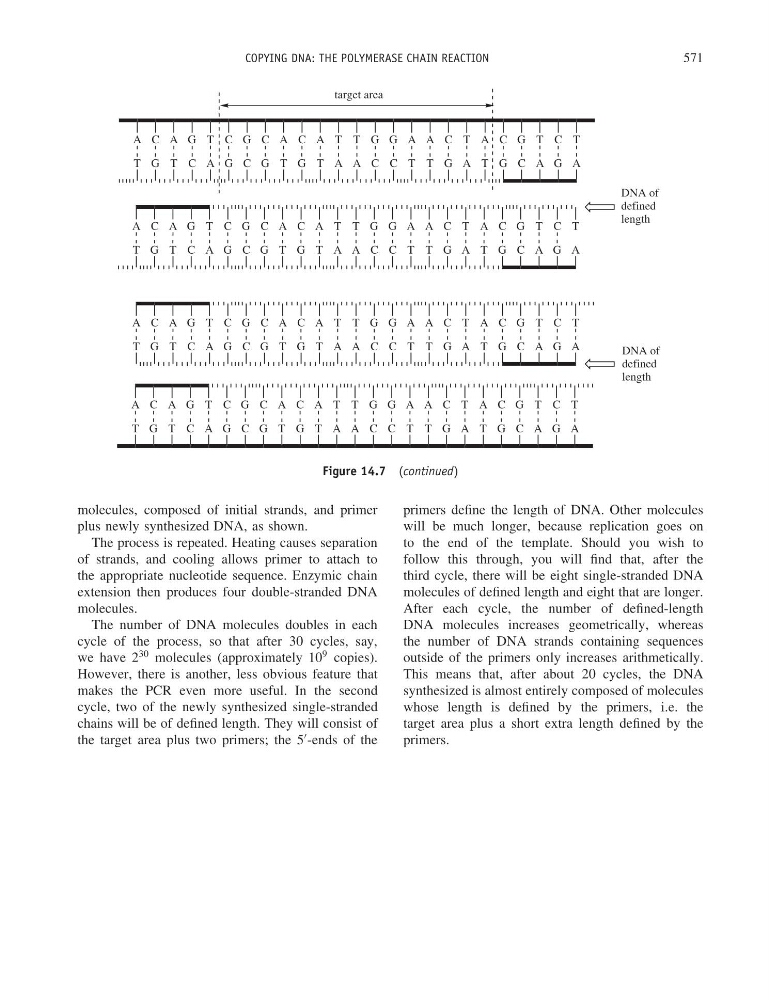
Figure 14.7 (continued)
molecules, composed of initial strands, and primer
plus newly synthesized DNA, as shown.
The process is repeated. Heating causes separation
of strands, and cooling allows primer to attach to
the appropriate nucleotide sequence. Enzymic chain
extension then produces four double-stranded DNA
molecules.
The number of DNA molecules doubles in each
cycle of the process, so that after 30 cycles, say,
we have 2
30 molecules (approximately 10
9 copies).
However, there is another, less obvious feature that
makes the PCR even more useful. In the second
cycle, two of the newly synthesized single-stranded
chains will be of defined length. They will consist of
the target area plus two primers; the 5
-ends of the
primers define the length of DNA. Other molecules
will be much longer, because replication goes on
to the end of the template. Should you wish to
follow this through, you will find that, after the
third cycle, there will be eight single-stranded DNA
molecules of defined length and eight that are longer.
After each cycle, the number of defined-length
DNA molecules increases geometrically, whereas
the number of DNA strands containing sequences
outside of the primers only increases arithmetically.
This means that, after about 20 cycles, the DNA
synthesized is almost entirely composed of molecules
whose length is defined by the primers, i.e. the
target area plus a short extra length defined by the
primers.
571
A C A G T C G C A C A T T G G A A C T A C G T C T
A C A G T C G C A C A T T G G A A C T A C G T C T
A C A G T
T G T C A G C G T G T A A C C T T G A T G C A G A
T G T C A G C G T G T A A C C T T G A T G C A G A
C G C A C A T T G G A A C T A C G T C T
A C A G T C G C A C A T T G G A A C T A C G T C T
T G T C A G C G T G T A A C C T T G A T G C A G A
T G T C A G C G T G T A A C C T T G A T G C A G A
target area
DNA of
defined
length
DNA of
defined
length
Figure 14.7 (continued)
molecules, composed of initial strands, and primer
plus newly synthesized DNA, as shown.
The process is repeated. Heating causes separation
of strands, and cooling allows primer to attach to
the appropriate nucleotide sequence. Enzymic chain
extension then produces four double-stranded DNA
molecules.
The number of DNA molecules doubles in each
cycle of the process, so that after 30 cycles, say,
we have 2
30 molecules (approximately 10
9 copies).
However, there is another, less obvious feature that
makes the PCR even more useful. In the second
cycle, two of the newly synthesized single-stranded
chains will be of defined length. They will consist of
the target area plus two primers; the 5
-ends of the
primers define the length of DNA. Other molecules
will be much longer, because replication goes on
to the end of the template. Should you wish to
follow this through, you will find that, after the
third cycle, there will be eight single-stranded DNA
molecules of defined length and eight that are longer.
After each cycle, the number of defined-length
DNA molecules increases geometrically, whereas
the number of DNA strands containing sequences
outside of the primers only increases arithmetically.
This means that, after about 20 cycles, the DNA
synthesized is almost entirely composed of molecules
whose length is defined by the primers, i.e. the
target area plus a short extra length defined by the
primers.