

COPYING DNA: THE POLYMERASE CHAIN REACTION
569
Of course, the product does not have a phosphate
linker between the two nucleosides, and phosphorus
is still in the wrong oxidation state. This is remedied
by oxidation of the dinucleotide phosphite to a phosphotriester using iodine. We now have the required
phosphate linker, though it is still protected with the
cyanoethyl group. This is retained at this stage.
The dimethoxytrityl ester protecting group is now
removed by treatment with mild acid (CCl 3 CO 2 H),
which is insufficiently reactive to hydrolyse the amide
protection of bases, or the cyanoethyl protection
of the phosphate. The coupling cycle can now
be repeated using a phosphoramidite derivative
of the next appropriate nucleoside. The sequences
will be continued as necessary until the desired
oligonucleotide is obtained.
It then remains to remove protecting groups and
release the product from the support. All of these
tasks, except for the removal of the dimethoxytrityl
group, are achieved by use of a single deprotection
reagent, aqueous base (ammonia). The cyanoethyl
groups are lost from the phosphates by base-catalysed
elimination, and amide protection of the bases is
removed by base-catalysed hydrolysis. The latter
process also achieves hydrolysis of the succinate ester
link to the support.
14.7 Copying DNA: the polymerase
chain reaction
The polymerase chain reaction (PCR), developed
by Mullis, is a simple and most effective way of
amplifying, i.e. producing multiple copies of, a DNA
sequence. It finds applications in all sorts of areas
not immediately associated with nucleic acid biochemistry, e.g. genetic screening, medical diagnostics, forensic science, and evolutionary biology. The
general public is now well aware of the importance
of some of these topics, e.g. the ability to identify a
person by DNA analysis, but perhaps does not realize
that tiny samples of DNA must be copied millions of
times to provide a sample large enough for chromatographic analysis.
PCR makes use of the heat-stable enzyme DNA
polymerase from the bacterium Thermus aquaticus
and its ability to synthesize complementary strands of
DNA when supplied with the necessary deoxyribonucleoside triphosphates. We have already looked at the
chemistry of DNA replication (see Section 14.2.2),
and this process is exactly the same, though it is carried out in the laboratory and has been automated.
Although knowledge of the whole nucleotide
sequence of the target area of DNA is not required,
one must know the sequence of some small stretch
on either side of the target area. These data
may be known from other sequencing studies;
or, surprisingly, it can even be predictable from
knowledge of related genes. Two single-stranded
oligonucleotides, one for each sequence, are then
synthesized to act as primers. Typically, the primers
should contain about 20 nucleotides, and they must
be complementary to the DNA sequences of opposite
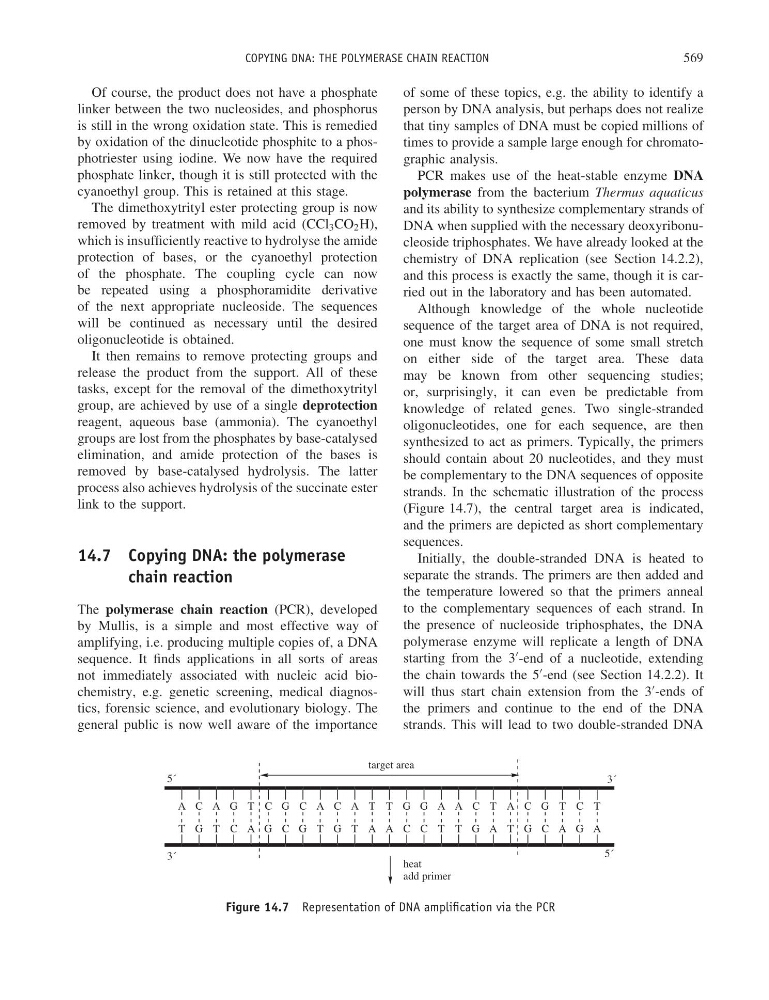
strands. In the schematic illustration of the process
(Figure 14.7), the central target area is indicated,
and the primers are depicted as short complementary
sequences.
Initially, the double-stranded DNA is heated to
separate the strands. The primers are then added and
the temperature lowered so that the primers anneal
to the complementary sequences of each strand. In
the presence of nucleoside triphosphates, the DNA
polymerase enzyme will replicate a length of DNA
starting from the 3
-end of a nucleotide, extending
the chain towards the 5
-end (see Section 14.2.2). It
will thus start chain extension from the 3
-ends of
the primers and continue to the end of the DNA
strands. This will lead to two double-stranded DNA
A C A G T C G C A C A T T G G A A C T A C
T G T C A G C G T G T A A C C T T G A T G
G
C
T C
A G
T
A
target area
5´
3´
3´
5´
heat
add primer
Figure 14.7 Representation of DNA amplification via the PCR
569
Of course, the product does not have a phosphate
linker between the two nucleosides, and phosphorus
is still in the wrong oxidation state. This is remedied
by oxidation of the dinucleotide phosphite to a phosphotriester using iodine. We now have the required
phosphate linker, though it is still protected with the
cyanoethyl group. This is retained at this stage.
The dimethoxytrityl ester protecting group is now
removed by treatment with mild acid (CCl 3 CO 2 H),
which is insufficiently reactive to hydrolyse the amide
protection of bases, or the cyanoethyl protection
of the phosphate. The coupling cycle can now
be repeated using a phosphoramidite derivative
of the next appropriate nucleoside. The sequences
will be continued as necessary until the desired
oligonucleotide is obtained.
It then remains to remove protecting groups and
release the product from the support. All of these
tasks, except for the removal of the dimethoxytrityl
group, are achieved by use of a single deprotection
reagent, aqueous base (ammonia). The cyanoethyl
groups are lost from the phosphates by base-catalysed
elimination, and amide protection of the bases is
removed by base-catalysed hydrolysis. The latter
process also achieves hydrolysis of the succinate ester
link to the support.
14.7 Copying DNA: the polymerase
chain reaction
The polymerase chain reaction (PCR), developed
by Mullis, is a simple and most effective way of
amplifying, i.e. producing multiple copies of, a DNA
sequence. It finds applications in all sorts of areas
not immediately associated with nucleic acid biochemistry, e.g. genetic screening, medical diagnostics, forensic science, and evolutionary biology. The
general public is now well aware of the importance
of some of these topics, e.g. the ability to identify a
person by DNA analysis, but perhaps does not realize
that tiny samples of DNA must be copied millions of
times to provide a sample large enough for chromatographic analysis.
PCR makes use of the heat-stable enzyme DNA
polymerase from the bacterium Thermus aquaticus
and its ability to synthesize complementary strands of
DNA when supplied with the necessary deoxyribonucleoside triphosphates. We have already looked at the
chemistry of DNA replication (see Section 14.2.2),
and this process is exactly the same, though it is carried out in the laboratory and has been automated.
Although knowledge of the whole nucleotide
sequence of the target area of DNA is not required,
one must know the sequence of some small stretch
on either side of the target area. These data
may be known from other sequencing studies;
or, surprisingly, it can even be predictable from
knowledge of related genes. Two single-stranded
oligonucleotides, one for each sequence, are then
synthesized to act as primers. Typically, the primers
should contain about 20 nucleotides, and they must
be complementary to the DNA sequences of opposite
strands. In the schematic illustration of the process
(Figure 14.7), the central target area is indicated,
and the primers are depicted as short complementary
sequences.
Initially, the double-stranded DNA is heated to
separate the strands. The primers are then added and
the temperature lowered so that the primers anneal
to the complementary sequences of each strand. In
the presence of nucleoside triphosphates, the DNA
polymerase enzyme will replicate a length of DNA
starting from the 3
-end of a nucleotide, extending
the chain towards the 5
-end (see Section 14.2.2). It
will thus start chain extension from the 3
-ends of
the primers and continue to the end of the DNA
strands. This will lead to two double-stranded DNA
A C A G T C G C A C A T T G G A A C T A C
T G T C A G C G T G T A A C C T T G A T G
G
C
T C
A G
T
A
target area
5´
3´
3´
5´
heat
add primer
Figure 14.7 Representation of DNA amplification via the PCR