

530
AMINO ACIDS, PEPTIDES AND PROTEINS
13.4.3 Thioesters as intermediates
The reaction of an amino group with an aldehyde or
ketone leads to an imine, which, as we have just seen
with aldolase, provides a splendid example of how
to bond a carbonyl substrate to an enzyme, and yet
maintain its chemical reactivity in terms of enolate
anion chemistry. Another type of covalent interaction
is quite commonly encountered, and this exploits the
thiol group of cysteine. Thiols are more acidic than
oxygen alcohols (see Section 4.3.2), sulfur is a better
nucleophile than oxygen (see Section 6.1.2), and
sulfur derivatives provide better leaving groups than
the corresponding oxygen ones (see Section 6.1.4). It
is not surprising that nature makes very good use of
these properties.
We shall meet several examples of this type of
process (see Sections 15.2, 15.4 and 15.5), and so
only the general mechanism will be considered at
this stage.
Cys SH
O
R
L
O
L
S
R
S
R
O
acyl group is now bound
to enzyme as thioester
Nu
O
Nu
S
R
Cys
Cys
Cys
nucleophilic attack
on thioester
thiolate good
leaving group
nucleophilic attack onto
suitable acyl derivative
Cys−SH is part of enzyme
L is often SCoA
O
L
S
R
Cys
H
−H +
Cys SH
O
R
Nu
H
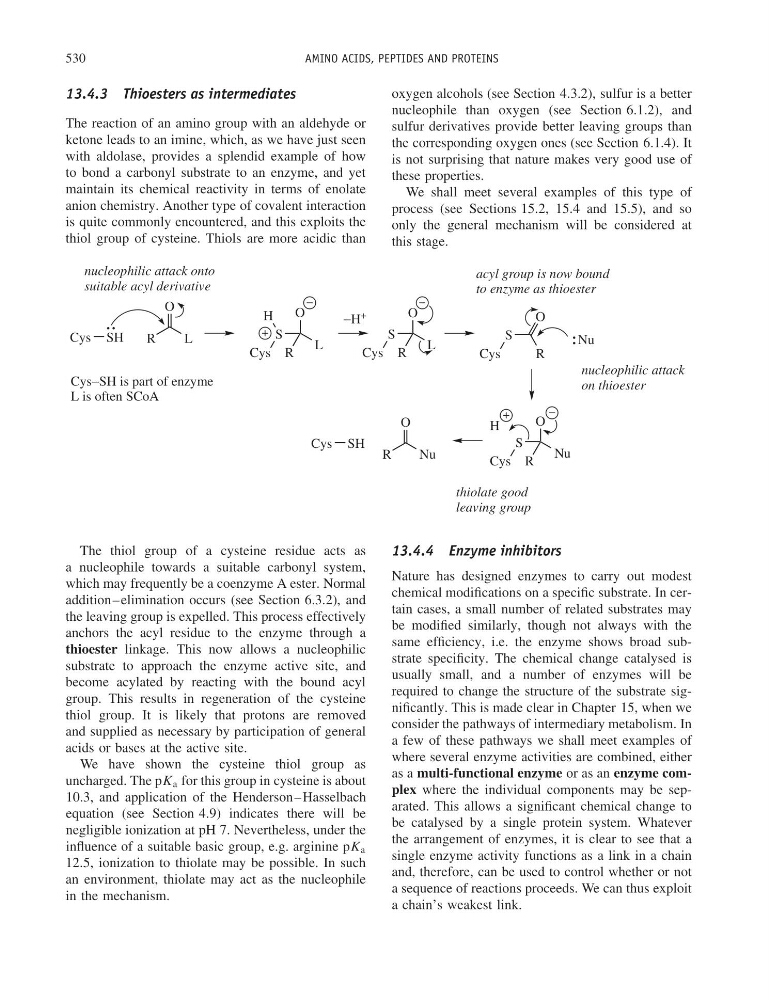
The thiol group of a cysteine residue acts as
a nucleophile towards a suitable carbonyl system,
which may frequently be a coenzyme A ester. Normal
addition–elimination occurs (see Section 6.3.2), and
the leaving group is expelled. This process effectively
anchors the acyl residue to the enzyme through a
thioester linkage. This now allows a nucleophilic
substrate to approach the enzyme active site, and
become acylated by reacting with the bound acyl
group. This results in regeneration of the cysteine
thiol group. It is likely that protons are removed
and supplied as necessary by participation of general
acids or bases at the active site.
We have shown the cysteine thiol group as
uncharged. The pK a for this group in cysteine is about
10.3, and application of the Henderson–Hasselbach
equation (see Section 4.9) indicates there will be
negligible ionization at pH 7. Nevertheless, under the
influence of a suitable basic group, e.g. arginine pK a
12.5, ionization to thiolate may be possible. In such
an environment, thiolate may act as the nucleophile
in the mechanism.
13.4.4 Enzyme inhibitors
Nature has designed enzymes to carry out modest
chemical modifications on a specific substrate. In certain cases, a small number of related substrates may
be modified similarly, though not always with the
same efficiency, i.e. the enzyme shows broad substrate specificity. The chemical change catalysed is
usually small, and a number of enzymes will be
required to change the structure of the substrate significantly. This is made clear in Chapter 15, when we
consider the pathways of intermediary metabolism. In
a few of these pathways we shall meet examples of
where several enzyme activities are combined, either
as a multi-functional enzyme or as an enzyme complex where the individual components may be separated. This allows a significant chemical change to
be catalysed by a single protein system. Whatever
the arrangement of enzymes, it is clear to see that a
single enzyme activity functions as a link in a chain
and, therefore, can be used to control whether or not
a sequence of reactions proceeds. We can thus exploit
a chain’s weakest link.
AMINO ACIDS, PEPTIDES AND PROTEINS
13.4.3 Thioesters as intermediates
The reaction of an amino group with an aldehyde or
ketone leads to an imine, which, as we have just seen
with aldolase, provides a splendid example of how
to bond a carbonyl substrate to an enzyme, and yet
maintain its chemical reactivity in terms of enolate
anion chemistry. Another type of covalent interaction
is quite commonly encountered, and this exploits the
thiol group of cysteine. Thiols are more acidic than
oxygen alcohols (see Section 4.3.2), sulfur is a better
nucleophile than oxygen (see Section 6.1.2), and
sulfur derivatives provide better leaving groups than
the corresponding oxygen ones (see Section 6.1.4). It
is not surprising that nature makes very good use of
these properties.
We shall meet several examples of this type of
process (see Sections 15.2, 15.4 and 15.5), and so
only the general mechanism will be considered at
this stage.
Cys SH
O
R
L
O
L
S
R
S
R
O
acyl group is now bound
to enzyme as thioester
Nu
O
Nu
S
R
Cys
Cys
Cys
nucleophilic attack
on thioester
thiolate good
leaving group
nucleophilic attack onto
suitable acyl derivative
Cys−SH is part of enzyme
L is often SCoA
O
L
S
R
Cys
H
−H +
Cys SH
O
R
Nu
H
The thiol group of a cysteine residue acts as
a nucleophile towards a suitable carbonyl system,
which may frequently be a coenzyme A ester. Normal
addition–elimination occurs (see Section 6.3.2), and
the leaving group is expelled. This process effectively
anchors the acyl residue to the enzyme through a
thioester linkage. This now allows a nucleophilic
substrate to approach the enzyme active site, and
become acylated by reacting with the bound acyl
group. This results in regeneration of the cysteine
thiol group. It is likely that protons are removed
and supplied as necessary by participation of general
acids or bases at the active site.
We have shown the cysteine thiol group as
uncharged. The pK a for this group in cysteine is about
10.3, and application of the Henderson–Hasselbach
equation (see Section 4.9) indicates there will be
negligible ionization at pH 7. Nevertheless, under the
influence of a suitable basic group, e.g. arginine pK a
12.5, ionization to thiolate may be possible. In such
an environment, thiolate may act as the nucleophile
in the mechanism.
13.4.4 Enzyme inhibitors
Nature has designed enzymes to carry out modest
chemical modifications on a specific substrate. In certain cases, a small number of related substrates may
be modified similarly, though not always with the
same efficiency, i.e. the enzyme shows broad substrate specificity. The chemical change catalysed is
usually small, and a number of enzymes will be
required to change the structure of the substrate significantly. This is made clear in Chapter 15, when we
consider the pathways of intermediary metabolism. In
a few of these pathways we shall meet examples of
where several enzyme activities are combined, either
as a multi-functional enzyme or as an enzyme complex where the individual components may be separated. This allows a significant chemical change to
be catalysed by a single protein system. Whatever
the arrangement of enzymes, it is clear to see that a
single enzyme activity functions as a link in a chain
and, therefore, can be used to control whether or not
a sequence of reactions proceeds. We can thus exploit
a chain’s weakest link.