

SOME CLASSIC AROMATIC HETEROCYCLE SYNTHESES
461
The synthesis works well only with an activated ester
like ethyl acetoacetate. Otherwise, self-condensation
of the α-aminoketone to a dihydropyrazine occurs
more readily than the cyclization.
EtO 2 C
O
Me
NH 2
CO 2 Et
O
Me
H 2 N
N
H
H
N
Me
EtO 2 C
Me
CO 2 Et
a dihydropyrazine
− H 2 O
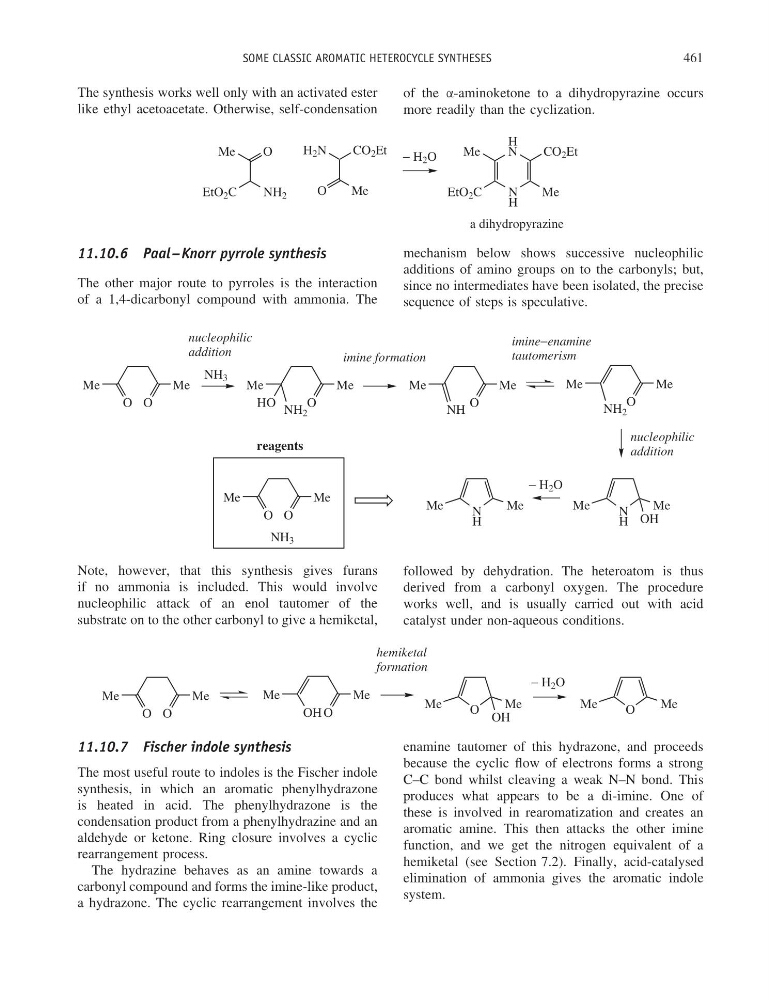
11.10.6 Paal–Knorr pyrrole synthesis
The other major route to pyrroles is the interaction
of a 1,4-dicarbonyl compound with ammonia. The
mechanism below shows successive nucleophilic
additions of amino groups on to the carbonyls; but,
since no intermediates have been isolated, the precise
sequence of steps is speculative.
O
Me
O
Me
NH 3
NH 2
Me
O
Me
HO
NH
Me
O
Me
NH 2
Me
O
Me
N
H
Me
Me
OH
N
H
Me
Me
imine formation
− H 2 O
nucleophilic
addition
nucleophilic
addition
O
Me
O
Me
NH 3
reagents
imine−enamine
tautomerism
Note, however, that this synthesis gives furans
if no ammonia is included. This would involve
nucleophilic attack of an enol tautomer of the
substrate on to the other carbonyl to give a hemiketal,
followed by dehydration. The heteroatom is thus
derived from a carbonyl oxygen. The procedure
works well, and is usually carried out with acid
catalyst under non-aqueous conditions.
O
Me
O
Me
Me
O
Me
OH
O
Me
Me
OH
hemiketal
formation
O
Me
Me
− H 2 O
11.10.7 Fischer indole synthesis
The most useful route to indoles is the Fischer indole
synthesis, in which an aromatic phenylhydrazone
is heated in acid. The phenylhydrazone is the
condensation product from a phenylhydrazine and an
aldehyde or ketone. Ring closure involves a cyclic
rearrangement process.
The hydrazine behaves as an amine towards a
carbonyl compound and forms the imine-like product,
a hydrazone. The cyclic rearrangement involves the
enamine tautomer of this hydrazone, and proceeds
because the cyclic flow of electrons forms a strong
C–C bond whilst cleaving a weak N–N bond. This
produces what appears to be a di-imine. One of
these is involved in rearomatization and creates an
aromatic amine. This then attacks the other imine
function, and we get the nitrogen equivalent of a
hemiketal (see Section 7.2). Finally, acid-catalysed
elimination of ammonia gives the aromatic indole
system.
461
The synthesis works well only with an activated ester
like ethyl acetoacetate. Otherwise, self-condensation
of the α-aminoketone to a dihydropyrazine occurs
more readily than the cyclization.
EtO 2 C
O
Me
NH 2
CO 2 Et
O
Me
H 2 N
N
H
H
N
Me
EtO 2 C
Me
CO 2 Et
a dihydropyrazine
− H 2 O
11.10.6 Paal–Knorr pyrrole synthesis
The other major route to pyrroles is the interaction
of a 1,4-dicarbonyl compound with ammonia. The
mechanism below shows successive nucleophilic
additions of amino groups on to the carbonyls; but,
since no intermediates have been isolated, the precise
sequence of steps is speculative.
O
Me
O
Me
NH 3
NH 2
Me
O
Me
HO
NH
Me
O
Me
NH 2
Me
O
Me
N
H
Me
Me
OH
N
H
Me
Me
imine formation
− H 2 O
nucleophilic
addition
nucleophilic
addition
O
Me
O
Me
NH 3
reagents
imine−enamine
tautomerism
Note, however, that this synthesis gives furans
if no ammonia is included. This would involve
nucleophilic attack of an enol tautomer of the
substrate on to the other carbonyl to give a hemiketal,
followed by dehydration. The heteroatom is thus
derived from a carbonyl oxygen. The procedure
works well, and is usually carried out with acid
catalyst under non-aqueous conditions.
O
Me
O
Me
Me
O
Me
OH
O
Me
Me
OH
hemiketal
formation
O
Me
Me
− H 2 O
11.10.7 Fischer indole synthesis
The most useful route to indoles is the Fischer indole
synthesis, in which an aromatic phenylhydrazone
is heated in acid. The phenylhydrazone is the
condensation product from a phenylhydrazine and an
aldehyde or ketone. Ring closure involves a cyclic
rearrangement process.
The hydrazine behaves as an amine towards a
carbonyl compound and forms the imine-like product,
a hydrazone. The cyclic rearrangement involves the
enamine tautomer of this hydrazone, and proceeds
because the cyclic flow of electrons forms a strong
C–C bond whilst cleaving a weak N–N bond. This
produces what appears to be a di-imine. One of
these is involved in rearomatization and creates an
aromatic amine. This then attacks the other imine
function, and we get the nitrogen equivalent of a
hemiketal (see Section 7.2). Finally, acid-catalysed
elimination of ammonia gives the aromatic indole
system.