

32
ATOMIC STRUCTURE AND BONDING
There is a similar effect in the length of C–H
bonds, but this is less dramatic, primarily because the
hydrogen atomic orbital involved (1s) is considerably
smaller than any of the hybrid orbitals we are
considering. Nevertheless, C–H bonds involving sphybridized carbon are shorter than those involving
sp
2 -hybridized carbon, and those with sp
3 -hybridized
carbon are the longest.
Note how we have resorted to another form of
representation of the ethane, ethylene, and acetylene molecules here, representations that are probably
familiar to you (see Section 1.1). These line drawings are simpler, much easier to draw, and clearly
show how the atoms are bonded – we use a line to
indicate the bonding molecular orbital. They do not
show the difference between σ and π bonds, however. We also introduce here the way in which we
can represent the tetrahedral array of bonds around
carbon in a two-dimensional drawing. This is to
use wedges and dots for bonds instead of lines.
By convention, the wedge means the bond is coming towards you, out of the plane of the paper.
The dotted bond means it is going away from you,
behind the plane of the paper. We shall discuss stereochemical representations in more detail later (see
Section 3.1).
At the beginning of this section we suggested
that students often found hybridization a difficult
concept to understand. We should emphasize that
hybridization is a model that helps us to appreciate
molecular structure and predict chemical reactivity.
Do not think in terms of atomic orbitals merging to
form hybrid orbitals, but consider that such orbitals
already exist as the lowest energy arrangement.
Hybridization is our modification of the first model,
which we saw had its limitations, to an improved
model that provides a rationale for experimental
observations. As research progresses, we may have
to apply even further modifications! At the present,
though, the concept of hybrid orbitals provides us
with satisfactory explanations for many chemical
features. We have already seen that hybridization
helps to define features such as bond angles
and bond lengths that dictate molecular shape
(stereochemistry; see Section 3.1). In later sections
we shall see that hybridization gives us good
explanations for other aspects of chemistry, such as
acidity and basicity (see Sections 4.3.4 and 4.5.3), the
relative reactivity of nucleophiles (see Section 6.1.2),
and the chemical behaviour of compounds having
conjugation (see Section 8.2) or aromatic rings (see
Section 8.4).
Carbanions, carbocations and radicals
Before we move on from the hybrid orbitals of carbon, we should take a look at the electronic structure
of important reactive species that will figure prominently in our consideration of chemical reactions.
First, let us consider carbanions and carbocations.
We shall consider the simplest examples, the methyl
anion CH 3
− and the methyl cation CH 3
+ , though
these are not going to be typical of the carbanions
and carbocations we shall be meeting, in that they
lack features to enhance their stability and utility.
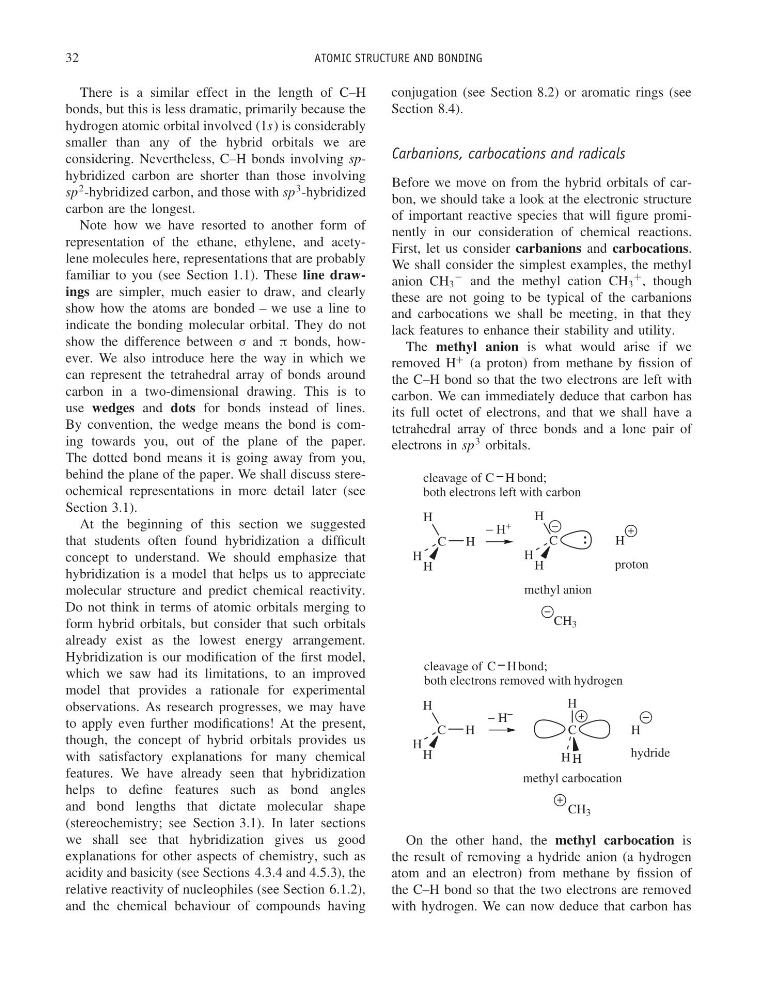
The methyl anion is what would arise if we
removed H
+ (a proton) from methane by fission of
the C–H bond so that the two electrons are left with
carbon. We can immediately deduce that carbon has
its full octet of electrons, and that we shall have a
tetrahedral array of three bonds and a lone pair of
electrons in sp
3 orbitals.
C
H
H
H
H
− H
+
C
H
H
H
methyl anion
C
H
H
H
H
− H −
C
H
H
H
methyl carbocation
CH 3
CH 3
H
H
cleavage of
bond;
both electrons left with carbon
cleavage of
bond;
both electrons removed with hydrogen
proton
hydride
C H
C H
On the other hand, the methyl carbocation is
the result of removing a hydride anion (a hydrogen
atom and an electron) from methane by fission of
the C–H bond so that the two electrons are removed
with hydrogen. We can now deduce that carbon has
ATOMIC STRUCTURE AND BONDING
There is a similar effect in the length of C–H
bonds, but this is less dramatic, primarily because the
hydrogen atomic orbital involved (1s) is considerably
smaller than any of the hybrid orbitals we are
considering. Nevertheless, C–H bonds involving sphybridized carbon are shorter than those involving
sp
2 -hybridized carbon, and those with sp
3 -hybridized
carbon are the longest.
Note how we have resorted to another form of
representation of the ethane, ethylene, and acetylene molecules here, representations that are probably
familiar to you (see Section 1.1). These line drawings are simpler, much easier to draw, and clearly
show how the atoms are bonded – we use a line to
indicate the bonding molecular orbital. They do not
show the difference between σ and π bonds, however. We also introduce here the way in which we
can represent the tetrahedral array of bonds around
carbon in a two-dimensional drawing. This is to
use wedges and dots for bonds instead of lines.
By convention, the wedge means the bond is coming towards you, out of the plane of the paper.
The dotted bond means it is going away from you,
behind the plane of the paper. We shall discuss stereochemical representations in more detail later (see
Section 3.1).
At the beginning of this section we suggested
that students often found hybridization a difficult
concept to understand. We should emphasize that
hybridization is a model that helps us to appreciate
molecular structure and predict chemical reactivity.
Do not think in terms of atomic orbitals merging to
form hybrid orbitals, but consider that such orbitals
already exist as the lowest energy arrangement.
Hybridization is our modification of the first model,
which we saw had its limitations, to an improved
model that provides a rationale for experimental
observations. As research progresses, we may have
to apply even further modifications! At the present,
though, the concept of hybrid orbitals provides us
with satisfactory explanations for many chemical
features. We have already seen that hybridization
helps to define features such as bond angles
and bond lengths that dictate molecular shape
(stereochemistry; see Section 3.1). In later sections
we shall see that hybridization gives us good
explanations for other aspects of chemistry, such as
acidity and basicity (see Sections 4.3.4 and 4.5.3), the
relative reactivity of nucleophiles (see Section 6.1.2),
and the chemical behaviour of compounds having
conjugation (see Section 8.2) or aromatic rings (see
Section 8.4).
Carbanions, carbocations and radicals
Before we move on from the hybrid orbitals of carbon, we should take a look at the electronic structure
of important reactive species that will figure prominently in our consideration of chemical reactions.
First, let us consider carbanions and carbocations.
We shall consider the simplest examples, the methyl
anion CH 3
− and the methyl cation CH 3
+ , though
these are not going to be typical of the carbanions
and carbocations we shall be meeting, in that they
lack features to enhance their stability and utility.
The methyl anion is what would arise if we
removed H
+ (a proton) from methane by fission of
the C–H bond so that the two electrons are left with
carbon. We can immediately deduce that carbon has
its full octet of electrons, and that we shall have a
tetrahedral array of three bonds and a lone pair of
electrons in sp
3 orbitals.
C
H
H
H
H
− H
+
C
H
H
H
methyl anion
C
H
H
H
H
− H −
C
H
H
H
methyl carbocation
CH 3
CH 3
H
H
cleavage of
bond;
both electrons left with carbon
cleavage of
bond;
both electrons removed with hydrogen
proton
hydride
C H
C H
On the other hand, the methyl carbocation is
the result of removing a hydride anion (a hydrogen
atom and an electron) from methane by fission of
the C–H bond so that the two electrons are removed
with hydrogen. We can now deduce that carbon has