

FUSED HETEROCYCLES
453
HN
N
N
H
H
N
H
N
H
N
CO 2 H
H 2 N
O
O
CO 2 H
dihydrofolic acid
(FH 2 )
NADPH
dihydrofolate
reductase
(DHFR)
HN
N
N
H
N
H
N
H
N
CO 2 H
H 2 N
O
O
CO 2 H
tetrahydrofolic acid
(FH 4 )
H
N
H
N
CO 2 H
O
CO 2 H
HN
N
N
N
H 2 N
O
a pteridine
p-aminobenzoic acid
(PABA)
L-Glu
folic acid
NADPH
dihydrofolate
reductase
(DHFR)
pyrazine ring
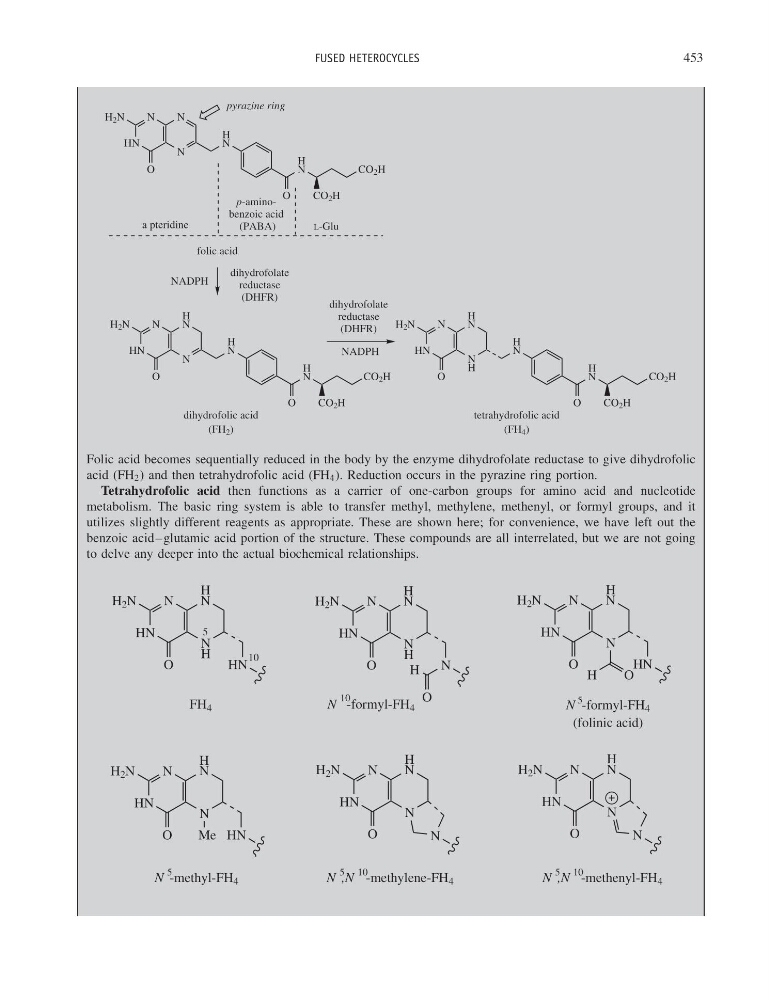
Folic acid becomes sequentially reduced in the body by the enzyme dihydrofolate reductase to give dihydrofolic
acid (FH 2 ) and then tetrahydrofolic acid (FH 4 ). Reduction occurs in the pyrazine ring portion.
Tetrahydrofolic acid then functions as a carrier of one-carbon groups for amino acid and nucleotide
metabolism. The basic ring system is able to transfer methyl, methylene, methenyl, or formyl groups, and it
utilizes slightly different reagents as appropriate. These are shown here; for convenience, we have left out the
benzoic acid–glutamic acid portion of the structure. These compounds are all interrelated, but we are not going
to delve any deeper into the actual biochemical relationships.
HN
N
N
H
H
N
H 2 N
O
HN
HN
N
N
H
H
N
H 2 N
O
N
H
O
HN
N
N
H
N
H 2 N
O
HN
H
O
HN
N
N
H
N
H 2 N
O
N
HN
N
N
H
N
O
N
10
5
HN
N
N
H
N
H 2 N
O
N -formyl-FH 4
(folinic acid)
N -formyl-FH 4
N ,N -methylene-FH 4
N ,N -methenyl-FH 4
HN
Me
N -methyl-FH 4
H 2 N
FH 4
10
5
5
5 10
5 10
453
HN
N
N
H
H
N
H
N
H
N
CO 2 H
H 2 N
O
O
CO 2 H
dihydrofolic acid
(FH 2 )
NADPH
dihydrofolate
reductase
(DHFR)
HN
N
N
H
N
H
N
H
N
CO 2 H
H 2 N
O
O
CO 2 H
tetrahydrofolic acid
(FH 4 )
H
N
H
N
CO 2 H
O
CO 2 H
HN
N
N
N
H 2 N
O
a pteridine
p-aminobenzoic acid
(PABA)
L-Glu
folic acid
NADPH
dihydrofolate
reductase
(DHFR)
pyrazine ring
Folic acid becomes sequentially reduced in the body by the enzyme dihydrofolate reductase to give dihydrofolic
acid (FH 2 ) and then tetrahydrofolic acid (FH 4 ). Reduction occurs in the pyrazine ring portion.
Tetrahydrofolic acid then functions as a carrier of one-carbon groups for amino acid and nucleotide
metabolism. The basic ring system is able to transfer methyl, methylene, methenyl, or formyl groups, and it
utilizes slightly different reagents as appropriate. These are shown here; for convenience, we have left out the
benzoic acid–glutamic acid portion of the structure. These compounds are all interrelated, but we are not going
to delve any deeper into the actual biochemical relationships.
HN
N
N
H
H
N
H 2 N
O
HN
HN
N
N
H
H
N
H 2 N
O
N
H
O
HN
N
N
H
N
H 2 N
O
HN
H
O
HN
N
N
H
N
H 2 N
O
N
HN
N
N
H
N
O
N
10
5
HN
N
N
H
N
H 2 N
O
N -formyl-FH 4
(folinic acid)
N -formyl-FH 4
N ,N -methylene-FH 4
N ,N -methenyl-FH 4
HN
Me
N -methyl-FH 4
H 2 N
FH 4
10
5
5
5 10
5 10