

30
ATOMIC STRUCTURE AND BONDING
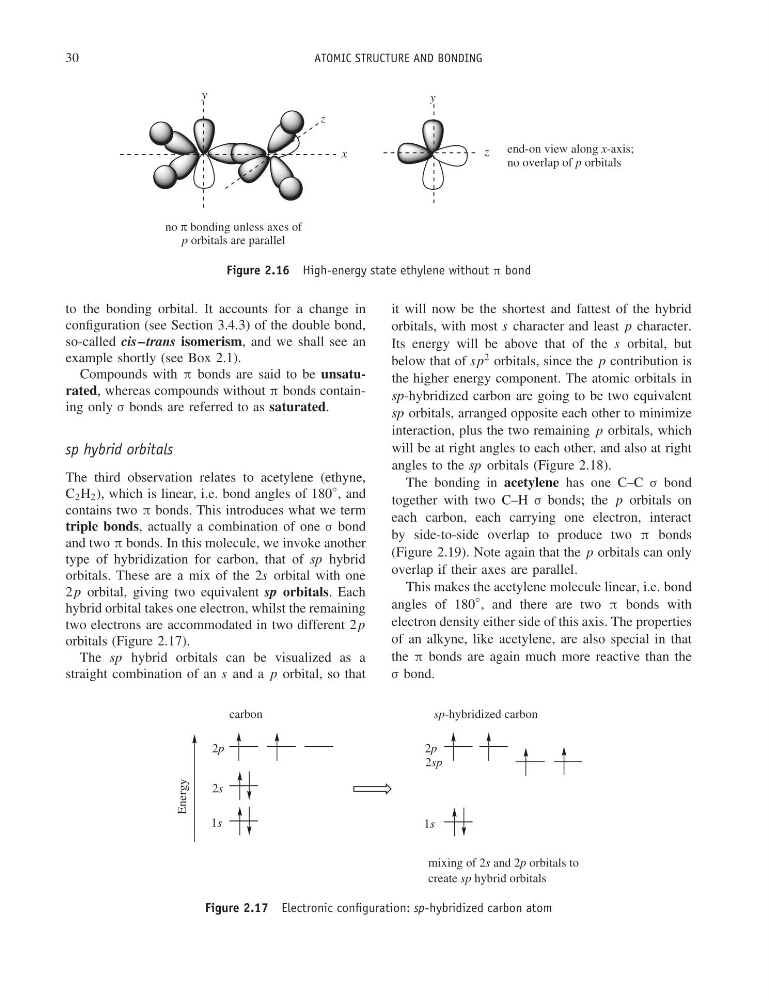
end-on view along x-axis;
no overlap of p orbitals
y
z
y
z
x
no π bonding unless axes of
p orbitals are parallel
Figure 2.16 High-energy state ethylene without π bond
to the bonding orbital. It accounts for a change in
configuration (see Section 3.4.3) of the double bond,
so-called cis–trans isomerism, and we shall see an
example shortly (see Box 2.1).
Compounds with π bonds are said to be unsaturated, whereas compounds without π bonds containing only σ bonds are referred to as saturated.
sp hybrid orbitals
The third observation relates to acetylene (ethyne,
C 2 H 2 ), which is linear, i.e. bond angles of 180
◦ , and
contains two π bonds. This introduces what we term
triple bonds, actually a combination of one σ bond
and two π bonds. In this molecule, we invoke another
type of hybridization for carbon, that of sp hybrid
orbitals. These are a mix of the 2s orbital with one
2p orbital, giving two equivalent sp orbitals. Each
hybrid orbital takes one electron, whilst the remaining
two electrons are accommodated in two different 2p
orbitals (Figure 2.17).
The sp hybrid orbitals can be visualized as a
straight combination of an s and a p orbital, so that
it will now be the shortest and fattest of the hybrid
orbitals, with most s character and least p character.
Its energy will be above that of the s orbital, but
below that of sp
2 orbitals, since the p contribution is
the higher energy component. The atomic orbitals in
sp-hybridized carbon are going to be two equivalent
sp orbitals, arranged opposite each other to minimize
interaction, plus the two remaining p orbitals, which
will be at right angles to each other, and also at right
angles to the sp orbitals (Figure 2.18).
The bonding in acetylene has one C–C σ bond
together with two C–H σ bonds; the p orbitals on
each carbon, each carrying one electron, interact
by side-to-side overlap to produce two π bonds
(Figure 2.19). Note again that the p orbitals can only
overlap if their axes are parallel.
This makes the acetylene molecule linear, i.e. bond
angles of 180
◦ , and there are two π bonds with
electron density either side of this axis. The properties
of an alkyne, like acetylene, are also special in that
the π bonds are again much more reactive than the
σ bond.
1s
2s
2p
carbon
1s
2sp
Energy
2p
mixing of 2s and 2p orbitals to
create sp hybrid orbitals
sp-hybridized carbon
Figure 2.17 Electronic configuration: sp-hybridized carbon atom
ATOMIC STRUCTURE AND BONDING
end-on view along x-axis;
no overlap of p orbitals
y
z
y
z
x
no π bonding unless axes of
p orbitals are parallel
Figure 2.16 High-energy state ethylene without π bond
to the bonding orbital. It accounts for a change in
configuration (see Section 3.4.3) of the double bond,
so-called cis–trans isomerism, and we shall see an
example shortly (see Box 2.1).
Compounds with π bonds are said to be unsaturated, whereas compounds without π bonds containing only σ bonds are referred to as saturated.
sp hybrid orbitals
The third observation relates to acetylene (ethyne,
C 2 H 2 ), which is linear, i.e. bond angles of 180
◦ , and
contains two π bonds. This introduces what we term
triple bonds, actually a combination of one σ bond
and two π bonds. In this molecule, we invoke another
type of hybridization for carbon, that of sp hybrid
orbitals. These are a mix of the 2s orbital with one
2p orbital, giving two equivalent sp orbitals. Each
hybrid orbital takes one electron, whilst the remaining
two electrons are accommodated in two different 2p
orbitals (Figure 2.17).
The sp hybrid orbitals can be visualized as a
straight combination of an s and a p orbital, so that
it will now be the shortest and fattest of the hybrid
orbitals, with most s character and least p character.
Its energy will be above that of the s orbital, but
below that of sp
2 orbitals, since the p contribution is
the higher energy component. The atomic orbitals in
sp-hybridized carbon are going to be two equivalent
sp orbitals, arranged opposite each other to minimize
interaction, plus the two remaining p orbitals, which
will be at right angles to each other, and also at right
angles to the sp orbitals (Figure 2.18).
The bonding in acetylene has one C–C σ bond
together with two C–H σ bonds; the p orbitals on
each carbon, each carrying one electron, interact
by side-to-side overlap to produce two π bonds
(Figure 2.19). Note again that the p orbitals can only
overlap if their axes are parallel.
This makes the acetylene molecule linear, i.e. bond
angles of 180
◦ , and there are two π bonds with
electron density either side of this axis. The properties
of an alkyne, like acetylene, are also special in that
the π bonds are again much more reactive than the
σ bond.
1s
2s
2p
carbon
1s
2sp
Energy
2p
mixing of 2s and 2p orbitals to
create sp hybrid orbitals
sp-hybridized carbon
Figure 2.17 Electronic configuration: sp-hybridized carbon atom