

432
HETEROCYCLES
the amino group is preferred over possible imino forms. Although we are accustomed to thinking of nucleic
acids containing ‘pyrimidine’ bases, this is not strictly correct. In fact, cytosine exists as an aminopyrimidone,
and thymine and uracil are pyrimidiones. Further, they are not particularly basic. Cytosine is the most basic of
the three (pK a 4.6), in that the amino group by a resonance effect can stabilize the conjugate acid (compare
4-aminopyrimidine pK a 5.7 above). Thymine and uracil are very weak bases, in that they are ‘amide-like’.
The most far-reaching feature of nucleic acids is the ability of the bases to hydrogen bond to other bases (see
Box 2.2). This property is fundamental to the double helix arrangement of the DNA molecule, and the translation
and transcription via RNA of the genetic information present in the DNA molecule. Hydrogen bonding occurs
between complementary purine and pyrimidine bases and involves either two or three hydrogen bonds. In DNA,
the base pairs are adenine–thymine and guanine–cytosine. In RNA, base pairing involves guanine–cytosine and
adenine–uracil. This property will be discussed in detail in Section 14.2, but it is worth noting at this stage
that hydrogen bonding is achieved between amino substituents (N–H) and the oxygen of carbonyl groups. These
functions in the pyrimidine bases (and also for that matter in the purine bases; see Section 11.9.2) arise directly
from the tautomeric preferences.
11.7 Five-membered rings with two
heteroatoms
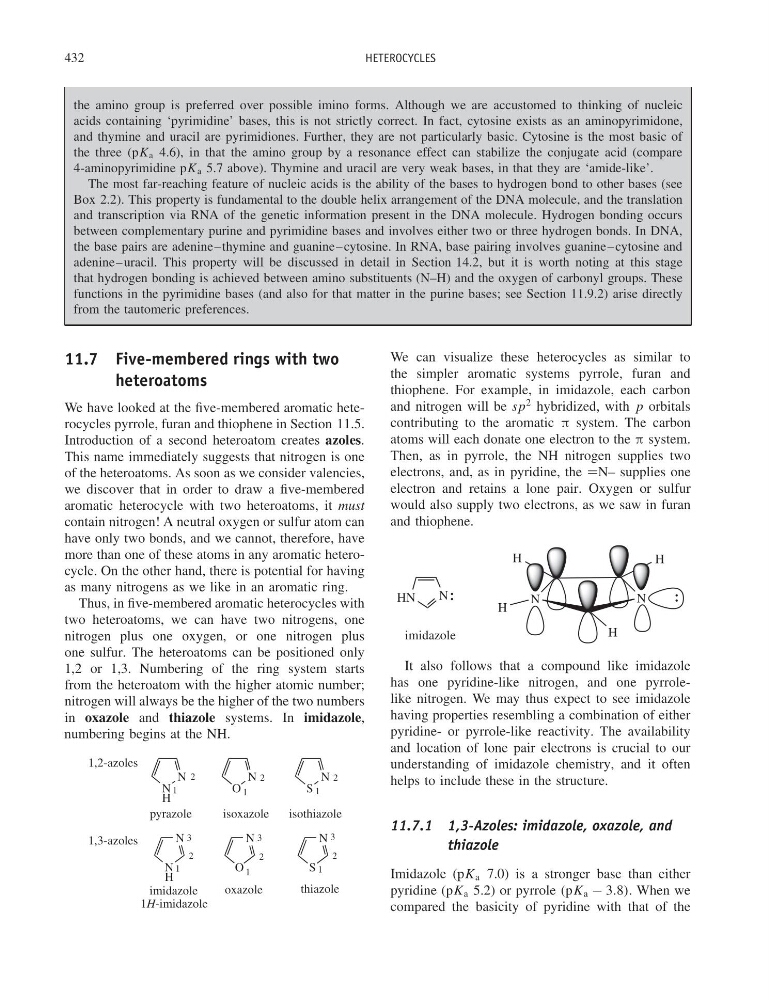
We have looked at the five-membered aromatic heterocycles pyrrole, furan and thiophene in Section 11.5.
Introduction of a second heteroatom creates azoles.
This name immediately suggests that nitrogen is one
of the heteroatoms. As soon as we consider valencies,
we discover that in order to draw a five-membered
aromatic heterocycle with two heteroatoms, it must
contain nitrogen! A neutral oxygen or sulfur atom can
have only two bonds, and we cannot, therefore, have
more than one of these atoms in any aromatic heterocycle. On the other hand, there is potential for having
as many nitrogens as we like in an aromatic ring.
Thus, in five-membered aromatic heterocycles with
two heteroatoms, we can have two nitrogens, one
nitrogen plus one oxygen, or one nitrogen plus
one sulfur. The heteroatoms can be positioned only
1,2 or 1,3. Numbering of the ring system starts
from the heteroatom with the higher atomic number;
nitrogen will always be the higher of the two numbers
in oxazole and thiazole systems. In imidazole,
numbering begins at the NH.
N
N
H
N
O
N
S
N
N
H
N
O
N
S
pyrazole
isoxazole
isothiazole
1,2-azoles
1,3-azoles
imidazole
1H-imidazole
oxazole
thiazole
1
1
2
2
2
3
3
3
1
1
1
1
2
2
2
We can visualize these heterocycles as similar to
the simpler aromatic systems pyrrole, furan and
thiophene. For example, in imidazole, each carbon
and nitrogen will be sp
2 hybridized, with p orbitals
contributing to the aromatic π system. The carbon
atoms will each donate one electron to the π system.
Then, as in pyrrole, the NH nitrogen supplies two
electrons, and, as in pyridine, the =N– supplies one
electron and retains a lone pair. Oxygen or sulfur
would also supply two electrons, as we saw in furan
and thiophene.
imidazole
N
N
H
H
H
H
HN
N
It also follows that a compound like imidazole
has one pyridine-like nitrogen, and one pyrrolelike nitrogen. We may thus expect to see imidazole
having properties resembling a combination of either
pyridine- or pyrrole-like reactivity. The availability
and location of lone pair electrons is crucial to our
understanding of imidazole chemistry, and it often
helps to include these in the structure.
11.7.1 1,3-Azoles: imidazole, oxazole, and
thiazole
Imidazole (pK a 7.0) is a stronger base than either
pyridine (pK a 5.2) or pyrrole (pK a − 3.8). When we
compared the basicity of pyridine with that of the
HETEROCYCLES
the amino group is preferred over possible imino forms. Although we are accustomed to thinking of nucleic
acids containing ‘pyrimidine’ bases, this is not strictly correct. In fact, cytosine exists as an aminopyrimidone,
and thymine and uracil are pyrimidiones. Further, they are not particularly basic. Cytosine is the most basic of
the three (pK a 4.6), in that the amino group by a resonance effect can stabilize the conjugate acid (compare
4-aminopyrimidine pK a 5.7 above). Thymine and uracil are very weak bases, in that they are ‘amide-like’.
The most far-reaching feature of nucleic acids is the ability of the bases to hydrogen bond to other bases (see
Box 2.2). This property is fundamental to the double helix arrangement of the DNA molecule, and the translation
and transcription via RNA of the genetic information present in the DNA molecule. Hydrogen bonding occurs
between complementary purine and pyrimidine bases and involves either two or three hydrogen bonds. In DNA,
the base pairs are adenine–thymine and guanine–cytosine. In RNA, base pairing involves guanine–cytosine and
adenine–uracil. This property will be discussed in detail in Section 14.2, but it is worth noting at this stage
that hydrogen bonding is achieved between amino substituents (N–H) and the oxygen of carbonyl groups. These
functions in the pyrimidine bases (and also for that matter in the purine bases; see Section 11.9.2) arise directly
from the tautomeric preferences.
11.7 Five-membered rings with two
heteroatoms
We have looked at the five-membered aromatic heterocycles pyrrole, furan and thiophene in Section 11.5.
Introduction of a second heteroatom creates azoles.
This name immediately suggests that nitrogen is one
of the heteroatoms. As soon as we consider valencies,
we discover that in order to draw a five-membered
aromatic heterocycle with two heteroatoms, it must
contain nitrogen! A neutral oxygen or sulfur atom can
have only two bonds, and we cannot, therefore, have
more than one of these atoms in any aromatic heterocycle. On the other hand, there is potential for having
as many nitrogens as we like in an aromatic ring.
Thus, in five-membered aromatic heterocycles with
two heteroatoms, we can have two nitrogens, one
nitrogen plus one oxygen, or one nitrogen plus
one sulfur. The heteroatoms can be positioned only
1,2 or 1,3. Numbering of the ring system starts
from the heteroatom with the higher atomic number;
nitrogen will always be the higher of the two numbers
in oxazole and thiazole systems. In imidazole,
numbering begins at the NH.
N
N
H
N
O
N
S
N
N
H
N
O
N
S
pyrazole
isoxazole
isothiazole
1,2-azoles
1,3-azoles
imidazole
1H-imidazole
oxazole
thiazole
1
1
2
2
2
3
3
3
1
1
1
1
2
2
2
We can visualize these heterocycles as similar to
the simpler aromatic systems pyrrole, furan and
thiophene. For example, in imidazole, each carbon
and nitrogen will be sp
2 hybridized, with p orbitals
contributing to the aromatic π system. The carbon
atoms will each donate one electron to the π system.
Then, as in pyrrole, the NH nitrogen supplies two
electrons, and, as in pyridine, the =N– supplies one
electron and retains a lone pair. Oxygen or sulfur
would also supply two electrons, as we saw in furan
and thiophene.
imidazole
N
N
H
H
H
H
HN
N
It also follows that a compound like imidazole
has one pyridine-like nitrogen, and one pyrrolelike nitrogen. We may thus expect to see imidazole
having properties resembling a combination of either
pyridine- or pyrrole-like reactivity. The availability
and location of lone pair electrons is crucial to our
understanding of imidazole chemistry, and it often
helps to include these in the structure.
11.7.1 1,3-Azoles: imidazole, oxazole, and
thiazole
Imidazole (pK a 7.0) is a stronger base than either
pyridine (pK a 5.2) or pyrrole (pK a − 3.8). When we
compared the basicity of pyridine with that of the