

28
ATOMIC STRUCTURE AND BONDING
hydrogen
1s orbital
carbon sp
3
orbital
σ bond orbital
overlap
formation of four
σ bonds in methane
(small lobes omitted)
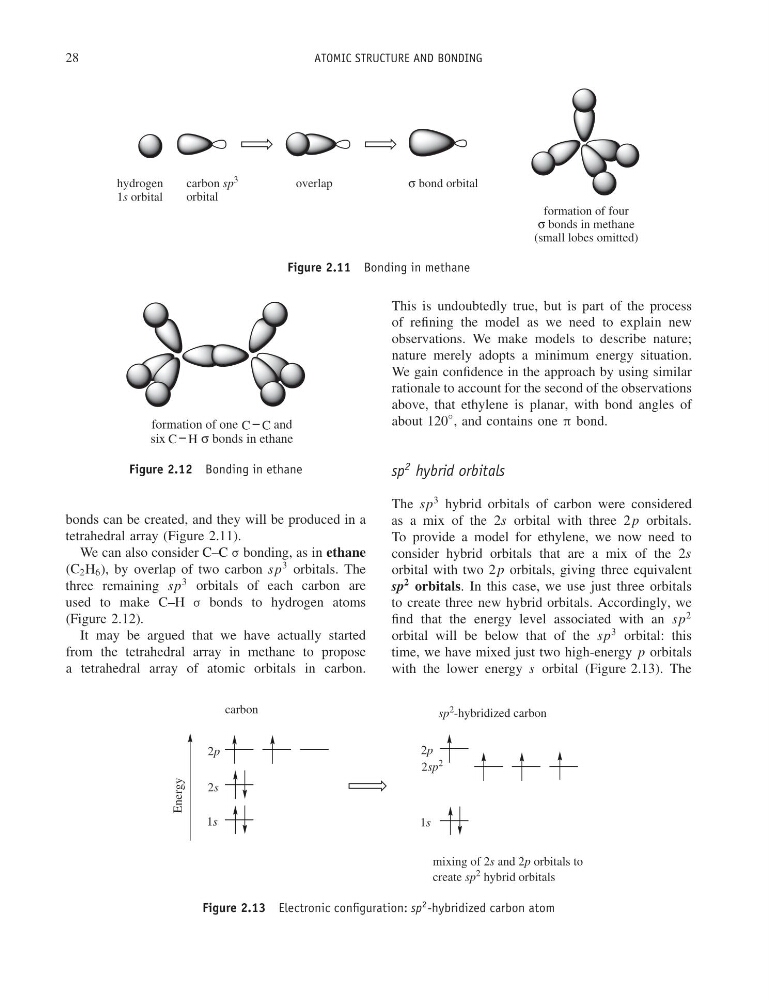
Figure 2.11 Bonding in methane
formation of one
and
six
σ bonds in ethane
C C
C H
Figure 2.12 Bonding in ethane
bonds can be created, and they will be produced in a
tetrahedral array (Figure 2.11).
We can also consider C–C σ bonding, as in ethane
(C 2 H 6 ), by overlap of two carbon sp
3 orbitals. The
three remaining sp
3 orbitals of each carbon are
used to make C–H σ bonds to hydrogen atoms
(Figure 2.12).
It may be argued that we have actually started
from the tetrahedral array in methane to propose
a tetrahedral array of atomic orbitals in carbon.
This is undoubtedly true, but is part of the process
of refining the model as we need to explain new
observations. We make models to describe nature;
nature merely adopts a minimum energy situation.
We gain confidence in the approach by using similar
rationale to account for the second of the observations
above, that ethylene is planar, with bond angles of
about 120
◦ , and contains one π bond.
sp
2 hybrid orbitals
The sp
3 hybrid orbitals of carbon were considered
as a mix of the 2s orbital with three 2p orbitals.
To provide a model for ethylene, we now need to
consider hybrid orbitals that are a mix of the 2s
orbital with two 2p orbitals, giving three equivalent
sp
2 orbitals. In this case, we use just three orbitals
to create three new hybrid orbitals. Accordingly, we
find that the energy level associated with an sp
2
orbital will be below that of the sp
3 orbital: this
time, we have mixed just two high-energy p orbitals
with the lower energy s orbital (Figure 2.13). The
1s
2s
2p
carbon
1s
2sp 2
Energy
2p
mixing of 2s and 2p orbitals to
create sp 2 hybrid orbitals
sp
2 -hybridized carbon
Figure 2.13 Electronic configuration: sp
2 -hybridized carbon atom
ATOMIC STRUCTURE AND BONDING
hydrogen
1s orbital
carbon sp
3
orbital
σ bond orbital
overlap
formation of four
σ bonds in methane
(small lobes omitted)
Figure 2.11 Bonding in methane
formation of one
and
six
σ bonds in ethane
C C
C H
Figure 2.12 Bonding in ethane
bonds can be created, and they will be produced in a
tetrahedral array (Figure 2.11).
We can also consider C–C σ bonding, as in ethane
(C 2 H 6 ), by overlap of two carbon sp
3 orbitals. The
three remaining sp
3 orbitals of each carbon are
used to make C–H σ bonds to hydrogen atoms
(Figure 2.12).
It may be argued that we have actually started
from the tetrahedral array in methane to propose
a tetrahedral array of atomic orbitals in carbon.
This is undoubtedly true, but is part of the process
of refining the model as we need to explain new
observations. We make models to describe nature;
nature merely adopts a minimum energy situation.
We gain confidence in the approach by using similar
rationale to account for the second of the observations
above, that ethylene is planar, with bond angles of
about 120
◦ , and contains one π bond.
sp
2 hybrid orbitals
The sp
3 hybrid orbitals of carbon were considered
as a mix of the 2s orbital with three 2p orbitals.
To provide a model for ethylene, we now need to
consider hybrid orbitals that are a mix of the 2s
orbital with two 2p orbitals, giving three equivalent
sp
2 orbitals. In this case, we use just three orbitals
to create three new hybrid orbitals. Accordingly, we
find that the energy level associated with an sp
2
orbital will be below that of the sp
3 orbital: this
time, we have mixed just two high-energy p orbitals
with the lower energy s orbital (Figure 2.13). The
1s
2s
2p
carbon
1s
2sp 2
Energy
2p
mixing of 2s and 2p orbitals to
create sp 2 hybrid orbitals
sp
2 -hybridized carbon
Figure 2.13 Electronic configuration: sp
2 -hybridized carbon atom