

SIX-MEMBERED AROMATIC HETEROCYCLES
413
N
N
Me
H
nicotine
In small doses, nicotine can act as a respiratory stimulant, though in larger doses it causes respiratory depression.
Nicotine is the only pharmacologically active component in tobacco, and it is highly addictive. On the other hand,
tobacco smoke contains a number of highly carcinogenic chemicals formed by incomplete combustion. Tobacco
smoking also contributes to atherosclerosis, chronic bronchitis and emphysema, and is regarded as the single most
preventable cause of death in modern society. Nicotine, in the form of chewing gum, nasal sprays, or trans-dermal
patches, is available for use by smokers who wish to stop the habit.
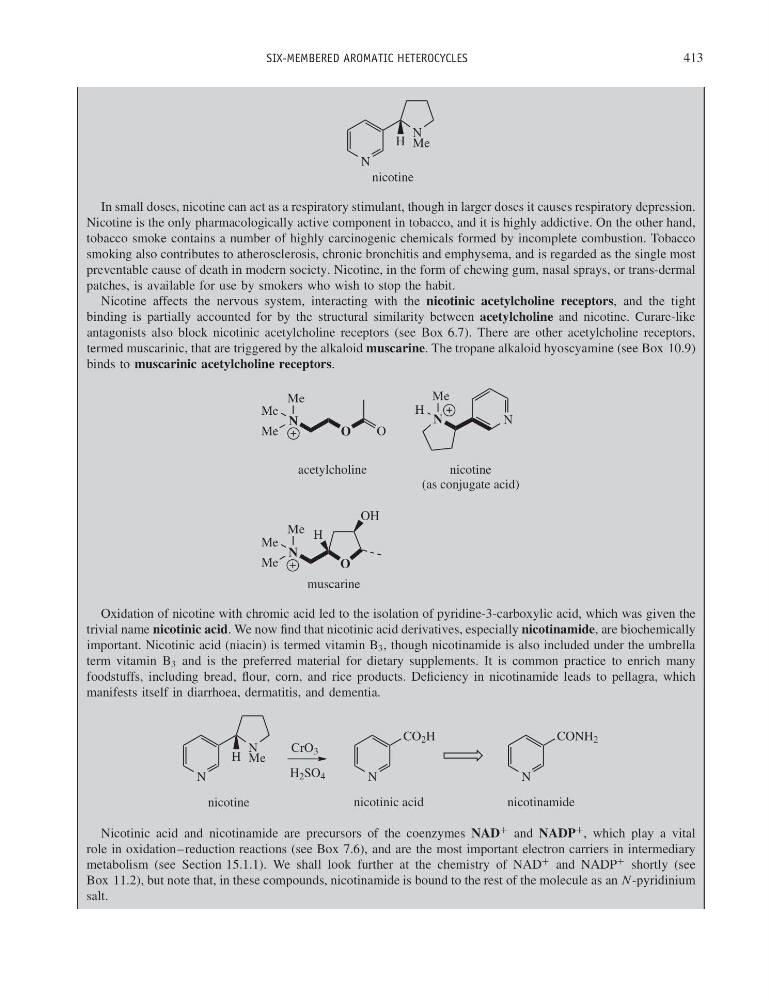
Nicotine affects the nervous system, interacting with the nicotinic acetylcholine receptors, and the tight
binding is partially accounted for by the structural similarity between acetylcholine and nicotine. Curare-like
antagonists also block nicotinic acetylcholine receptors (see Box 6.7). There are other acetylcholine receptors,
termed muscarinic, that are triggered by the alkaloid muscarine. The tropane alkaloid hyoscyamine (see Box 10.9)
binds to muscarinic acetylcholine receptors.
Me
N
O
O
Me
Me
N
N
Me
H
acetylcholine
nicotine
(as conjugate acid)
O
N
Me
Me
Me
OH
H
muscarine
Oxidation of nicotine with chromic acid led to the isolation of pyridine-3-carboxylic acid, which was given the
trivial name nicotinic acid. We now find that nicotinic acid derivatives, especially nicotinamide, are biochemically
important. Nicotinic acid (niacin) is termed vitamin B 3 , though nicotinamide is also included under the umbrella
term vitamin B 3 and is the preferred material for dietary supplements. It is common practice to enrich many
foodstuffs, including bread, flour, corn, and rice products. Deficiency in nicotinamide leads to pellagra, which
manifests itself in diarrhoea, dermatitis, and dementia.
N
N
Me
H
nicotine
CrO 3
H 2 SO 4
N
CO 2 H
nicotinic acid
N
CONH 2
nicotinamide
Nicotinic acid and nicotinamide are precursors of the coenzymes NAD
+ and NADP
+ , which play a vital
role in oxidation–reduction reactions (see Box 7.6), and are the most important electron carriers in intermediary
metabolism (see Section 15.1.1). We shall look further at the chemistry of NAD
+ and NADP
+ shortly (see
Box 11.2), but note that, in these compounds, nicotinamide is bound to the rest of the molecule as an N-pyridinium
salt.
413
N
N
Me
H
nicotine
In small doses, nicotine can act as a respiratory stimulant, though in larger doses it causes respiratory depression.
Nicotine is the only pharmacologically active component in tobacco, and it is highly addictive. On the other hand,
tobacco smoke contains a number of highly carcinogenic chemicals formed by incomplete combustion. Tobacco
smoking also contributes to atherosclerosis, chronic bronchitis and emphysema, and is regarded as the single most
preventable cause of death in modern society. Nicotine, in the form of chewing gum, nasal sprays, or trans-dermal
patches, is available for use by smokers who wish to stop the habit.
Nicotine affects the nervous system, interacting with the nicotinic acetylcholine receptors, and the tight
binding is partially accounted for by the structural similarity between acetylcholine and nicotine. Curare-like
antagonists also block nicotinic acetylcholine receptors (see Box 6.7). There are other acetylcholine receptors,
termed muscarinic, that are triggered by the alkaloid muscarine. The tropane alkaloid hyoscyamine (see Box 10.9)
binds to muscarinic acetylcholine receptors.
Me
N
O
O
Me
Me
N
N
Me
H
acetylcholine
nicotine
(as conjugate acid)
O
N
Me
Me
Me
OH
H
muscarine
Oxidation of nicotine with chromic acid led to the isolation of pyridine-3-carboxylic acid, which was given the
trivial name nicotinic acid. We now find that nicotinic acid derivatives, especially nicotinamide, are biochemically
important. Nicotinic acid (niacin) is termed vitamin B 3 , though nicotinamide is also included under the umbrella
term vitamin B 3 and is the preferred material for dietary supplements. It is common practice to enrich many
foodstuffs, including bread, flour, corn, and rice products. Deficiency in nicotinamide leads to pellagra, which
manifests itself in diarrhoea, dermatitis, and dementia.
N
N
Me
H
nicotine
CrO 3
H 2 SO 4
N
CO 2 H
nicotinic acid
N
CONH 2
nicotinamide
Nicotinic acid and nicotinamide are precursors of the coenzymes NAD
+ and NADP
+ , which play a vital
role in oxidation–reduction reactions (see Box 7.6), and are the most important electron carriers in intermediary
metabolism (see Section 15.1.1). We shall look further at the chemistry of NAD
+ and NADP
+ shortly (see
Box 11.2), but note that, in these compounds, nicotinamide is bound to the rest of the molecule as an N-pyridinium
salt.