

ENOLS AND ENOLIZATION
351
This enediol can be regarded as a common enol tautomer for two different keto structures. In other words, there
are two ways in which this enediol can tautomerize back to a keto form, and the reaction thus appears to shift the
position of the carbonyl group. The reaction is enzyme catalysed, which allows the normal equilibrium processes
to be disturbed.
It is nice to see this series of reactions being repeated in the glycolytic pathway, this time accounting for
the transformation of glucose 6-phosphate into fructose 6-phosphate. Although the substrates are different, the
reacting portion of the molecules is exactly the same as that in the glyceraldehyde 3-phosphate to dihydroxyacetone
phosphate transformation. Again, this is an enzyme-catalysed reaction.
10.1.1 Hydrogen exchange
The intermediacy of enols or enolate anions may
be demonstrated by hydrogen exchange reactions
(see Section 4.11.2). Both acid-catalysed and basecatalysed tautomerism mechanisms involve removal
of a proton from the α-carbon and supply of a proton
from solvent to the carbonyl oxygen. Accordingly,
this removal/supply of protons can be observed using
isotopes of hydrogen, either radioactive tritium or the
stable deuterium, which can be detected easily via
NMR techniques.
HCl or NaOH
DCl or NaOD
can reverse by using
large excess H 2 O
if large excess D 2 O used
will completely deuteriate
α-positions only
H 3 C
CH 3
O
H H
H
H
H 3 C
CH 3
O
D D
D
D
H 3 C
CH 3
O
H H
H
H
D 2 O
pentan-3-one
H 2 O
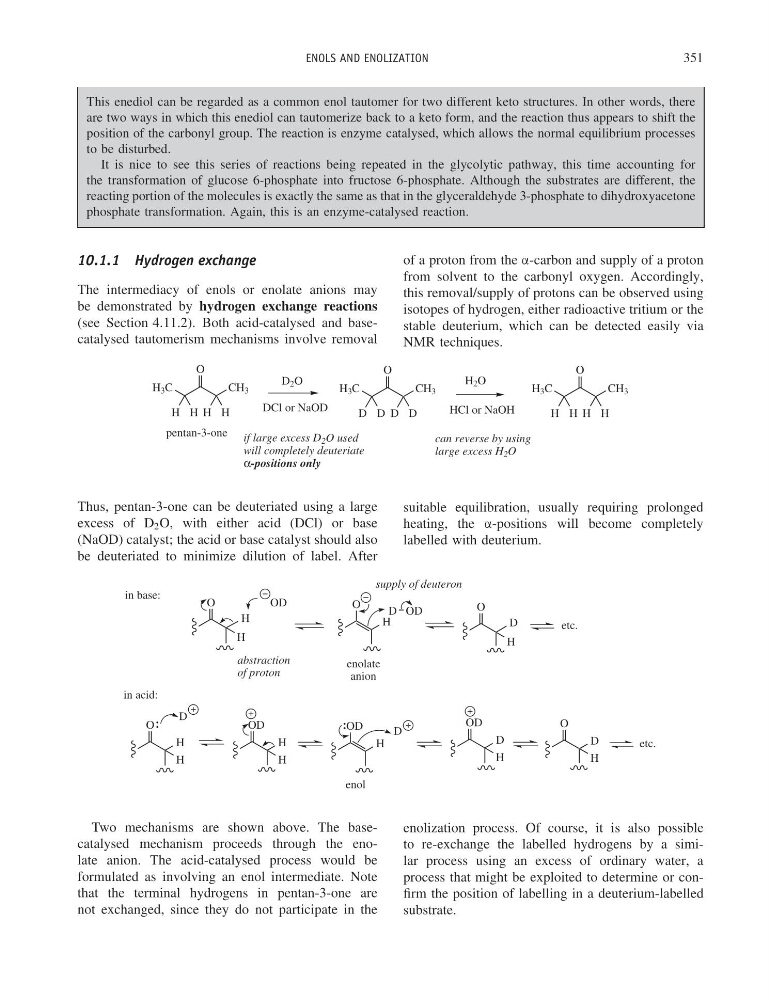
Thus, pentan-3-one can be deuteriated using a large
excess of D 2 O, with either acid (DCl) or base
(NaOD) catalyst; the acid or base catalyst should also
be deuteriated to minimize dilution of label. After
suitable equilibration, usually requiring prolonged
heating, the α-positions will become completely
labelled with deuterium.
etc.
D OD
abstraction
of proton
O
H
OD
O
supply of deuteron
O
D
H
H
H
in acid:
OD
H
H
OD
H
D
OD
H
D
O
H
D
O
H
H
D
etc.
in base:
enolate
anion
enol
Two mechanisms are shown above. The basecatalysed mechanism proceeds through the enolate anion. The acid-catalysed process would be
formulated as involving an enol intermediate. Note
that the terminal hydrogens in pentan-3-one are
not exchanged, since they do not participate in the
enolization process. Of course, it is also possible
to re-exchange the labelled hydrogens by a similar process using an excess of ordinary water, a
process that might be exploited to determine or confirm the position of labelling in a deuterium-labelled
substrate.
351
This enediol can be regarded as a common enol tautomer for two different keto structures. In other words, there
are two ways in which this enediol can tautomerize back to a keto form, and the reaction thus appears to shift the
position of the carbonyl group. The reaction is enzyme catalysed, which allows the normal equilibrium processes
to be disturbed.
It is nice to see this series of reactions being repeated in the glycolytic pathway, this time accounting for
the transformation of glucose 6-phosphate into fructose 6-phosphate. Although the substrates are different, the
reacting portion of the molecules is exactly the same as that in the glyceraldehyde 3-phosphate to dihydroxyacetone
phosphate transformation. Again, this is an enzyme-catalysed reaction.
10.1.1 Hydrogen exchange
The intermediacy of enols or enolate anions may
be demonstrated by hydrogen exchange reactions
(see Section 4.11.2). Both acid-catalysed and basecatalysed tautomerism mechanisms involve removal
of a proton from the α-carbon and supply of a proton
from solvent to the carbonyl oxygen. Accordingly,
this removal/supply of protons can be observed using
isotopes of hydrogen, either radioactive tritium or the
stable deuterium, which can be detected easily via
NMR techniques.
HCl or NaOH
DCl or NaOD
can reverse by using
large excess H 2 O
if large excess D 2 O used
will completely deuteriate
α-positions only
H 3 C
CH 3
O
H H
H
H
H 3 C
CH 3
O
D D
D
D
H 3 C
CH 3
O
H H
H
H
D 2 O
pentan-3-one
H 2 O
Thus, pentan-3-one can be deuteriated using a large
excess of D 2 O, with either acid (DCl) or base
(NaOD) catalyst; the acid or base catalyst should also
be deuteriated to minimize dilution of label. After
suitable equilibration, usually requiring prolonged
heating, the α-positions will become completely
labelled with deuterium.
etc.
D OD
abstraction
of proton
O
H
OD
O
supply of deuteron
O
D
H
H
H
in acid:
OD
H
H
OD
H
D
OD
H
D
O
H
D
O
H
H
D
etc.
in base:
enolate
anion
enol
Two mechanisms are shown above. The basecatalysed mechanism proceeds through the enolate anion. The acid-catalysed process would be
formulated as involving an enol intermediate. Note
that the terminal hydrogens in pentan-3-one are
not exchanged, since they do not participate in the
enolization process. Of course, it is also possible
to re-exchange the labelled hydrogens by a similar process using an excess of ordinary water, a
process that might be exploited to determine or confirm the position of labelling in a deuterium-labelled
substrate.