

240
NUCLEOPHILIC REACTIONS OF CARBONYL GROUPS
Bitter almonds contain amygdalin, which is the β-D-glucoside of prunasin, so it hydrolyses sequentially to the
same products. Cassava, which is used in many parts of the world as a food plant, contains linamarin, which is
the β-D-glucoside of acetone cyanohydrin. Preparation of the starchy tuberous roots of cassava for food involves
prolonged hydrolysis and boiling to release and drive off the HCN before they are suitable for consumption.
7.6.2 Organometallics: Grignard reagents and
acetylides
The use of organometallic reagents as nucleophiles
towards carbonyl compounds is also synthetically
important, since it results in the formation of new
C–C bonds, building up the size and complexity of
the molecule. For carbon to act as a nucleophile,
we require a negative charge on carbon, i.e. a
carbanion or equivalent. Although there are a variety
of organometallic reagents available, we include
here only two types of reagent, Grignard reagents
and acetylides. We have met these organometallic
reagents earlier (see Section 6.3.4)
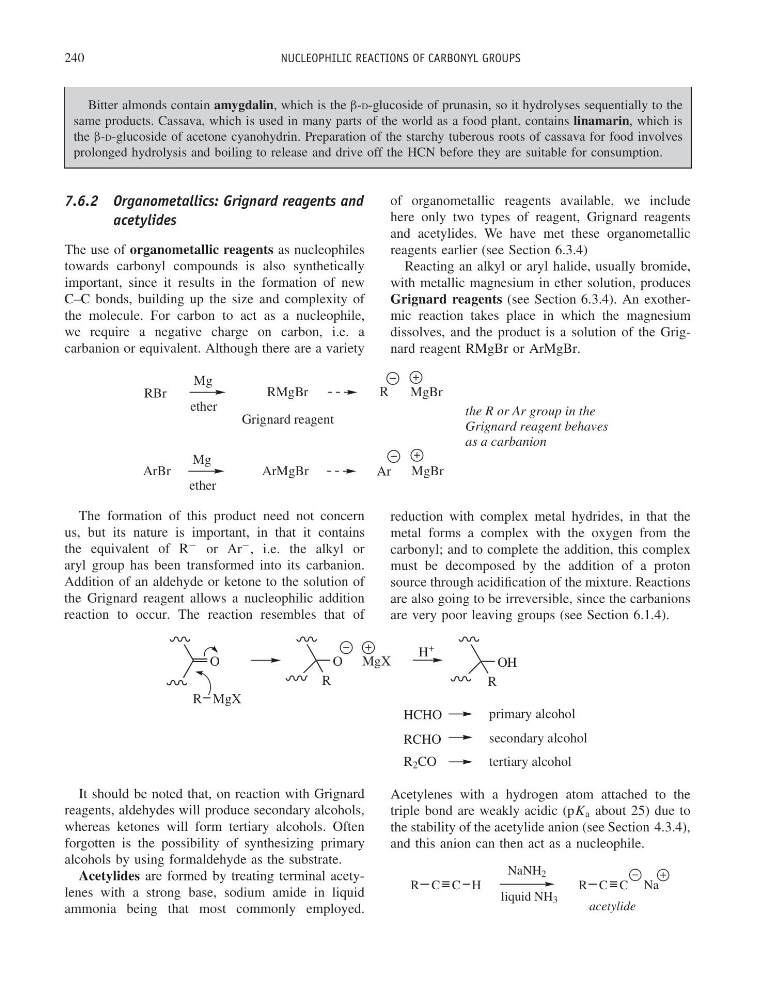
Reacting an alkyl or aryl halide, usually bromide,
with metallic magnesium in ether solution, produces
Grignard reagents (see Section 6.3.4). An exothermic reaction takes place in which the magnesium
dissolves, and the product is a solution of the Grignard reagent RMgBr or ArMgBr.
ether
Grignard reagent
the R or Ar group in the
Grignard reagent behaves
as a carbanion
Mg
RBr
ether
Mg
ArBr
ArMgBr
Ar
RMgBr
R
MgBr
MgBr
The formation of this product need not concern
us, but its nature is important, in that it contains
the equivalent of R
− or Ar
− , i.e. the alkyl or
aryl group has been transformed into its carbanion.
Addition of an aldehyde or ketone to the solution of
the Grignard reagent allows a nucleophilic addition
reaction to occur. The reaction resembles that of
reduction with complex metal hydrides, in that the
metal forms a complex with the oxygen from the
carbonyl; and to complete the addition, this complex
must be decomposed by the addition of a proton
source through acidification of the mixture. Reactions
are also going to be irreversible, since the carbanions
are very poor leaving groups (see Section 6.1.4).
O
R MgX
O
R
OH
R
primary alcohol
secondary alcohol
tertiary alcohol
H
+
MgX
RCHO
HCHO
R 2 CO
It should be noted that, on reaction with Grignard
reagents, aldehydes will produce secondary alcohols,
whereas ketones will form tertiary alcohols. Often
forgotten is the possibility of synthesizing primary
alcohols by using formaldehyde as the substrate.
Acetylides are formed by treating terminal acetylenes with a strong base, sodium amide in liquid
ammonia being that most commonly employed.
Acetylenes with a hydrogen atom attached to the
triple bond are weakly acidic (pK a about 25) due to
the stability of the acetylide anion (see Section 4.3.4),
and this anion can then act as a nucleophile.
C C
R
H
C C
R
liquid NH 3
acetylide
Na
NaNH 2
NUCLEOPHILIC REACTIONS OF CARBONYL GROUPS
Bitter almonds contain amygdalin, which is the β-D-glucoside of prunasin, so it hydrolyses sequentially to the
same products. Cassava, which is used in many parts of the world as a food plant, contains linamarin, which is
the β-D-glucoside of acetone cyanohydrin. Preparation of the starchy tuberous roots of cassava for food involves
prolonged hydrolysis and boiling to release and drive off the HCN before they are suitable for consumption.
7.6.2 Organometallics: Grignard reagents and
acetylides
The use of organometallic reagents as nucleophiles
towards carbonyl compounds is also synthetically
important, since it results in the formation of new
C–C bonds, building up the size and complexity of
the molecule. For carbon to act as a nucleophile,
we require a negative charge on carbon, i.e. a
carbanion or equivalent. Although there are a variety
of organometallic reagents available, we include
here only two types of reagent, Grignard reagents
and acetylides. We have met these organometallic
reagents earlier (see Section 6.3.4)
Reacting an alkyl or aryl halide, usually bromide,
with metallic magnesium in ether solution, produces
Grignard reagents (see Section 6.3.4). An exothermic reaction takes place in which the magnesium
dissolves, and the product is a solution of the Grignard reagent RMgBr or ArMgBr.
ether
Grignard reagent
the R or Ar group in the
Grignard reagent behaves
as a carbanion
Mg
RBr
ether
Mg
ArBr
ArMgBr
Ar
RMgBr
R
MgBr
MgBr
The formation of this product need not concern
us, but its nature is important, in that it contains
the equivalent of R
− or Ar
− , i.e. the alkyl or
aryl group has been transformed into its carbanion.
Addition of an aldehyde or ketone to the solution of
the Grignard reagent allows a nucleophilic addition
reaction to occur. The reaction resembles that of
reduction with complex metal hydrides, in that the
metal forms a complex with the oxygen from the
carbonyl; and to complete the addition, this complex
must be decomposed by the addition of a proton
source through acidification of the mixture. Reactions
are also going to be irreversible, since the carbanions
are very poor leaving groups (see Section 6.1.4).
O
R MgX
O
R
OH
R
primary alcohol
secondary alcohol
tertiary alcohol
H
+
MgX
RCHO
HCHO
R 2 CO
It should be noted that, on reaction with Grignard
reagents, aldehydes will produce secondary alcohols,
whereas ketones will form tertiary alcohols. Often
forgotten is the possibility of synthesizing primary
alcohols by using formaldehyde as the substrate.
Acetylides are formed by treating terminal acetylenes with a strong base, sodium amide in liquid
ammonia being that most commonly employed.
Acetylenes with a hydrogen atom attached to the
triple bond are weakly acidic (pK a about 25) due to
the stability of the acetylide anion (see Section 4.3.4),
and this anion can then act as a nucleophile.
C C
R
H
C C
R
liquid NH 3
acetylide
Na
NaNH 2